
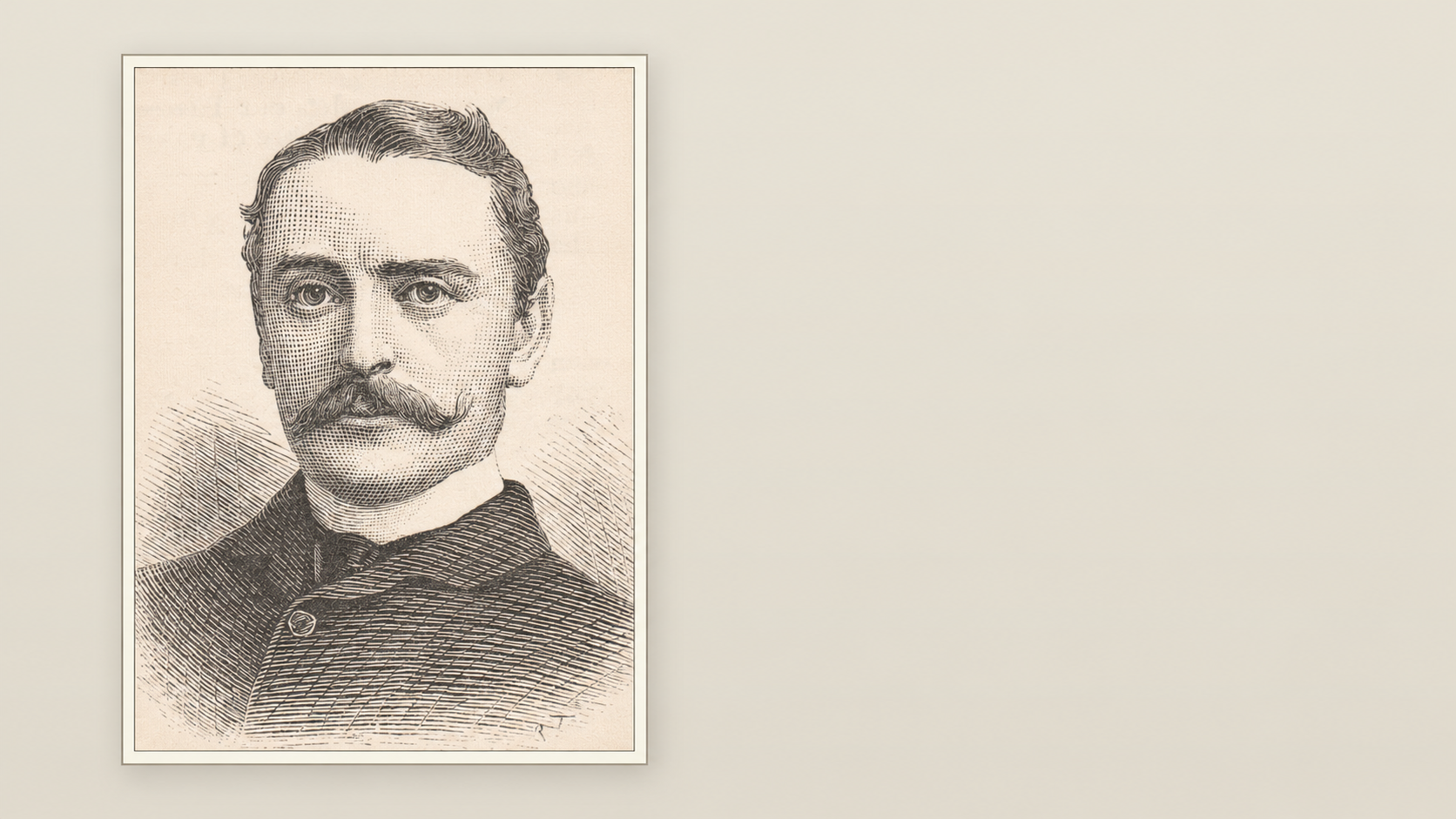
Arthur Henry John Walsh, 3rd Baron Ormathwaite, spent much of his life in a world far removed from the ordinary experience of the people of Radnorshire. He was born into one of the county’s great landowning families, educated at Eton, served in the Household Cavalry, represented Radnorshire in Parliament and became a familiar figure at the courts of Edward VII and George V. For thirteen years he held the office of Master of the Ceremonies in the Royal Household, receiving some of the highest honours awarded for personal service to the Sovereign. Yet behind this distinguished public career lay a family inheritance already weakened by debt, the gradual dispersal of extensive estates and, eventually, a very different existence from that which his upbringing had led him to expect.
His final years were spent not in one of the great houses associated with his family, but in a comparatively modest home at Ealing, where failing eyesight made him increasingly dependent upon the care of his longtime valet and the valet’s wife. When he died in March 1937, having remained a personal friend of Queen Mary, he left his property to that family rather than to his aristocratic relatives. Newspapers reported an inheritance worth more than £100,000, only for it to emerge that the estate was heavily mortgaged. Surviving correspondence subsequently confirmed that his estate was insolvent.
Walsh’s life therefore offers more than the biography of a Victorian politician or royal courtier. It belongs to the wider history of landed Radnorshire, where the wealth and authority accumulated by earlier generations were gradually undermined by borrowing, taxation and changes in the ownership of agricultural land. His story is also unusually well documented, through his own recollections, parliamentary proceedings, estate records and contemporary newspapers, including the remarkable accounts published following his death.
The Origins of the Ormathwaite Fortune
The Walsh family’s association with Radnorshire began long before Arthur Henry John Walsh was born. Its landed position was established by John Walsh, who had accumulated a substantial fortune through service with the East India Company and private commercial activities in India. Returning to Britain with wealth estimated at £140,000, he began acquiring the property and social standing expected of a successful eighteenth-century gentleman.
In 1768 he purchased the manors of Cefnllys and Busmore, together with farms in the surrounding district, for £13,450. Further acquisitions followed, including the manor of Coed Swydd and more than two thousand acres in Radnorshire. The purchases formed part of a much larger landed interest extending into Ireland and Berkshire. Warfield Park, near Bracknell, became an important family residence, while the Radnorshire holdings provided an enduring connection with the county.
Through a complicated succession involving the Benn and Fowke families, the estates eventually passed to John Benn Walsh, who became the first Baron Ormathwaite in 1868. He was a prominent politician and administrator, serving as Member of Parliament for Radnorshire and Lord-Lieutenant of the county. He also considerably enlarged the family’s property. The National Library of Wales records that the Radnorshire estate, comprising approximately 4,266 acres in 1820, had grown to almost 12,500 acres by 1873, producing an annual rental exceeding £9,200.
The extent of these holdings mattered in a county where agricultural land formed the basis of much economic and social life. Ownership brought influence over farms, tenancies, local employment and the management of estates. It also helped sustain the family’s position in county government, politics and the social institutions through which landowners exercised their authority.
By the time Arthur Henry John Walsh was born, however, the foundations of that prosperity were already less secure than they appeared.
Childhood, Education and Military Service
Arthur Henry John Walsh was born on 10 April 1859, the eldest son of Arthur Walsh, later 2nd Baron Ormathwaite, and Lady Katherine Emily Mary Somerset, daughter of the 7th Duke of Beaufort. His childhood was spent among the social connections of the British aristocracy, although the family’s circumstances were not without financial difficulties.
He was educated at Eton, but his schooling was interrupted by illness. In recollections later published in his autobiography, he described an early visit to Cannes with his mother while recovering from bronchitis. During their stay, a candle accidentally set fire to a mosquito net, causing considerable damage to their hotel. The future Edward VII, then Prince of Wales, happened to be nearby and helped resolve the resulting difficulties. Walsh remembered the incident as an early encounter with the man whose friendship would later become important to his career.
In 1877 he spent several months in Germany, improving his command of the language. He had already learned French during his childhood. These accomplishments were particularly useful in the international society of the late Victorian aristocracy and would eventually prove valuable in his ceremonial duties at Court.
His military career began in 1876 with a commission in the Royal South Wales Borderers Militia. Two years later he entered the 1st Life Guards, one of the regiments of the Household Cavalry, serving until 1886. He subsequently held a commission in the Royal East Kent Yeomanry.
Service in the Life Guards brought him into regular contact with the Royal Family. In his memoir he recalled receiving an invitation to Sandringham following a military occasion attended by the Prince of Wales. Such connections were not incidental to the world in which he moved. For young aristocratic officers, military service, court attendance, country-house visits and personal introductions often formed part of the same social network.
Walsh also acknowledged the expense of maintaining this position. The social obligations of an officer in the Household Cavalry were substantial, and he admitted that he frequently found himself in debt. The difficulties were personal, but they also reflected the wider financial pressures already affecting his family.
Member of Parliament for Radnorshire
In December 1885 Walsh was elected Conservative Member of Parliament for Radnorshire, defeating the Liberal candidate Charles Coltman Rogers by the narrow majority of sixty-seven votes. Walsh received 1,880 votes against Rogers’s 1,813.
The result demonstrated how closely divided the constituency had become. Radnorshire remained a predominantly agricultural county, but its electorate was changing, particularly following the extension of voting rights under the parliamentary reforms of 1884 and 1885. Landownership continued to carry considerable influence, although the political authority of the traditional county families could no longer be taken for granted.
Walsh retained the seat at the general election of July 1886, increasing his majority to 242 votes against Sir Richard Green-Price. The election took place during the national divisions surrounding Irish Home Rule, a question of particular relevance to a politician whose family had extensive Irish interests.
His parliamentary career was not especially distinguished by frequent speeches. In later recollections he admitted that he had not taken as much interest in the proceedings of the House of Commons as he might have done. He appears to have found the social opportunities of parliamentary life more congenial than its lengthy debates and procedural business.
Nevertheless, his parliamentary record contains evidence of attention to practical concerns affecting rural communities. In February 1887 he raised the question of legislation to help agricultural labourers obtain allotments, an issue closely connected with the limited opportunities available to working families whose livelihoods depended upon agriculture.
A particularly important intervention came on 8 March 1892, when the House of Commons debated the Birmingham Corporation Water Bill. The proposed scheme involved taking water from the Elan and Claerwen valleys, transforming a substantial part of western Radnorshire to supply Birmingham and neighbouring industrial districts.
The debate raised questions concerning local rights, the River Wye, fishing, common land and the consequences of bringing large numbers of construction workers into the district. Walsh asked for assurances that compensation would be available for damage and for the additional burdens likely to fall upon local authorities, particularly the cost of policing and maintaining roads.
His intervention was comparatively brief, but its significance should not be overlooked. He was addressing one of the most consequential developments in the modern history of Radnorshire. The construction of the Elan Valley reservoirs would alter the landscape, remove established farms and homes, and bring an extraordinary influx of labour into a previously isolated rural district.
Walsh did not seek to stop the scheme in the recorded intervention. His immediate concern was to ensure that its promoters accepted responsibility for some of the additional costs imposed upon the locality. The debate places him directly within the history of the Elan Valley at the moment when its transformation was being considered by Parliament.
His parliamentary career ended at the dissolution of 1892. Although some later biographical accounts suggest that he was personally defeated by the Liberal Francis Edwards, the Conservative candidate at that election was Joseph Alfred Bradney. Walsh did not contest the seat.
He had served in the House of Commons for nearly seven years, but his future lay increasingly in another sphere of public life.
Marriage and the Royal Household
On 26 July 1890 Walsh married Lady Clementine Frances Anne Pratt, daughter of the 3rd Marquess Camden. The marriage brought together two established aristocratic families, although Walsh’s recollections suggest that financial complications had initially presented difficulties. The couple had no children.
By the early 1890s his connections with the Royal Family were developing into formal appointments. In January 1892 he was appointed Equerry-in-Waiting to Prince Albert Victor, Duke of Clarence and Avondale, eldest son of the future Edward VII. The appointment was overtaken almost immediately by the Duke’s death on 14 January, only days after its announcement.
The Duke had been engaged to Princess Mary of Teck, who subsequently married his younger brother, the future George V. Walsh’s association with the Royal Household continued through these changes and eventually brought him into close contact with the woman who would become Queen Mary.
Following the accession of Edward VII in 1901, Walsh’s position at Court became more firmly established. In 1902 he was appointed a Gentleman Usher to the King, and in 1907 he became Master of the Ceremonies, succeeding Sir Douglas Dawson.
The office was an important part of the organisation of diplomatic and royal ceremonial. It involved receiving foreign ambassadors and distinguished visitors, arranging formal occasions and ensuring that the complicated requirements of court etiquette were properly observed. The work demanded tact, familiarity with European society and considerable attention to detail.
Walsh’s knowledge of French and German was an advantage, as were the personal connections developed during his years in the Household Cavalry and aristocratic society. He had known Edward VII long before the King’s accession and was familiar with many of the people who attended the Royal Court.
In 1910, following Edward VII’s death, Walsh assisted with the arrangements surrounding the King’s funeral, including the reception of foreign sovereigns and representatives. He continued in office under George V, taking part in the ceremonial life of the new reign.
His service was recognised through successive promotions in the Royal Victorian Order. He became a Commander in 1910, a Knight Commander in 1912 and, on his retirement in 1920, a Knight Grand Cross.
For a man whose family had long derived its standing from landownership and county administration, his position at Court represented another form of distinction, dependent upon personal service to the Crown rather than the extent of his estates.
Radnorshire and the Responsibilities of Landownership
Although much of Walsh’s professional life was spent in London and at Court, his association with Radnorshire remained substantial. He was a justice of the peace, served as a Deputy Lieutenant and eventually became Lord-Lieutenant of the county. He also held the presidency of the Radnorshire Territorial Association.
The surviving estate papers provide useful evidence of his involvement in local affairs. In October 1893 he and his father were parties to an agreement allowing Radnorshire County Council to obtain water from a spring on Penybont Common and convey it to the police station at Llandegley. The arrangement, made for ninety-nine years at an annual rent of five shillings, illustrates the practical relationship between private landownership and the development of public services.
Another document, dated June 1920, identifies Walsh as landlord of Lower Pentre in Llanddewi Ystradenni. The holding comprised approximately 119 acres and carried an annual rent of £140. Such records are important because they bring the history of the Ormathwaite family back to the farms and communities from which much of its income was derived.
Following the coronation of George V in 1911, Walsh and his wife took a small house in Llandrindod Wells. In his memoir he recalled visiting tenants and joining shooting parties during their stays in the district. His description of the farming families was affectionate, and he remembered the loyalty shown to his family over many years.
Such recollections offer a glimpse of the relationship as he understood it, although the experience of tenants themselves is less fully represented in the surviving material. For the landowner, visiting a farm might be a social occasion or an expression of longstanding family interest. For the tenant, the same relationship involved rent, security of tenure and dependence upon decisions taken elsewhere.
Walsh succeeded Sir Powlett Milbank as Lord-Lieutenant of Radnorshire during the latter part of the First World War. The office placed him at the head of the county’s ceremonial establishment and involved responsibilities connected with public occasions, military affairs and the representation of the Crown.
His connection with Llandrindod Wells continued after his retirement from royal service. In 1925 he accepted the presidency of Llandrindod Wells Bowling Club, succeeding the town’s prominent businessman Tom Norton. Walsh held the position until 1931, during a period when the club attracted competitors from across Britain and helped sustain the town’s reputation as a sporting and holiday resort.
These associations demonstrate that Walsh was not merely an absentee landowner whose principal interests lay in London. His commitments to the county were sometimes ceremonial and sometimes practical, but they remained part of his life long after he had ceased to represent Radnorshire in Parliament.
The First World War and the End of an Era
The outbreak of the First World War brought an abrupt change to the European society in which Walsh had spent so much of his adult life.
In the summer of 1914 he was staying at Marienbad, the fashionable continental resort frequented by members of the aristocracy and diplomatic world. As the international crisis deepened, he was advised to return to Britain. His subsequent account describes crowded railway stations, military movements, confused arrangements and the difficulties encountered by travellers attempting to cross national borders.
Travelling with a party that included Mrs Rothschild and Lady Wolverton, Walsh found himself dealing with circumstances very different from those to which he was accustomed. He recalled the unusual inconvenience of carrying luggage and travelling third class, and admitted using money to obtain assistance during the journey.
The episode is revealing partly because of its social perspective. What Walsh remembered as extraordinary discomfort would have been familiar to many ordinary travellers. Yet the sudden collapse of the comfortable arrangements of pre-war Europe made a lasting impression upon him.
The war also changed the Royal Court. The ceremonial gatherings of European sovereigns, once a central feature of his professional life, belonged increasingly to a vanished political order. Monarchies with which the British Royal Family had maintained close relationships were destroyed or profoundly altered by the conflict.
Walsh continued serving George V throughout the war, but by 1920 his own health was deteriorating. He retired from his royal appointment that year, bringing to an end thirteen years as Master of the Ceremonies.
The Decline of the Ormathwaite Estates
The financial difficulties of the Walsh family had developed over several generations, and their full extent is unusually well documented in the Ormathwaite Estate Records preserved at the National Library of Wales.
Arthur’s grandfather, the first Baron Ormathwaite, had greatly enlarged the family holdings. His son, the second Baron, inherited substantial property but had already accumulated heavy liabilities before succeeding to the estates in 1881. His enthusiasm for shooting and the expenses associated with maintaining an aristocratic establishment contributed to prolonged financial difficulties.
By 1886 the estates were mortgaged for £153,755. Ten years later the mortgage debt had risen to £167,731, while unsecured creditors were owed more than £22,300. The estate income was no longer sufficient to meet the interest and other annual obligations.
Furniture, plate and farming equipment were sold in attempts to satisfy creditors. In 1895 the second Baron petitioned the High Court, declaring his inability to pay his debts. A receiver was appointed, and arrangements were made to administer the property and meet the claims against it.
The family’s difficulties were therefore not simply the result of changing agricultural conditions after the First World War. They had developed during the Victorian period, when the outward appearance of substantial landownership could conceal an increasingly precarious financial position.
Arthur Henry John Walsh was himself involved in some of the borrowing arrangements. The surviving papers include an 1886 promissory note for £23,000 involving both father and son. His own financial affairs cannot therefore be separated entirely from the difficulties of the wider estate.
The Irish properties were gradually disposed of, with substantial sales taking place between 1906 and 1912. Following the second Baron’s death in March 1920, further sales became necessary. By November that year at least eighteen Radnorshire properties had been sold for £18,145. Additional disposals followed in 1921, affecting land in Radnorshire, Cumberland and Berkshire.
The third Baron had inherited the title at a time when the family estates were already deeply burdened. His succession brought the responsibilities and distinctions of the peerage, but not the financial security which earlier generations had enjoyed.
It is important to distinguish the Ormathwaite estates from nearby Penybont Hall. Although the Walsh family later occupied that house, the purchase was associated with Arthur’s younger brother Reginald Walsh and his wife, following the death of Sarah Whitehead in 1926. Reginald eventually succeeded as fifth Baron Ormathwaite in 1943. There is no sufficient evidence to identify Arthur Henry John Walsh himself as the purchaser or resident owner of Penybont Hall.
The history of that house nevertheless belongs to the same wider period of change. The great estates of Radnorshire were being reduced, farms were passing into other ownership and country houses were becoming increasingly difficult to maintain in their former condition.
The Death of Lady Ormathwaite
The death of Lady Clementine Ormathwaite on 13 January 1921 marked a profound personal change in Walsh’s life. She had been active in charitable work, including service as president of Queen Mary’s Needlework Guild, and had shared his long association with the Royal Household.
According to the account of his memoir preserved in the research of Penybont and District Local History Group, Lady Clementine became ill during the Christmas and New Year period of 1920–21 and died of encephalitis. Walsh was deeply affected by her loss.
His autobiography effectively ends with her death. He expressed the depth of his bereavement in the words, “Virtually I died when my wife died.”
The statement is unusually personal for a man whose public existence had been governed by ceremony, rank and social convention. It also helps explain the withdrawal from public life which followed.
Walsh relinquished the Lord-Lieutenancy of Radnorshire in 1922. His health had already been failing, and the combination of illness, bereavement and financial difficulty brought an increasingly restricted existence.
He eventually left the country-house life with which he had been associated for so many years. His later circumstances would become known only after his death, when newspapers began investigating the unusual provisions of his will.
Frederick and Rose Spary
Among the people closest to Walsh during his final years were Frederick Spary, his valet of more than thirty years, and Frederick’s wife, Rose.
The relationship between the family and their former employer was described in considerable detail by the Kensington Post and the Middlesex County Times in August 1937. Their reports provide a rare account of Walsh’s private circumstances, largely through the recollections of people who had lived with and cared for him.
After Lady Ormathwaite’s death, Walsh had gradually disposed of property and withdrawn from the establishments he had previously maintained. When his financial difficulties became more severe, he asked whether he might live with Frederick and Rose at their home in Bassett Road, North Kensington.
The arrangement was accepted. Walsh continued to meet his own living expenses and paid Frederick for his services, while Rose undertook the duties of housekeeper. According to the newspaper account, she did not accept payment for this work.
The household later moved to 35 Inglis Road, Ealing Common, where Walsh spent the remainder of his life.
His eyesight had been deteriorating for some years. Rose Spary told the Kensington Post that he had begun losing his sight approximately a decade before his death and had become almost blind towards the end. Frederick increasingly assisted him with his everyday needs, while Rose provided domestic care and supervision.
The association extended to the Sparys’ children, Arthur and John, to both of whom Walsh was godfather. Arthur, the elder son, recalled accompanying Lord Ormathwaite to Wales and helping him during a period when Frederick had been unwell.
His recollections suggest considerable personal affection. Walsh was remembered as treating the young man almost as a member of his own family.
There was still a formal distinction between employer and servant, and Frederick continued to receive a salary. Nevertheless, the evidence suggests a relationship that had developed well beyond the ordinary obligations of domestic employment.
For a man who had spent his professional life among monarchs, diplomats and aristocratic households, his final years depended increasingly upon the loyalty of a family whose own circumstances were far removed from his upbringing.
Queen Mary’s Last Visit
Despite his retirement and declining health, Walsh was not forgotten by the Royal Family.
Contemporary obituaries recorded that Queen Mary continued sending him Christmas gifts. One newspaper added that she regularly sent game from Sandringham, maintaining a personal connection with the former Master of the Ceremonies.
In November 1936, only four months before his death, the Queen paid an unexpected visit to his home at Ealing.
According to the account published in several newspapers following his death, Frederick Spary admitted the Queen, who found Walsh dozing in his chair. Unable to rise and greet her properly, he apologised for remaining seated.
Queen Mary smiled and placed a warm rug around him, having brought it as a present. She then remained with him for approximately an hour.
The incident was reported in remarkably similar terms by the Western Mail, The Scotsman, the Dundee Courier and other newspapers in March 1937. The similarity indicates that the accounts probably originated from a common report, but the story remains a valuable contemporary description of his continuing association with the Queen.
It also provides a revealing contrast with the formalities of his earlier career. The man who had once organised the reception of visiting sovereigns was now almost blind and unable to rise from his chair. The Queen who had known him throughout her years at Court visited him privately in the suburban home where he spent his retirement.
The Will and the Fortune That Was Not There
Following Walsh’s death, the provisions of his will attracted considerable newspaper attention.
The Kensington Post reported on 6 August 1937 that he had left his property to Rose Spary and her two sons, Arthur and John. The following day the Middlesex County Times carried the story prominently on its front page under the heading A Peer Left Them His Fortune, describing an estate with a reported gross value exceeding £100,000.
For the Spary family, the apparent inheritance was astonishing. Rose told reporters that she had never believed Walsh possessed any substantial money to leave. Her husband was similarly sceptical.
The newspaper reported that the property was heavily mortgaged and that an unnamed member of the Ormathwaite family had indicated that the estate’s liabilities consumed its value.
The story was made more unusual by Walsh’s decision to benefit the family of his longtime servant rather than his titled relatives. Rose and Frederick had cared for him through years of deteriorating health, and the provision made for Rose and the children appears consistent with the affection described in their interviews.
The eventual financial position was less encouraging than the newspaper headlines suggested.
The National Library of Wales preserves extensive papers concerning the administration of Walsh’s estate, including drafts of his will, alterations made in 1936, inventories of furniture and silver plate, and correspondence with creditors.
In November 1939 the solicitors Farrer & Co. informed the Express Dairy Company that the late Lord Ormathwaite’s estate was insolvent. A preferential income-tax claim had not been fully satisfied, and ordinary creditors would receive nothing.
The correspondence confirms that the estate’s financial difficulties continued after Walsh’s death. It does not, by itself, establish precisely what Rose Spary and her sons eventually received under the will. The reported gross valuation must therefore be distinguished from the amount available for distribution after mortgages, taxation and other liabilities had been met.
The will nevertheless remains one of the most revealing documents associated with Walsh’s final years. Whatever the value of the inheritance, he had chosen to make provision for the people who had shared his home and cared for him during his increasing dependence upon others.
Death, Funeral and the Llandrindod Memorial Service
Arthur Henry John Walsh died at 35 Inglis Road, Ealing Common, on Saturday, 13 March 1937, aged seventy-seven.
His death was reported in newspapers across Britain, reflecting his long association with the Royal Household and his earlier parliamentary and county appointments. The obituaries recalled his service under Edward VII and George V, his military career, his representation of Radnorshire and his friendship with Queen Mary.
His funeral took place on Thursday, 18 March, at Warfield Parish Church in Berkshire, with interment at Warfield Park, a place closely associated with earlier generations of the family.
The West Middlesex Gazette subsequently reported that floral tributes had been sent by Queen Maud of Norway, Princess Alice, Countess of Athlone, and the Earl of Athlone, together with the Marquess and Marchioness of Cambridge.
These tributes reflected the royal and aristocratic connections which Walsh had maintained throughout his life, even after his withdrawal from public office.
His death was also commemorated in Radnorshire.
The Western Mail of 17 March 1937 announced that a memorial service would be held at Holy Trinity Church, Llandrindod Wells, at three o’clock on the afternoon of Saturday, 20 March. The later report in the West Middlesex Gazette confirms that the service took place.
Although Walsh had spent his final years in London and was buried in Berkshire, Llandrindod Wells remained sufficiently connected with his public life for a separate memorial service to be arranged in the town.
The service is an important detail in the history of his relationship with Radnorshire. He had represented the county in Parliament, held its Lord-Lieutenancy, maintained agricultural interests in its countryside and served as president of one of Llandrindod’s principal sporting institutions. His death was therefore marked not only within the world of royal service, but also in the county with which his family had been associated for generations.
Having died without children, Walsh was succeeded in the barony by his younger brother, George Harry William Walsh, who became the fourth Baron Ormathwaite.
The Final Dispersal of the Estates
The death of the third Baron did not bring the financial difficulties of the Ormathwaite estates to an immediate conclusion.
His brother George died in 1943 and was succeeded by Reginald Walsh, the fifth Baron, whose association with Penybont Hall belonged to the later history of the family.
In 1945 the remaining Radnorshire estate, amounting to approximately 11,977 acres, was sold. The National Library of Wales suggests that the disposals may have been influenced by the estate duties arising from the deaths of the third and fourth Barons.
The sale marked the final substantial dispersal of a landed inheritance whose origins in Radnorshire reached back to John Walsh’s purchases of 1768.
The process had taken many decades. An estate built through commercial wealth acquired in India had been enlarged through eighteenth- and nineteenth-century land purchases, then progressively burdened by debt, placed under receivership and reduced through successive sales.
The consequences extended beyond the Walsh family. Farms which had once formed part of a large estate passed into other ownership. Tenancies and relationships between landlords and farming families changed. Property that had helped sustain one family’s influence in county affairs was gradually dispersed across the countryside.
The family’s later connection with Penybont Hall continued for another generation, but it belonged to a very different period in the history of Radnorshire landownership.
A Life Between Two Worlds
Arthur Henry John Walsh lived at a time when the traditional landed aristocracy continued to occupy some of the most prominent positions in British public life, even as the economic foundations of its authority were weakening.
His family background opened doors which remained closed to most people. Eton, the Household Cavalry, parliamentary representation and intimate access to the Royal Family formed a remarkably privileged sequence of opportunities. His career as Master of the Ceremonies depended upon the social training, personal acquaintances and inherited position which had shaped his upbringing.
Yet these distinctions offered little protection against the financial difficulties of the estates. The family had accumulated debts long before his succession, and the responsibilities which came with the title could not restore the wealth consumed by mortgages and previous borrowing.
His own recollections reveal a man who valued aristocratic society and the forms of courtesy and ceremony associated with it. They also reveal considerable affection for his wife, loyalty towards the Royal Family and a sense of attachment to the tenants of his Radnorshire estates. As with most autobiographical accounts, these memories tell us something about the man himself, but also about the way he wished his life to be remembered.
The recollections of the Spary family provide a different perspective. Their accounts concern an elderly widower whose sight was failing, who had gradually withdrawn from public life and who relied upon the assistance of people who had served him for many years. The affection expressed by the Sparys, and his decision to benefit Rose and her sons in his will, suggest that their relationship had become one of considerable personal importance.
There is a temptation to regard Walsh’s final circumstances simply as a fall from aristocratic grandeur into financial disappointment. Such an interpretation would overlook much of his life. He had served two monarchs with distinction, represented Radnorshire during an important period of political change and maintained personal relationships which survived the loss of public office and financial security.
Nevertheless, the contrast between his beginnings and his final years is difficult to ignore. The eldest son of a great landowning family ended his life almost blind, living quietly with his valet and housekeeper, while the property he intended to leave them was burdened by debts.
Within eight years of his death, the remaining Radnorshire estate was being dispersed.
Walsh’s story therefore belongs not only to the history of the Royal Household, but to the changing countryside of Radnorshire. The fortunes accumulated by his ancestors had helped establish a family whose influence extended through Parliament, county administration, farming and local society. By the middle of the twentieth century much of that landed inheritance had disappeared.
What survives is a remarkably complete record of one man’s passage through that changing world, from the confidence of late Victorian aristocratic life to an uncertain inheritance and a memorial service in the county whose history his family had helped shape for nearly two centuries.
Related Essays
- Sir Powlett Milbank: Norton Manor and Public Life in Radnorshire
- Penybont Hall: The Rise and Fall of a Radnorshire Estate
- A Valley Remade: The Lost Families, Navvies and Changing Language of Elan
- Bowling in Llandrindod Wells
- Beyond the Country House: The Workers, Tenants and Families Who Made the Welsh Estate
- Charles Venables-Llewelyn and the Radnorshire Elections of 1910
Explore more Radnorshire history
Continue with Radnorshire History, Notable People of Mid Wales, Country Houses & Estates, Welsh Rural History and Victorian & Edwardian Wales.
Receive new historical essays by email
For new essays on Welsh history, biography, genealogy and rural community life, subscribe on the homepage.
Sources and Further Reading
The principal archival source is the Ormathwaite Estate Records held by the National Library of Wales, reference GB 0210 ORMITE. The collection contains deeds, rentals, estate correspondence, mortgages, receivership papers and material relating to the administration of the family estates. Particularly important are the records documenting the expansion of the Radnorshire holdings, the debts of the second Baron Ormathwaite, the sale of property after 1920 and the later executorship of Arthur Henry John Walsh. The Ormathwaite (BRA) papers include his will and associated correspondence, especially the files relating to amendments made in 1936 and correspondence concerning the estate’s insolvency in 1939.
The principal autobiographical source is Arthur Henry John Walsh, 3rd Baron Ormathwaite, When I Was at Court, published by Hutchinson in 1937. The volume provides his recollections of childhood, military service, aristocratic society, parliamentary life, royal appointments and the death of Lady Ormathwaite. A detailed discussion of the memoir and family history was presented by Shirley Morgan to Penybont and District History Group on 7 May 2018. The group’s published notes are particularly useful for the family’s local connections, although details drawn from the memoir should ideally be checked against the original text.
The parliamentary evidence includes the recorded election results for Radnorshire in 1885, 1886 and 1892, together with Hansard, particularly the debate on the Birmingham Corporation Water Bill of 8 March 1892. The latter preserves Walsh’s intervention concerning compensation, policing and road maintenance arising from the proposed Elan Valley waterworks.
Contemporary newspaper sources include the Western Mail and South Wales News, 15 March 1937, page 6, ‘Master of Ceremonies to British Royal Household’; The Scotsman, 15 March 1937, page 8, ‘Lord Ormathwaite Dead’; Dundee Courier, 15 March 1937, page 6, ‘Long Service with Royal Family’; Birmingham Gazette, 15 March 1937, page 9, ‘Death of Veteran Peer’; Western Mail, 17 March 1937, page 6, ‘Late Lord Ormathwaite’; Hull and East Yorkshire Times, 20 March 1937, page 3, ‘Royal Master of Ceremonies’; and West Middlesex Gazette, 27 March 1937, page 11, ‘Late Lord Ormathwaite: Flowers from the Queen of Norway’.
The most important reports concerning Walsh’s final years and the Spary family are the Kensington Post, 6 August 1937, page 3, ‘Fortune for Valet’s Family’, and the Middlesex County Times, 7 August 1937, front page, ‘A Peer Left Them His Fortune: £100,000 Estate, But All Mortgaged’. These accounts are especially valuable because they contain recollections attributed to members of the Spary family. The newspaper descriptions of the proposed inheritance should be read alongside the subsequent insolvency correspondence in the National Library of Wales collection.
Further local evidence is preserved in the Pen-y-bont Hall Estate papers at Powys Archives, including the agreements relating to the Llandegley police station water supply and the tenancy of Lower Pentre. Llandrindod Wells Bowling Club’s historical records document Walsh’s presidency from 1925 to 1931. The Llandrindod Wells Library Deposit at Powys Archives also includes a scrapbook containing material relating to his funeral.
For the wider local context, related studies on this website include Penybont Hall: The Rise and Fall of a Radnorshire Estate, Elan Valley: Lost Families, Navvies and a Valley Remade, and Tom Norton: Llandrindod Wells’ Great Entrepreneur. These place Walsh’s life alongside the history of Radnorshire’s country houses, the transformation of the Elan Valley and the development of Llandrindod Wells during the late Victorian and Edwardian periods.