
During the closing years of the nineteenth century, a succession of deaths devastated a farming family at Ceniarth, near Machynlleth in Montgomeryshire. Within six years, tuberculosis claimed the lives of Griffith Owen, his daughter Margaret and three of his sons. The youngest was only about twenty. Others had reached an age when they might have expected to establish families, pursue occupations and take their places in the communities where they had grown up.
The tragedy was not confined to those who remained at Ceniarth. One of the sons had left Montgomeryshire to establish a dairy business in Folkestone, Kent, but died there from the same disease. Years later, a grandson who had spent part of his childhood in the household would also die of tuberculosis, this time in a Lancashire workhouse infirmary.
Tuberculosis, commonly known as consumption, remained one of the most feared causes of premature death in Victorian Britain. It could develop slowly, bringing prolonged illness to people in the most productive years of their lives. The Owens’ experience is particularly revealing because it took place not in an overcrowded industrial town but on a substantial farm in rural Mid Wales.
The deaths also threatened the continuity of a working agricultural business, where sons, daughters and parents were more than members of a household. They represented its labour, management, inheritance and future.
The Owen Family of Ceniarth
The family’s connection with the district began before its occupation of Ceniarth Farm. Griffith Owen was born at Mallwyd, probably about 1827, the son of Richard Owen and his wife Margaret. During the 1830s the family moved into the countryside around Machynlleth, where Richard established himself at Byrdir, a holding of approximately 113 acres belonging to the Gilbertson-Pritchard estate.
Griffith succeeded his father as farmer of Byrdir during the 1850s. On 17 February 1854 he married Ann Owen at Machynlleth, and the couple went on to have nine children. About 1876 the family moved to neighbouring Ceniarth Farm, a much larger tenancy of approximately 350 acres. It was a significant advancement for a family whose income and social position depended upon agriculture.
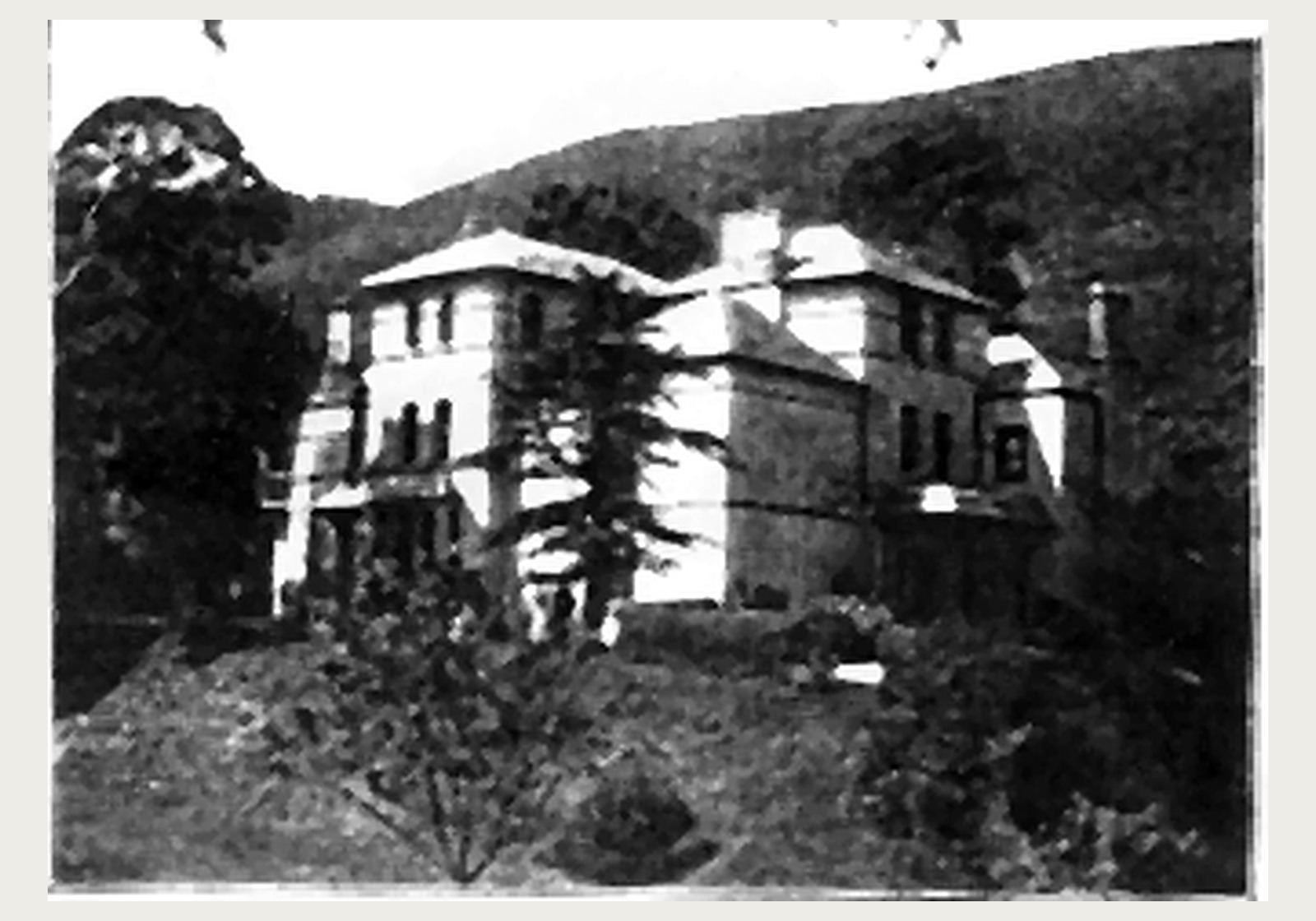
The relationship with their landlords extended beyond the tenancy. Griffith’s mother Margaret became housekeeper at Ceniarth Hall, the residence of the Gilbertson-Pritchard family. She died there on 18 November 1883, aged ninety-two, of bronchitis. Ceniarth Hall, pictured in the featured photograph, was the estate house and should not be confused with the farmhouse where Griffith and Ann lived.
By the middle of the 1880s the Owens had occupied Ceniarth for nearly a decade. Some of their children were entering occupations elsewhere, while others remained connected with the farm. There was every prospect that the family would continue through farming, marriage and the expanding opportunities offered by towns and industries beyond Montgomeryshire.
The First Illnesses, 1887–1888
The first known signs of the family’s tuberculosis tragedy appeared about 1887, when Griffith Owen, a son of the farmer who bore the same name, became seriously ill. Born in 1860, the younger Griffith was about twenty-seven when the illness began. The family research indicates that he suffered for roughly two years, suggesting the prolonged course so often associated with consumption.
His younger brother Thomas Rowland Owen, born in 1868, developed tuberculosis at approximately the same time. For a farming household, two adult sons becoming seriously ill would have consequences beyond the immediate anxiety for their health. Agricultural work was physically demanding, and responsibilities which had once been shared might have fallen increasingly upon other members of the family.
We do not know the precise symptoms they experienced, the treatment they received, or the names of any doctors who attended them. Nor can we establish whether one brother infected the other, whether both encountered the disease through shared exposure, or whether infection had occurred some years earlier.
Thomas was the first to die. He died at Ceniarth on 13 June 1888, aged about twenty. His death marked the beginning of an extraordinary succession of bereavements.
A Second Son Lost in 1889
The younger Griffith survived Thomas by less than eighteen months. His illness continued through 1888 and into the following year, without any lasting recovery recorded in the surviving account. He died at Ceniarth on 1 November 1889, aged twenty-nine.
Two brothers had now died of tuberculosis in consecutive years. Other members of the household were still living in close association with one another, but their precise understanding of the danger would have depended upon the medical knowledge available in the late Victorian period.
For generations, physicians had debated whether consumption resulted from inherited weakness, poor living conditions, constitutional susceptibility or contagion. A decisive advance had come only recently. On 24 March 1882 the German physician Robert Koch had announced his discovery of the bacillus responsible for tuberculosis, establishing the disease’s bacterial origin.
The discovery provided an explanation, not a cure. In 1890 Koch announced a preparation called tuberculin, initially greeted with great optimism. It soon proved ineffective as treatment. Families living through the consequences of consumption gained little immediate benefit from a scientific advance whose practical application would take many more years.
The Death of Griffith Owen, 1891
The disease next claimed the head of the family. Griffith Owen died of tuberculosis at Ceniarth on 19 November 1891, aged sixty-four. His death followed those of Thomas and the younger Griffith, making him the third tuberculosis victim in the immediate household.
He had spent decades establishing himself as a farmer. Beginning at Byrdir, where he succeeded his father, he had advanced to a larger tenancy and built a substantial agricultural business. His position represented the kind of continuity which mattered greatly in Victorian rural society, particularly where a holding passed through the practical efforts of successive generations.
His personal estate was valued at approximately £436. Under his will, the farming business was divided into three equal shares between his widow Ann, his son Evan Owen and his daughter Margaret Owen. One provision was particularly revealing: he intended that all his children should always have a home at Ceniarth Farm.
The promise must be understood within the family’s circumstances. His will sought to preserve a measure of security for those who survived him, but Griffith was a tenant rather than the landowner. He could divide his interest in the business, but could not guarantee that the family would remain on the holding indefinitely.
Ann Owen and the Loss of Both Parents
Ann survived her husband by little more than six months. She died at Ceniarth on 24 May 1892, aged sixty-seven, with a heart attack recorded as the cause. Her death must be distinguished from those caused by tuberculosis, but it formed part of the same devastating series of losses.
Within four years the family had buried two adult sons and both parents. Their surviving children were left to manage the consequences, both personal and practical, of losing the generation which had established the household at Ceniarth.
Ann’s share in the farm had been one of the interests created by Griffith’s will. With her death, the responsibilities of the holding fell increasingly upon Evan and his sister Margaret. Whatever the father’s intentions, the arrangements he had made were already being overtaken by events.
Margaret Owen and the Continuing Tragedy
Margaret Owen, born in 1865, had remained associated with Ceniarth and received an equal interest in the business under her father’s will. She too contracted tuberculosis and died at the farmhouse on 29 April 1893, aged twenty-eight.
Her death was the fourth tuberculosis fatality recorded in the immediate family since June 1888, and the fifth bereavement when her mother’s death from heart disease is counted. This was not a scattering of deaths over several generations, but a tightly concentrated succession within a single farming household.
Such a pattern is consistent with the infectious nature of tuberculosis, particularly where people lived in close contact. It does not, however, identify the original source of infection or the means of its transmission. There is no surviving sanitary inspection, medical case history or detailed description of the household conditions which would justify attributing the deaths to any particular defect in the farmhouse.
Margaret’s death also changed the ownership of the farming business. By the spring of 1893 Evan Owen was the sole survivor among the three people to whom Griffith had left equal shares.
John Owen: From Ceniarth to Folkestone
The youngest son, John Owen, had already pursued a different livelihood. Born in 1870, he left Montgomeryshire during the later 1880s and established a dairy business in Folkestone, Kent.
His departure belonged to a much wider pattern of Welsh migration. The milk and dairy trade provided opportunities for young people from agricultural families, and Welsh migrants had long been prominent in dairying in English towns and cities. For John, it offered a chance to become independent of the family holding.
Yet the move did not spare him from tuberculosis. The earlier family research places the likely beginning of his illness about 1887 or 1888, when his brothers had also become unwell. That chronology is suggestive, but without additional medical evidence his precise date and place of infection cannot be established.
John died in Folkestone on 31 January 1894, aged twenty-three. His death brought the total number of tuberculosis victims in Griffith and Ann’s immediate family to five, including their father.
His experience reveals how the disease could connect rural households and distant towns. Leaving the farm did not necessarily mean escaping infection already acquired, and tuberculosis could develop long after exposure.
Why Tuberculosis Was So Dangerous in Rural Wales
Tuberculosis is often associated with industrialisation, overcrowded housing and poverty in the rapidly growing towns of nineteenth-century Britain. Such conditions undoubtedly contributed to the disease, but they do not explain the whole of its history.
Research into Welsh mortality has shown that tuberculosis remained a serious problem in sparsely populated rural districts. During the early twentieth century, parts of rural Wales recorded higher mortality than comparable districts in England. Clean air and open countryside, traditionally treated as safeguards against consumption, offered no certain protection.
The reasons were disputed by contemporary medical officers and reformers. Housing, ventilation, nutrition, working conditions and the relationship between infection and susceptibility all figured in their explanations. Some arguments about Welsh climate or supposedly unhealthy rural habits reflected the assumptions and prejudices of the period rather than findings that can now be accepted uncritically.
Modern medical knowledge establishes that tuberculosis is caused by bacteria and most commonly transmitted through the air when someone with infectious pulmonary disease releases them. Infection does not invariably lead to active illness, and disease can become apparent much later. The cluster of deaths at Ceniarth is therefore highly significant, but cannot by itself demonstrate which individual was infected first.
There was also increasing late Victorian concern about tuberculosis in cattle and possible transmission through infected milk. Those questions were particularly relevant to agricultural districts and the expanding dairy trade. No evidence has been found, however, to connect the Owen family’s illnesses with infected livestock or dairy produce. That possibility belongs to the wider medical background, not to the established facts of this case.
Bed rest, nourishing food, fresh air and changes of climate were among the treatments recommended before the antibiotic era, but none offered a reliable cure for advanced disease. The family experienced a tragedy which medicine could describe with increasing confidence, but could do little to reverse.
Evan Owen and the Survival of the Farm
Evan Owen, born at Byrdir on 19 February 1858, was one of those who survived. He had moved to Ceniarth with his parents about 1876 and grown up within the agricultural business. After his father’s death he inherited a third share, but by April 1893 both his mother and sister Margaret had died, leaving him in sole control.
The transformation of the household had been immense. Within a few years he had moved from being one of several adult children associated with Ceniarth to holding principal responsibility for the farm.
On 13 May 1893, a fortnight after Margaret’s death, Evan married Elizabeth Owen, daughter of John Owen of Tymawr near Llanbrynmair, at Machynlleth Register Office. The marriage brought a new household relationship to a farm whose earlier family structure had been severely diminished.
Evan continued at Ceniarth until March 1899. His eventual departure resulted from a dispute with the landlord, William Edward Gilbertson-Pritchard, concerning increased rent and compensation for agricultural improvements and damage. The disagreement came before the court at Welshpool in February 1900 and is examined separately in The Ceniarth Farm Dispute of 1900.
It would be wrong to attribute that departure directly to tuberculosis when the surviving legal evidence identifies the tenancy dispute as its immediate cause. Nevertheless, the family which left the farm in 1899 was very different from the one which had arrived more than two decades earlier.
The Lives of the Survivors
The remaining members of the family pursued markedly different occupations. Richard Owen, born in 1857, settled at Penrhiwceiber in the Glamorgan coalfield, where he worked as a mine sinker and later a coal miner. He married Margaret Griffiths in 1890 and remained in South Wales until his death from heart failure on 10 April 1930, aged seventy-three.
Edward Owen, born in 1866, entered the dairy trade in London. He married Ann Edwards in November 1889 and established a successful business, before eventually retiring to Machynlleth. He died of heart disease on 9 May 1931.
The eldest daughter Catherine, who had married William Breese of Tyddyn y Plas in 1876, subsequently farmed with her husband in the Mallwyd district and later at Nantbran, Llangadfan. She survived until 1931.
Evan himself left Ceniarth with Elizabeth and lived for a time at Penrhiwceiber, where they operated a shop. They returned to Machynlleth in 1907 and entered the hotel trade at the White Horse in Maengwyn Street. Evan died there following a stroke on 21 December 1920; Elizabeth remained involved with the hotel until her death in 1925.
The Owens were therefore not extinguished by tuberculosis. Their descendants and connections continued in Wales and England. Yet the family which Griffith and Ann had raised at Ceniarth had been permanently altered, and the farm could no longer serve as the home he had wished to preserve for all his children.
Humphrey Breese: A Final Death in 1911
The family tragedy had a later chapter in the life of Humphrey Breese, born in 1878, the eldest son of Catherine Owen and William Breese. Although his parents subsequently moved elsewhere, the family research indicates that he spent part of his childhood at Ceniarth with his grandparents. Griffith evidently retained a particular interest in him, leaving him £10 in his will.
As an adult Humphrey entered mining, first working as a copper miner at Llanberis and later as a coal miner in the Lancashire coalfield. By the time of the 1911 census he was employed in the St Helens district.
He died of tuberculosis on 13 August 1911, aged thirty-three, at the Workhouse Infirmary in Whiston, Lancashire. His death came nearly seventeen years after that of his uncle John and more than two decades after the first fatality at Ceniarth.
The records do not establish where Humphrey contracted the infection. His childhood association with the Owen household and his later life in mining communities are relevant to his biography, but cannot prove a particular route of transmission. Nor should admission to a workhouse infirmary automatically be taken as proof of destitution. Such institutions also provided medical care where other hospital facilities were limited.
The death nevertheless supplies a poignant continuation of the family history. A grandson raised for a time within the household devastated during the late 1880s and early 1890s died of the same disease a generation later.
A National Campaign Which Came Too Late
By 1911 public attitudes to tuberculosis were changing. Medical understanding, recognition of the disease’s economic consequences and concern over mortality encouraged the development of more organised schemes of prevention and treatment.
Wales faced a particularly serious problem, including in rural counties. In 1910 the King Edward VII Welsh National Memorial Association was established, principally through the initiative and financial support of David Davies of Llandinam, the Montgomeryshire politician and philanthropist. The Association received its royal charter on 17 May 1912 and developed a network of dispensaries, sanatoria, education and associated medical services.
Its establishment did not mean that tuberculosis immediately ceased to be dangerous. Historians have shown that the Association’s ambitions also gave rise to disagreement with local authorities, some of which favoured preventative improvements to housing and the domestic environment. Effective antibiotic treatment was still decades away.
For Griffith Owen and his children the campaign came too late. Their first deaths had occurred more than twenty years before an all-Wales service began to take shape. Their circumstances help explain why the disease eventually came to be understood as a national problem rather than a succession of private misfortunes.
Remembering the Owen Family
Between June 1888 and January 1894, five members of the immediate Owen family died of tuberculosis. A sixth death, that of Humphrey Breese in 1911, carried its history into another generation. Ann Owen’s death from heart disease in 1892 added to the extraordinary succession of bereavements.
The figures alone are striking, but their consequences matter just as much. Thomas Rowland was about twenty, the younger Griffith twenty-nine, Margaret twenty-eight and John twenty-three. Their lives ended at an age when marriage, work, migration and the continuation of a family could still lie ahead.
Their father had spent decades establishing himself in agriculture. Through his will he attempted to ensure that Ceniarth would always offer a home to his children. Within a few years the household had lost much of its younger generation, and the future envisaged in that will had become impossible.
The Owens were not destitute labourers or residents of an industrial slum. They occupied a substantial Montgomeryshire farm, belonged to an established rural network and had the means to establish livelihoods elsewhere. None of that protected them from the disease.
Ceniarth is therefore more than an example of an unusually severe family tragedy. It reveals the vulnerability which could lie behind the apparent stability of Victorian rural life. Land, occupation, kinship and the security of a familiar household offered advantages, but they could not remove the danger of infection.
Today the family’s story survives through the records of Byrdir and Ceniarth, the histories of their descendants, the will of Griffith Owen and the wider documentary record of Montgomeryshire farming. Read together, those sources allow the lives of those who died to be remembered not merely as a sequence of names and dates, but as part of the social and medical history of rural Wales.
Related Essays
- The Ceniarth Farm Dispute of 1900: A Montgomeryshire Farmer Challenges His Landlord, Evan Owen’s departure from Ceniarth and his subsequent claim for compensation.
- The White Horse Hotel, Machynlleth, the later lives of Evan and Elizabeth Owen in the licensed trade.
- Machynlleth Fairs and Markets, the agricultural and commercial world in which the Owen family lived.
- Caeadda, Llanwrin: Three Centuries of Farming, another long-established Montgomeryshire upland farming household.
- Gwen Jones of Caeadda, 1841–1926, the responsibilities of a Welsh farming family during the later Victorian period.
Explore more Montgomeryshire and rural history
Continue with the Montgomeryshire History, Welsh Rural History, Family History & Genealogy and Victorian & Edwardian Wales guides, or browse the related essays above.
Receive new historical essays by email
For new essays on Welsh history, biography, genealogy and rural community life, subscribe on the homepage.
Sources and Further Reading
The principal source is Antony David Davies, Old Llyfnant Valley Farming Families: Including the Jones Glandwr and Davies Caeadda Families, pp. 160–168. The Owen family account supplies the dates and causes of death, family relationships, history of the holdings at Byrdir and Ceniarth, the will of Griffith Owen and the later careers of the surviving children. The present essay brings that family research into the wider history of Victorian disease and rural society.
- Keir Waddington, “Resistance and Prevention: Rural Local Government and the Fight Against Tuberculosis”, Modern British History, 35, no. 2 (2024), pp. 180–198, for tuberculosis mortality, rural Wales and the changing public-health response.
- Centers for Disease Control and Prevention, “Historical Perspectives Centennial: Koch’s Discovery of the Tubercle Bacillus”, for the discovery of the cause of tuberculosis in 1882 and the failure of tuberculin as a treatment.
- National Library of Wales, King Edward VII Welsh National Memorial Association, for the establishment of the Welsh campaign in 1910 and royal charter in 1912.
- National Library of Wales, Welsh National Memorial Association records, including administrative and medical records of the organised response.
- National Library of Wales, Medicine and Health collections, for further historical medical reports and printed sources.
- The Ceniarth Farm Dispute of 1900, for the published history of the farm’s later tenancy and landlord dispute.
- Featured photograph: Ceniarth Hall near Machynlleth, the Gilbertson-Pritchard estate house, reproduced from Old Llyfnant Valley Farming Families, p. 162. The original date and photographer are not established. The photograph has been conventionally adjusted for clarity and framed for display without AI-generated reconstruction.
The recorded deaths establish a severe concentration of tuberculosis in the Owen family, but the surviving evidence does not identify the original source of infection or its route of transmission. In particular, no claim is made that contaminated milk, poor housing or any identifiable family member was responsible. The dates are drawn from the family-history research; original certificates, medical reports and further contemporary newspaper material may yet clarify the individual illnesses.