
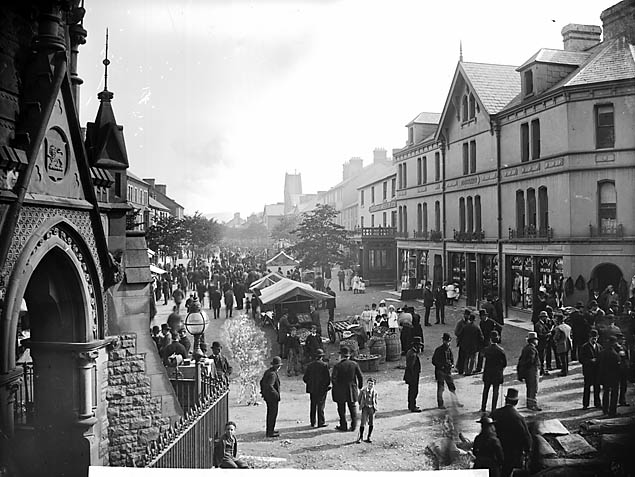
For generations of farming families in western Montgomeryshire, Machynlleth was much more than the nearest town. It was where livestock was sold, supplies were purchased, accounts were settled and news was exchanged. Farmers travelled in from the surrounding valleys and hills, often after difficult journeys along narrow roads, while dealers and traders arrived from further afield. On the busiest fair days, the streets became the centre of an agricultural economy extending well beyond the town itself.
By the Victorian period, Machynlleth already possessed a long-established reputation as a market centre. Its position near the head of the Dyfi estuary brought together routes from Montgomeryshire, Merionethshire and Cardiganshire, while the surrounding countryside supplied sheep, cattle, horses, wool and other agricultural produce. The town also served the quarrying and manufacturing districts further north, giving its commercial life a character which was not exclusively agricultural.
The history of these markets is closely connected with the lives of the people who worked the farms around Llanwrin, Cemmaes, Pennal, Corris and the Llyfnant Valley. Market day provided an opportunity to do business, but it also brought together communities whose everyday lives were often separated by considerable distances.
A Market Established in the Thirteenth Century
Machynlleth’s importance as a trading centre can be traced to the closing years of the thirteenth century. On 28 December 1291, Edward I granted Owen de la Pole the right to hold a weekly market and two annual fairs in the town. The charter established Wednesday as the regular market day, a tradition which has survived for more than seven centuries.
Markets were not simply informal gatherings of farmers and traders. They were regulated institutions, established under legal authority and associated with rights to collect tolls and other dues. The ability to hold a recognised market attracted commerce, encouraged settlement and helped determine which towns became centres of economic and administrative life.
Machynlleth was well placed to benefit. Routes through the Dyfi Valley connected the town with the coast, while roads towards Llanbrynmair, Newtown and Dolgellau brought traffic through mountainous country in which travelling between communities could be difficult. For farmers living several miles from the town, the weekly market offered access to buyers and supplies which could not easily be obtained nearer home.
Its commercial reach was already considerable by the seventeenth century. A document of 1632 records animals arriving for sale from Merionethshire, Montgomeryshire, Cardiganshire, Carmarthenshire and Denbighshire. Buyers came from an equally extensive area, including Flintshire, Radnorshire, Brecknockshire, Herefordshire and Shropshire. Machynlleth was consequently part of a much wider trading network long before the railway arrived.
The Victorian Fair Calendar
The regular Wednesday market was only one part of Machynlleth’s commercial activity. Annual fairs brought additional business into the town, particularly the buying and selling of livestock.
John Marius Wilson’s Imperial Gazetteer of England and Wales, published in the early 1870s, recorded fairs on the first Wednesday in March, 16 May, 26 June, 9 July, 7 August, 18 September, 21 October, 26 November and the Wednesday before Christmas. The dates indicate the extent to which fairs were distributed through the agricultural year.
By 1895 the arrangements had become more extensive. Slater’s Directory of North and Mid Wales recorded markets on both Wednesday and Saturday, together with fourteen fair dates between February and November. These included two dates in March, April, May, September and October. The calendar provided repeated opportunities for farmers and dealers to meet throughout the year.
Around 1900 Machynlleth was holding approximately fifteen annual fairs in addition to its Christmas fair. Four were devoted exclusively to sheep, cattle were sold at eight, and horses at nine. These figures demonstrate the importance which livestock trading continued to possess even as the railway and other forms of commercial transport were changing agricultural distribution.
For the farmer, the date of a fair was not simply an entry in a calendar. It might determine when animals were ready for sale, when money became available to meet expenses, or when additional stock could be purchased. Decisions made at the market could affect the financial position of a household for much of the following year.
The fairs also varied in their purpose. A sheep fair brought together different concerns from a horse fair, while a general market allowed traders to sell goods used in everyday domestic life. The business of a rural town could not be measured solely by the number of animals changing hands.
The Streets on Market Day
The surviving photographs of nineteenth-century Machynlleth give some indication of the town during this period. Particularly valuable is a photograph taken by John Thomas around 1885, showing a fair from the direction of the clock tower, with stalls occupying the street. It is a record of an occasion which has otherwise survived mainly through printed notices, advertisements and brief descriptions.
For farmers arriving from the hills, a visit to town could involve considerably more than selling livestock. There were purchases to make, accounts to settle and people to see. Shops supplied clothing, footwear, ironmongery and household goods, while inns provided accommodation and places in which business could be discussed. Solicitors, banks, auctioneers and other professional services formed part of the commercial life of the town.
An advertisement might announce the sale of land, timber or farm stock, but the transactions themselves often depended upon personal knowledge and local reputation. A farmer might know a dealer through repeated dealings over many years. Equally, a family which seldom travelled beyond its own district could maintain regular contact with people from quite distant communities through the markets.
Market day also offered opportunities for conversation and the exchange of information. News of births, deaths, marriages, farm sales and changes of tenancy circulated through such gatherings. In communities where much of the population lived in scattered farmhouses, these meetings helped maintain relationships which were otherwise difficult to sustain.
The Welsh language remained central to much of this activity. Although Machynlleth traded with English counties and possessed connections extending beyond Wales, the surrounding agricultural communities were predominantly Welsh-speaking. For many who travelled into town, the market was a familiar social and commercial environment in which business could be conducted in their own language.
The Price of Bringing Goods to Market
One of the more revealing survivals from Machynlleth’s commercial history is the schedule of tolls formerly payable to the lord of the manor. These charges covered goods and animals passing through the town, as well as transactions conducted at its fairs. They provide an unusually detailed indication of the traffic which converged upon Machynlleth before the disappearance of the old toll arrangements.
The charges included sixpence for a wagonload of goods passing through the town, fourpence for a cartload and one penny for a horseload. A penny was also payable for each head of cattle passing through in a drove, while a score of sheep attracted a charge of fourpence.
Separate charges applied to animals sold at fairs. The sale of a horse involved sixpence payable by the seller and one shilling and sixpence by the purchaser. Bulls, cattle, pigs and sheep were also subject to prescribed charges. Such payments formed part of the costs associated with bringing produce and livestock to market, and reflected the longstanding manorial rights which had developed around the town’s commercial activities.
The tolls were recorded on slate boards placed along the roads entering Machynlleth, including locations associated with Heol y Doll, Heol Maengwyn and Heol Pentrerhydyn. They made the charges visible to those approaching the market.
The arrangements eventually disappeared during the later nineteenth century. The local turnpike gates ceased to operate in May 1882, while in March 1885 a subscription of £100 was raised by townspeople and paid to the lord of the manor to bring the old toll collection to an end. The surviving toll boards, subsequently preserved at the Owain Glyndŵr Centre, provide a tangible connection with a period when passage through a market town could itself carry a financial obligation.
Farming Families and the Machynlleth Economy
The importance of these markets becomes particularly clear when considered alongside the history of individual farms.
At Caeadda near Llanwrin, the Davies family worked a substantial upland holding whose history can be followed through parish registers, census returns, estate documents and newspaper advertisements. Their principal agricultural interest was sheep, but the household economy also depended upon cattle, crops, woodland and the labour of family members and servants.
For a farming household of this kind, Machynlleth provided a principal commercial connection with the wider world. The annual movement of livestock, the purchase of agricultural necessities and the sale of produce all brought the family into contact with the town.
The surviving history of Caeadda offers examples of the variety of business conducted there. In May 1881, and again in April 1891, oak timber from the farm was advertised for sale at auctions in Machynlleth. These were not ordinary livestock transactions, but they show how a farmer could draw upon other resources of his holding when circumstances required additional income.
The position of women within this economy also deserves attention. Gwen Jones, later Davies, of Caeadda continued to exercise responsibility within the farming household following the death of her husband Thomas in 1891. She subsequently appeared in agricultural records as an exhibitor of Welsh Mountain rams at Machynlleth.
Her participation is a reminder that agricultural commerce was not confined to the men whose names most frequently appeared in directories and other public records. Women managed farms, maintained accounts, supervised domestic production and, particularly in widowhood, could undertake substantial agricultural responsibilities in their own right.
The wider history of the Llyfnant Valley reveals similar connections between dispersed communities and the services provided by Machynlleth. Farming families needed access to merchants and markets, but also to professional services, transport and opportunities for employment.
Railways and the Changing Trade of Machynlleth
The arrival of the railway during the 1860s brought significant changes to the town’s commercial position. The Newtown and Machynlleth Railway opened at the beginning of 1863, providing a new connection eastwards through Montgomeryshire. Railway development continued with the opening of the line towards Borth in July 1863 and the subsequent extension to Aberystwyth in 1864. Further developments created connections towards the coast and neighbouring districts.
These improvements altered the movement of people and goods through Machynlleth. Agricultural produce could reach more distant markets through the railway network, while manufactured goods and other supplies could be brought into the district more readily than had previously been possible.
The town also acquired an important role in the movement of slate. The Corris Railway connected the quarrying districts of the Dulas Valley with Machynlleth, where goods could be transferred to the main railway system. Railway sidings, warehouses and associated businesses contributed to the town’s wider commercial development.
Yet the coming of the railway did not immediately bring an end to the older livestock trade. Drovers continued to play a part in moving sheep and cattle, and the markets retained their importance as places where animals were assembled, examined and sold.
The Royal Commission on the Ancient and Historical Monuments of Wales records that David Isaac and John George, two of the later Welsh drovers, conducted business at Machynlleth between 1911 and 1932. Their sheep were driven from pens near Pont-ar-Ddyfi towards Brecon, demonstrating the persistence of traditional methods even after the railway had become firmly established.
Machynlleth consequently occupied a position between two systems of agricultural commerce. The older roads and droving routes remained important, while railway connections offered alternative means of reaching regional and national markets.
The Town Hall and the Business of the Market
The changing appearance of Machynlleth during the Victorian period reflected its continuing commercial importance. An earlier town and market hall had stood at the junction of the principal streets. In 1783 a new building was erected on the site, incorporating a covered market area at ground level with rooms above used for public and judicial business.
The building was described by George Borrow, who visited Machynlleth in November 1854. He found the magistrates sitting upstairs while a crowd gathered below in connection with a poaching case. His account, subsequently published in Wild Wales in 1862, preserves a picture of a town in which commercial, social and judicial activities occupied the same central space.
The old town hall eventually disappeared during the redevelopment of the town centre in the 1870s. A replacement town hall was erected in Penrallt Street in 1872, on land provided by Earl Vane and Sir Watkin Williams-Wynn. Its accommodation included a market hall, shops, an upstairs theatre and living quarters for the caretaker.
The building served purposes extending beyond the sale of goods. Public meetings, court proceedings and entertainments formed part of its use, illustrating the close relationship between the market and the civic life of Machynlleth.
The earlier town hall was demolished in 1874 to make way for the clock tower, erected in commemoration of the coming of age of Viscount Castlereagh of Plas Machynlleth. The tower subsequently became the best-known landmark in the town, standing at the junction through which generations of farmers and traders had passed.
In 1908 Machynlleth Urban District Council agreed to purchase the town hall and market place. This brought the administration of these facilities more directly into the sphere of local government, reflecting wider changes in municipal responsibility during the Edwardian period.
Agricultural Shows and the Reputation of Local Farmers
Alongside the regular fairs and markets, agricultural shows became important occasions for the farming community. Although commercial considerations remained important, the shows also encouraged improvements in breeding and cultivation and provided opportunities for farmers to demonstrate the quality of their stock and produce.
The tenth annual Machynlleth Show, held in August 1897, offers a useful example. Contemporary reporting in The Cambrian News and Merionethshire Standard, subsequently examined in research undertaken at Aberystwyth University, recorded competitions involving grain and root crops. Farmers from the district exhibited wheat, barley, white oats and black Tartarian oats, together with turnips, swedes and mangel-wurzels.
These entries provide evidence of the mixed agricultural economy which continued to exist around the Dyfi Valley. Although sheep farming is often the activity most readily associated with the uplands of western Montgomeryshire, cultivation remained important, particularly on suitable land in the valleys and lower-lying districts.
The shows also brought recognition to individual farmers and their families. Prizes reflected agricultural skill, careful breeding and the ability to produce quality stock or crops under local conditions. For some competitors, success at a show could contribute to their reputation and the standing of their animals in subsequent sales.
The participation of Gwen Davies of Caeadda in the exhibition of Welsh Mountain rams belongs within this wider tradition. It places a woman whose life was largely spent on an upland farm within the organised agricultural society of the district.
Markets, Employment and Rural Society
Agricultural households depended upon labour, particularly during periods of heavy seasonal work. Shepherding, haymaking, harvesting and the maintenance of farms required assistance beyond that which a household could always provide for itself. In some cases agricultural servants lived with their employers, becoming members of the working household for substantial periods.
Hiring arrangements were an established feature of Welsh rural society, and fair gatherings could offer opportunities for employers and prospective servants to make contact. Such relationships were particularly important in the hill country around Machynlleth, where dispersed farms might be some distance from the nearest village. Employment could lead a young man or woman from one valley into another, sometimes beginning a family connection which would endure for generations.
At the same time, the market allowed farmers and labourers to maintain relationships with a wider circle of people. A visit to Machynlleth might bring an opportunity to see relatives, discuss local affairs or hear news from communities beyond the immediate neighbourhood.
The town’s inns, shops and public spaces were consequently important meeting places. They helped link separate households and settlements of western Montgomeryshire into a recognisable regional society. Such connections survive indirectly through marriages between farming families, changes in occupation, the movement of servants and the business notices which appear in contemporary newspapers.
Agricultural Depression and the Changing Rural Economy
The later Victorian period was not an uninterrupted age of agricultural prosperity. From the 1870s onwards, British farming entered a prolonged period of difficulty. Increased competition from imported produce, changes in prices and the costs associated with maintaining agricultural holdings placed pressure upon farmers throughout the country.
The effects were felt in western Montgomeryshire. At Caeadda, the number of live-in servants recorded in the census declined from three in 1861 and 1871 to one in 1881. By 1891 no resident servants were recorded, and the farm was increasingly dependent upon family labour.
Such changes help explain why markets remained important. A farmer facing falling returns still needed to sell animals, purchase necessities and meet financial obligations. The availability of buyers and the prices secured for livestock could make a considerable difference to the survival of a holding.
The evidence from the Ceniarth Farm dispute of 1900 illustrates another side of these difficulties. Evan Owen’s disagreement with his former landlord involved rent, damage associated with timber operations and claims for compensation. The case reveals some of the pressures under which tenant farmers were working at the close of the nineteenth century.
Market activity continued despite these difficulties. The substantial fair calendar recorded around 1900 shows that Machynlleth retained an important place in the agricultural economy, even as the circumstances of farming were changing.
Surviving local government records suggest that this activity required increasingly formal regulation. Among the Machynlleth Salvage Papers held at the National Library of Wales is a substantial file covering markets and fairs between 1903 and 1916. It contains correspondence, newspaper cuttings, posters, bye-laws and price lists, including material concerning proposals to alter the days upon which fairs and markets were held.
The existence of this file demonstrates that the organisation of the market was an active concern of local administration during the Edwardian years, rather than simply the continuation of an unchanging medieval custom. It also provides an important avenue for further research into the practical arrangements governing livestock sales, traders and the use of public space.
The Market at the Centre of Rural Montgomeryshire
By the outbreak of the First World War, Machynlleth had undergone considerable change. The railway had transformed transport, the town centre had been altered by Victorian building projects, and local government had assumed responsibilities which earlier generations would have associated with private companies or manorial authority. Yet the market retained much of its traditional importance.
The farming families who travelled into Machynlleth were part of a society in which agricultural knowledge, kinship and local reputation remained central. Their dealings with the town connected isolated upland holdings with buyers, merchants, employers and professional services. The wider commercial world might be changing, but the market continued to provide a familiar place in which those connections could be maintained.
Much of this history is easily overlooked because it concerns ordinary activities rather than exceptional events. A farmer selling sheep, a woman entering livestock at an agricultural show, or a family travelling into town to purchase supplies seldom left records which immediately attracted the attention of historians. Yet these experiences were fundamental to the economic and social life of rural Montgomeryshire.
The history of Machynlleth’s fairs is also the history of the communities which sustained them. Its streets brought together people from Llanwrin, Cemmaes, Pennal, Corris, the Llyfnant Valley and many other districts, creating connections which extended across county boundaries and often beyond Wales itself.
The Wednesday market continues, a remarkable survival from the charter of 1291. Its present character is naturally different from that of the Victorian livestock fairs, but its continuing place in the town provides a visible reminder of a much older commercial tradition.
For the generations who worked the surrounding farms, Machynlleth was where much of the business of rural life was conducted. The market connected their separate worlds, and through it the agricultural communities of western Montgomeryshire maintained their place within the wider economy.
Related Essays
- Caeadda, Llanwrin: Three Centuries of Farming in the Montgomeryshire Uplands, the history of a farming family closely connected with Machynlleth.
- Gwen Jones of Caeadda, 1841–1926: A Welsh Farming Matriarch, including participation in the local agricultural show.
- The Llyfnant Valley: Farming, Waterfalls, Tourism and the Waters Family, on the rural communities served by Machynlleth.
- Esgair Llewelyn: A Medieval Welsh Farmhouse and the Social History of a Llanwrin Family, another study of upland society.
- The Ceniarth Farm Dispute of 1900: A Montgomeryshire Farmer Challenges His Landlord, a case from the same rural economy.
- David Davies of Llandinam (1818–1890): The Sawyer Who Redrew the Map of Wales, exploring the wider changing economy of nineteenth-century Wales.
- John Pugh of Glyncaerig (1834–1912): From Farm Labourer’s Son to Montgomeryshire Landowner, a farmer’s rise to the ownership of Glyncaerig within the livestock and market economy of western Montgomeryshire.
- Thomas Davies of Penlan and Gwernstablau (1864–1930): Farming, Family and Public Life in Montgomeryshire, a Penlan and Gwernstablau sheep farmer whose livestock and agricultural shows connected him to the Machynlleth market economy.
- The White Horse Hotel, Machynlleth: Fire, Farming Families and Life on Maengwyn Street, a study of a central Machynlleth inn, its market-day role, the 1911 fire and its connections with farming families of the district.
Explore more Montgomeryshire and rural history
Continue with the Montgomeryshire History, Welsh Rural History, Family History & Genealogy and Victorian & Edwardian Wales guides, or browse the related essays above.
Receive new historical essays by email
For new essays on Welsh history, biography, genealogy and rural community life, subscribe on the homepage.
Sources and Further Reading
National Library of Wales, Charles Ashton Manuscripts, NLW MS 2132B, containing a transcript and English translation of the charter of Edward I, dated 28 December 1291, granting a weekly market and two annual fairs at Machynlleth.
John Marius Wilson, The Imperial Gazetteer of England and Wales (1870–1872), entry for Machynlleth, providing the weekly market day, fair dates, manufacturing trades and population.
Slater’s Directory of North and Mid Wales (1895), Machynlleth entry, recording Wednesday and Saturday markets, fourteen fair dates, local institutions and principal trades.
Royal Commission on the Ancient and Historical Monuments of Wales, Coflein, Machynlleth Town and Market Hall, NPRN 408661, including the history of the market and the number and character of fairs around 1900.
Royal Commission on the Ancient and Historical Monuments of Wales, Coflein, Former Toll House, Heol Maengwyn, NPRN 421126, recording the former manorial toll schedule and its abolition.
National Library of Wales, Machynlleth Salvage Papers, File 54, Markets and Fairs, 1903–1916, correspondence, posters, price lists, bye-laws and proposed changes to market and fair days.
George Borrow, Wild Wales (1862), account of his visit to Machynlleth in November 1854.
History Points, Site of Town Hall, Machynlleth, documenting the replacement town hall, its uses and its purchase by the Urban District Council.
The Cambrian News and Merionethshire Standard, August 1897, reporting the tenth annual Machynlleth Agricultural Show and its grain and root competitions.
Sarah Higgins, Mixed Farming: Histories and Futures, Historical Agriculture Data Report, Aberystwyth University, 2020, examining agricultural records, tithe evidence and contemporary reporting of the 1897 show.
John Thomas, Machynlleth Fair, circa 1885, photograph from the National Library of Wales collection, record 3361956, used as the featured image.

Antony David Davies, Voices from the Uplands, Old Llyfnant Valley Farming Families and The Davies Caeadda Family, for the wider agricultural, genealogical and community history of Llanwrin, Caeadda and the Montgomeryshire uplands.
The sources establish the continuity of the markets, although the attendance and quantities of livestock traded at individual Victorian fairs remain subjects for further archival research. The National Library of Wales collection covering 1903–1916 is especially promising for the study of Edwardian fair administration.