
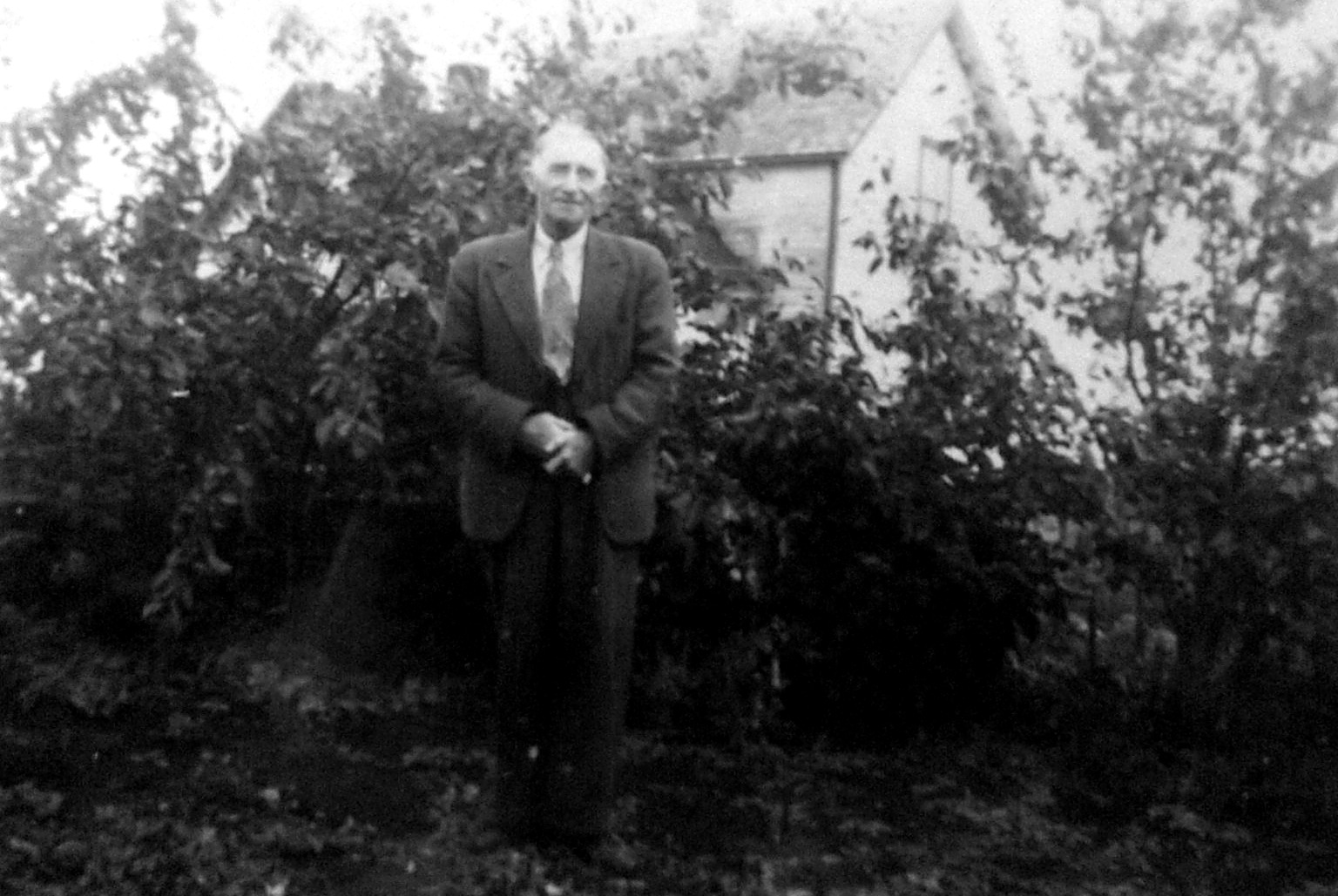
Owen Jones Davies was born on 7 September 1875, one of twelve children of Thomas Davies and Gwen Jones of Caeadda, near Llanwrin in Montgomeryshire. The history written in Canada by his son Iorwerth and daughter-in-law Laura gives Machynlleth as his birthplace, while the family home in which he grew up was Caeadda. Those few miles of Welsh countryside provided his first experience of agriculture and remained important to his identity throughout a life spent largely overseas.
After an apprenticeship in London and a return to farming in Montgomeryshire, Owen emigrated to the United States in 1902. He worked in a Colorado mine, joined other Welshmen in an agricultural venture farther west and then moved north to Alberta. At Wood River, near Ponoka, he helped establish a new farming settlement, acquired land of his own and became a familiar figure in the Welsh chapel and its musical life.
Owen was my great-uncle, the elder brother of my grandfather Griffith Llewelyn Davies. His life is particularly well documented because Iorwerth and Laura Davies contributed an account of him to From Wales to Wood River and Surrounding Districts, the local history compiled by Kelt Hughes and Griff Jones in 1980. Read alongside my own family research, it gives an unusually close view of the movements, work and household of a Montgomeryshire emigrant.
The Davies Family of Caeadda
Owen belonged to a farming family with deep connections to Llanwrin, Esgair Llewelyn and the Llyfnant Valley. His parents had married in 1859. His mother, Gwen Jones, came from the Jones family of Esgair Llewelyn, while his father farmed at Caeadda. Their household was a large one, and its children grew up in a district where agricultural work, neighbouring farms, chapel life and the markets of Machynlleth formed the basis of everyday society.
The late Victorian countryside was not an easy place in which to establish an independent livelihood. Agricultural prices had fallen, tenancies were often uncertain and farms already supporting large families could not necessarily provide for every son and daughter. Owen’s father died in 1891, leaving Gwen and her children to adapt to a changed household. The family retained its association with Caeadda, but the younger generation followed different occupations and moved between farms, towns and, eventually, countries.
There was nothing inevitable about Owen becoming a Canadian farmer. His first substantial period of employment took him away from the land and into one of the trades in which Welsh migrants had long established themselves in London.
Five Years in a London Drapery
According to the account written by Iorwerth and Laura, Owen served a five-year apprenticeship in the dry-goods trade with C. and A. Daniels of Kentish Town, London. The business belonged to the drapery trade, handling textiles and other manufactured goods. For a young man raised on a Welsh farm, it offered training in a very different working environment, involving the discipline of a large shop, customers and the routines of commercial life.
The name of his employer provides a useful connection with the wider history of shop work. In July 1907, some years after Owen had departed, twenty-four of the firm’s eighty-four employees went on strike during a dispute concerning the compulsory living-in system and union recognition. The stoppage lasted sixteen weeks. Its circumstances were later recorded in Philip Hoffmann’s history of the shopworkers’ movement, They Also Serve. Owen was not involved in that dispute, but it shows the kind of commercial establishment in which he had trained and the employment practices being challenged in the early twentieth century.
His London apprenticeship had not ended his interest in agriculture. By the later 1890s he was back in Montgomeryshire, working at Penlan, near Ceinws, with his elder brother Thomas Davies.
Penlan and the Concerts at Ceinws
Thomas had established himself as a farmer at Penlan, above Ceinws, and Owen worked there for several years. The return gave him further practical experience of livestock and upland agriculture, but his name also appears in connection with another part of local life. Newspaper accounts of benefit concerts at Ceinws during 1898 record his success as a tenor singer.
These concerts were part of a well-established Welsh tradition in which chapel, community fundraising and musical competition frequently overlapped. For Owen they were more than a passing amusement. The local history written many decades later in Alberta remembered his achievements as a soloist in Wales, and singing continued to occupy an important place in his life after emigration.
There is a striking continuity between the young man singing at Ceinws and the choir leader later remembered in Wood River. The two communities were separated by thousands of miles, but they shared forms of worship and music that Owen knew from childhood.
Denver, Colorado, and the Journey West
In 1902 Owen left for the United States, travelling to an old friend in Denver, Colorado. The 1980 family account states that he spent about a year working as a timekeeper at a gold and silver mine. His duties are not described in detail, although such work ordinarily involved keeping records of employees’ hours. It was another departure from his earlier occupations, and probably provided the income needed to attempt a business of his own.
He subsequently joined three other young Welshmen in purchasing a small farm. They operated it for two years before selling to a railway company for what the family account describes as a good sum. My earlier family research places this venture in the vicinity of Almira, Washington State, although the names of all four partners and the precise property still require confirmation.
That partnership is an important stage in his career. Owen was learning how to combine agriculture with the purchase and sale of land. He had also acquired useful experience of working alongside fellow Welsh migrants, relationships which could provide both capital and practical assistance in a new country.
The Welsh Settlement at Wood River
In the spring of 1905, according to Iorwerth and Laura, Owen travelled with Evan R. Evans to Ponoka and then to Wood River, in the newly developing agricultural country of central Alberta. Other evidence gives 1906 as his year of immigration into Canada, including transcriptions of the 1906 and 1911 Canadian censuses. The difference has not been resolved by examination of the original returns. What is beyond doubt is that Owen and Evans were established at Wood River during the opening years of the settlement.
Wood River was one of the most distinctive Welsh agricultural communities in western Canada. Its settlement developed around the turn of the century, drawing in both people who had travelled directly from Wales and Welsh families who had already spent years in the United States. By about 1910 the Welsh population of the district was estimated at some two hundred. The community maintained its own religious and social institutions, giving settlers a familiar network in a landscape and economy quite unlike those of Montgomeryshire.
Alberta became a Canadian province in September 1905. Land was being surveyed, homesteads established and prairie holdings turned into farms. This was also a process of settler colonial expansion on Indigenous lands, including the territory covered by Treaty 6. The growth of Wood River therefore belongs to a wider history than the achievements of its Welsh settlers alone.
Evan R. Evans and the First Farm
The identity of Owen’s first Canadian farming partner is no longer a matter of speculation. The account written by his own family names Evan R. Evans, and a photograph reproduced in the Wood River history shows the two men together. The census transcription which places E. R. Evans close to O. G. Davis is consistent with that account.
They acquired a property formerly associated with Bob Bunn, on land described in the family history by its township and section. Their partnership was relatively brief. In 1907 they sold the holding to Hugh F. Davies. Evans returned to the United States, while Owen remained in Alberta and purchased another property, this time in his own name.
The separation says something about the uncertainty and mobility of the early settlement years. Partnerships could provide a means of beginning, but they did not necessarily endure. Owen’s decision to stay at Wood River determined the course of the next fifty years of his life.
Making a Farm from Unimproved Land
Owen’s new purchase was the north-east quarter of section 3, township 43, range 24, west of the fourth meridian. He acquired it from Will E. James of Colorado, described in the family account as a cousin of the John James family. There were no buildings or other improvements. Before it could function as a productive farm, land had to be cleared and the necessary buildings erected.
Working with Ed James, Owen acquired about five hundred sheep. The animals were kept for several years and helped make use of and open up the land. The family account also states that Indigenous workers were employed in clearing brush. It does not identify those workers by name or community, but their contribution should not be lost from the history of the property.
The farm could not immediately provide every source of income Owen needed. He therefore transported cream from neighbouring holdings to the Earlville Creamery, earning money which helped meet the cost of the land. That detail is particularly revealing. The establishment of a new farm depended not merely on possession of acreage but upon regular income, transport, labour and the cooperation of neighbouring households.
The Canadian farm was very different in scale and circumstances from the land Owen had known as a boy, yet the work still depended upon practical agricultural knowledge. He had acquired that knowledge at Caeadda and Penlan, and then supplemented it with experience gained during his years in the United States.
The Grass Fire of 1909
In 1909 a serious grass fire came from the west, travelling through the Dalton property and reaching Owen’s holding. It destroyed his barn and granaries. The loss of agricultural buildings and stored produce was a considerable blow to a farmer who was still establishing his business.
His neighbours, the L. J. Nelson family, allowed him to use part of their barn until rebuilding could take place. The Wood River account recalls that large fires were common in those years, and that people were frequently called upon to assist. The episode provides a clear example of the neighbourly obligations upon which isolated farming communities depended.
The destruction did not end Owen’s farming career. He rebuilt and continued acquiring land. The setback is worth recording because it places his eventual success in proper proportion: it was achieved through years of work and not without serious reverses.
Homestead, School Land and a Growing Holding
In addition to the farm purchased from Will E. James, Owen filed on the south-west quarter of section 34, township 42, range 24, west of the fourth meridian, and completed the requirements for his homestead. The land had previously been associated with Alec Lamb, who had relinquished it. This provides a second identifiable holding in Owen’s developing business.
During the 1920s Owen and Johnny James purchased a parcel of school land together, described as the south-west quarter of section 11, township 43, range 24. Owen subsequently acquired James’s share. The transactions show that he was no longer simply making a beginning on unimproved land. He had become an established farmer capable of extending his property.
My earlier family account describes his eventual holding as extending to approximately six hundred acres. The precise sequence of purchases and the extent of the farm at different dates would benefit from a systematic comparison of the land registers, homestead file and subsequent conveyances. The local history nevertheless establishes the essential course of events: from partnership to independent farm, and from an unimproved holding to a substantial agricultural enterprise.
Marriage to Mary George
On Christmas Eve 1913 Owen married Mary George, whose family had emigrated from Pembrokeshire the previous year. Her parents, William and Mrs George, came from the Cilgerran district and settled near Ponoka with a large family of three sons and six daughters. Mary was the eldest daughter.
The George family’s story is preserved separately in the Wood River history. Several of Mary’s brothers and sisters married or established homes in the district, while other members of the family continued farming. Owen’s marriage therefore brought him into another Welsh household with connections both to the old country and to the new community taking shape around Ponoka.
Owen and Mary had two sons, Dewi and Iorwerth. Dewi died in infancy. Iorwerth survived and would eventually take over the family farm. The death of their infant son was followed by another tragedy when Mary died in March 1917, leaving Owen a widower and Iorwerth still a baby.
Clara Cook and the Care of Iorwerth
After Mary’s death, Mrs Carl Courser and Maude George helped look after the infant Iorwerth. Clara Maria Cook subsequently joined Owen’s household and took on the long-term care of his son. In the words of the family account, she became a homemaker and mother to Iorwerth, who was then about six months old.
Clara had her own history of migration. Born in Lincolnshire on 26 May 1876, she moved with her family to Hull and married Harry Cook in 1901. The couple emigrated to Juneau, Alaska, where Harry worked as a chef. His health later obliged them to leave, and they travelled to Calgary and then Ponoka. Clara worked for local families and at the Ponoka Mental Hospital before entering Owen’s household.
The family history is careful about her place in the home. Clara was Owen’s housekeeper and Iorwerth’s principal maternal figure; it does not record a marriage between her and Owen. She remained closely connected with them and with Iorwerth’s later family. Her work belonged to the often overlooked domestic history that made continuity possible within agricultural households after bereavement.
Clara was also a devoted member of Zion Church and received life membership of its women’s association. She remained in the family home until illness led to her admission to hospital in December 1959. She died at the Rose Haven Home in Camrose on 10 March 1960.
Welsh Music and the Wood River Festivals
Owen never abandoned the interest in singing first recorded in the Ceinws concerts. In Alberta he conducted the Zion Church choir and, for a period during the 1930s, directed two ladies’ choirs. The family account records first prizes at two Wood River Festivals. A photograph of the ladies’ choir in 1934 identifies O. G. Davies among those pictured.
Such competitions were important occasions in Welsh community life. They gave opportunities for families to gather, for singers to perform and for inherited musical traditions to be passed to people who had never lived in Wales. At Wood River, the continuity between chapel and festival was particularly strong.
Owen’s contribution was not simply that of a settler who enjoyed music. He had brought a skill acquired in Montgomeryshire into the cultural life of a Canadian farming district. His name appears in the local account as a conductor and prizewinner because the music continued to matter to those who remembered the early community.
Zion Church and a Welsh Community Overseas
Zion Welsh Presbyterian Church was central to the life of Wood River. The community developed two Welsh chapels, and Zion remained the more enduring institution. Church meetings, worship, choirs and associated gatherings gave settlers a place to preserve something of the communal life they had left behind.
Over time, however, that society changed. English increasingly displaced Welsh in everyday use, and the children and grandchildren of immigrants entered the wider life of Alberta. Regular services at Zion eventually ended in 1995. The church building, photographed after renovation in 1965, and the continuing Welsh singing traditions of the district formed part of the community’s longer inheritance.
There was a further, very personal link with home in the name by which Owen became known. Born Owen Jones Davies, he generally appeared in Canada as Owen G. Davies. My earlier family research connected the initial with Gwrin, the saint associated with Llanwrin. The middle name is recorded differently in some later references, so the exact form deserves care, but the family explanation is revealing: the emigrant retained a reminder of the parish in which he had grown up.
The Next Generation at Wood River
On 16 June 1942 Iorwerth Davies married Laura Schierer, with the Revd E. Davidge and the Revd T. E. Jeffreys officiating. The young couple first lived on Owen’s homestead and then, in the summer of 1944, moved into his home place. Their marriage marked the continuation of the farm by a second generation born into the Canadian community.
During the summer of 1943 the household also took in Harry Thacker, a twelve-year-old boy from the Kiwanis Home in Edmonton. He remained with them until he was sixteen. The family history records this plainly, as part of the domestic life of the farm rather than as an exceptional event.
Iorwerth and Laura raised six children, John, Gwen, Edward, Neil, Ellis and Wesley. The Wood River account follows their education, employment and family lives, and notes the continued involvement of several family members in music, church activities and agriculture. It also records that Iorwerth and Laura built a new house on the farm and moved into it in October 1978.
That history gives a sense of the permanence Owen had achieved. The land which had first required clearing, buildings, livestock and outside earnings remained associated with his descendants long after the immigrant generation had passed.
Owen’s Death and the Survival of His Work
Owen died at Ponoka on 8 December 1958, aged eighty-three. This is the date recorded in my family history, Old Llyfnant Valley Farming Families, and in the official Alberta death index, which registers him as Owen Gurin Davies. The 1980 Wood River history prepared by Iorwerth and Laura gives 9 December, a one-day discrepancy which does not alter the agreement between the family research and the provincial index. He was buried at Zion Welsh Presbyterian Church near Ponoka, where he had taken such an active part in the life of the congregation.
By then the Wood River settlement had changed greatly from the place Owen and Evan Evans had known in its earliest years. The pioneers who had established farms and chapels were passing away, and the community was increasingly Canadian in language and everyday outlook. Nevertheless, its Welsh history survived in local memories, the church, the annual gatherings and the work of families such as the Davieses.
The 1980 account is especially valuable because it was written by people who had known Owen and continued to occupy the family land. Its details of work, neighbours, losses and family responsibilities are precisely the things which can disappear when an emigrant’s life is reduced to dates of departure and death.
A Montgomeryshire Farmer in a Canadian Landscape
Owen’s life was marked by movement, but agriculture remained its centre. He grew up at Caeadda, learnt another trade in London, returned to work for his brother at Penlan and then moved through Colorado and the American West before settling in Alberta. The opportunities were different in each place, as were the people with whom he worked. He responded by acquiring new skills without losing the practical experience gained in rural Wales.
His achievements were substantial. He endured the destruction of farm buildings, expanded his landholding, raised a family after early bereavement and helped sustain a church and musical community. These were not public distinctions of the kind most often preserved in biographical dictionaries, but they mattered deeply to the people among whom he lived.
For me, his story also belongs alongside that of his mother Gwen and his brothers who remained in Montgomeryshire. They began life in the same farming household, but the changing world offered them very different courses. My grandfather Griffith Llewelyn Davies continued his life in Wales; his elder brother Owen made a permanent home on the Canadian Prairies.
What connected them was more than a surname. It was a knowledge of farming, an attachment to family and a culture shaped by the rural communities of Montgomeryshire. Owen carried much of that inheritance overseas, and the account preserved by Iorwerth and Laura allows us to see how it became part of the history of Wood River.
Related Essays
- Caeadda, Llanwrin: Three Centuries of Farming in the Montgomeryshire Uplands, the farm where Owen grew up.
- Gwen Jones of Caeadda, 1841–1926: A Welsh Farming Matriarch, Owen’s mother and the farming household she sustained.
- Thomas Davies of Penlan and Gwernstablau (1864–1930), Owen’s elder brother and employer before emigration.
- Esgair Llewelyn: A Medieval Welsh Farmhouse and the Social History of a Llanwrin Family, tracing the maternal family.
- Machynlleth Fairs and Markets, the economy and community Owen knew before emigrating.
- The Llyfnant Valley: Farming, Waterfalls, Tourism and the Waters Family, the wider Montgomeryshire district.
Explore more Montgomeryshire and rural history
Continue with the Montgomeryshire History, Welsh Rural History, Family History & Genealogy and Victorian & Edwardian Wales guides, or browse the related essays above.
Receive new historical essays by email
For new essays on Welsh history, biography, genealogy and rural community life, subscribe on the homepage.
Sources and Further Reading
The principal contemporary family source is Laura and Iorwerth Davies, “Owen G. Davies”, in Kelt Hughes and Griff Jones (compilers), From Wales to Wood River and Surrounding Districts: A Short History of the Welsh Who Settled This Area (Ponoka, 1980). The photographs and accompanying entries on the George family, Iorwerth and Laura Davies, and Zion Church have also been consulted. Iorwerth was Owen’s son, making this an unusually valuable family account, although it was compiled many years after some of the events described.
For Owen’s origins in Montgomeryshire and the relationships between the Davies and Jones families, see my Old Llyfnant Valley Farming Families: Including the Jones Glandwr and Davies Caeadda Families, pp. 201–204, together with the family records, census research and newspaper references assembled for that work.
- Philip Hoffmann, They Also Serve: The Story of the Shopworker, Part II, listed on the Usdaw historical publications page, for the July 1907 dispute at C. and A. Daniels of Kentish Town. The strike occurred after Owen had left the firm.
- RootsChat, “Owen Jones Davies (1876–1958)”, for transcriptions and discussion of the 1906 and 1911 Canadian census entries. Their dates and land locations require checking against original returns.
- Wayne K. D. Davies, “Welsh”, Encyclopedia of the Great Plains, for the Wood River settlement, its Welsh population and the history of Zion.
- Provincial Archives of Alberta, Death Indexes (1955–1959), recording Owen Gurin Davies, 8 December 1958, Ponoka, registration no. 008-986.
- Library and Archives Canada, Land Records, for further investigation of the Alberta homestead and land descriptions.
- The 1980 history includes a photograph of Owen Davies and Evan R. Evans, a 1934 ladies’ choir photograph identifying O. G. Davies, and a view of Zion Church after its renovation in 1965. They provide important visual evidence of the family and the Welsh community in Alberta. The featured portrait is a family photograph provided by the author and adjusted using conventional photographic methods for tonal balance and clarity, without AI reconstruction.
The source accounts differ over Owen’s arrival in Canada and the spelling or expansion of his adopted middle initial. The Wood River family account says spring 1905, while later census transcriptions give 1906; original census and land records merit further checking. The Wood River volume gives his death as 9 December 1958, but my Old Llyfnant Valley Farming Families gives 8 December 1958, corroborated by the official Alberta death index. The Find a Grave memorial for Owen G. Davies is a further genealogical reference. These differences have been acknowledged where material rather than allowing a minor inconsistency to obscure established facts.