
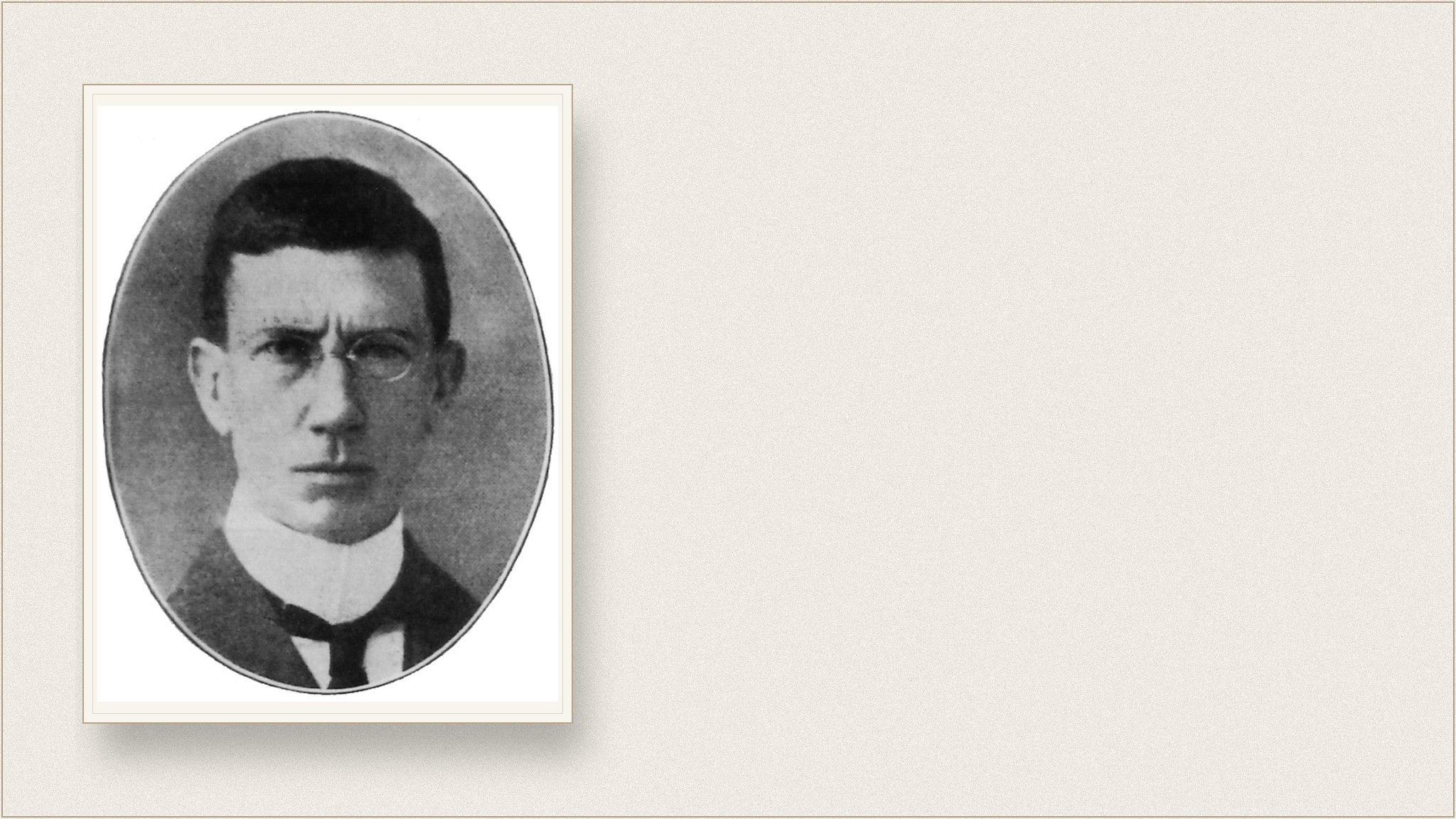
Few members of my extended family moved so confidently across the intellectual and geographical boundaries of the Edwardian world as Herbert George Flaxman Spurrell.
Physician, biologist, zoological collector and author, he worked in Britain, the United States, West Africa and Colombia. His specimens contributed to the scientific description of previously unrecorded animals, while his books ranged across physiology, human evolution, social biology and imaginative writing about the ancient past. By the time war redirected his career into military medicine, several species already carried his name, museum collections held type material he had gathered, and his work had attracted attention in some of the principal scientific circles of his day.
He died from pneumonia in an Alexandria military hospital on 8 November 1918, three days before the Armistice. He was forty-one.
Spurrell’s life was brief, but it was neither narrow nor unfinished in the ordinary sense. He had already built an international career encompassing medicine, field science, teaching and authorship. What was lost in 1918 was not merely a promising beginning, but the prospect of a substantial second half to an already remarkable life.
Family, inheritance and intellectual formation
Herbert George Flaxman Spurrell was born at Eastbourne, Sussex, on 20 June 1877. He was the only son of Herbert Spurrell and Harriet Rebecca Blaxland, who had married the previous year. Through his mother he belonged to the wider Jones family of Glandwr Hall. Harriet Rebecca descended through the Blaxland branch from William Jones of Glandwr Hall, 1792–1882, making Spurrell one of William’s great-grandchildren. His scientific and medical career therefore belongs not only to the history of the Spurrell family, but also to the wider dispersal of the Glandwr descendants into the professional, intellectual and imperial worlds of the late nineteenth and early twentieth centuries.
His father practised as an architect and had trained in the professional world of Victorian architecture, including work under Alfred Waterhouse before establishing himself in practice at Eastbourne. That placed the household firmly within the educated professional middle class. The wider Spurrell family also possessed a pronounced scholarly tradition. Herbert’s uncle, Flaxman Charles John Spurrell, became a respected archaeologist, geologist and photographer. He worked on prehistoric sites in Kent and Essex, studied ancient technology and collaborated with some of the leading archaeologists of his age.
Young Herbert therefore grew up within a family culture in which intellectual enquiry was not remote or ornamental. Observation, classification and the recovery of knowledge were established family pursuits.
As an only child, particular hopes must have rested upon him, although the evidence does not permit us to reconstruct the emotional character of his upbringing. What can be said is that his subsequent career justified the family tradition that remembered him as exceptionally gifted.
Merton College and the study of life
Spurrell entered Merton College, Oxford, in 1895 and completed his Bachelor of Arts degree in 1899. He was also associated with the Bodley Club, a student literary society that encouraged discussion and intellectual exchange.
Oxford at the end of the nineteenth century was undergoing an important scientific transformation. The older classical curriculum remained powerful, but physiology, zoology, anthropology and evolutionary biology were acquiring greater institutional authority. Debates generated by Darwin and his successors had moved beyond the origins of species into questions about inheritance, human development and the relationship between biological organisation and society.
Spurrell distinguished himself academically. A contemporary obituary in the London Hospital Gazette records that he won the Welsh Memorial Prize at Oxford in 1901. The precise category of the prize in that year requires further archival confirmation, but the award itself is important evidence that his scientific promise was recognised before he had completed his medical qualification.
His first major book, The Commonwealth of Cells: Some Popular Essays on Human Physiology, also appeared in 1901, when he was only twenty-four. The title revealed an idea that would recur throughout his writing, the body understood not as a single indivisible object, but as an organised community of living units.
The book considered living matter, the chemistry and mechanics of the body, the nervous system and the relationship between individual cells and the whole organism. It sought to make contemporary physiology intelligible to a general reader without abandoning scientific seriousness. Spurrell explained in his preface that the book grew from questions repeatedly put to him by non-scientific friends about medicine, bodily function and the physical basis of mind. He was therefore already attempting, at a very young age, to bridge the gap between specialist science and an educated general readership.
The work was dedicated “To my esteemed friend and tutor, Gustav Mann”, a revealing acknowledgement of one of the formative scientific relationships of Spurrell’s early life. Mann was an important physiologist, and the dedication helps explain the continuity between Spurrell’s Oxford education and his later move to the United States.
The Commonwealth of Cells can now be read in full through Project Gutenberg. Its survival gives Spurrell something denied to many promising Edwardian scientists. We can encounter not only his name and qualifications, but the movement of his thought.
From biology to medicine
After Oxford, Spurrell continued his education at the London Hospital, one of the capital’s most important teaching institutions. He completed his medical training in 1907, qualifying MB and BCh.
Medicine and zoology were not separate worlds in this period. Physiology, comparative anatomy, parasitology and tropical medicine all depended upon an understanding of animal life. A physician working in West Africa or tropical South America required knowledge extending well beyond the conventional consulting room.
Spurrell subsequently spent a year at Tulane University in New Orleans, where he studied under Gustav Mann and served as Assistant Professor of Physiology. The appointment is sometimes described imprecisely as a professorship at the “University of New Orleans”. The surviving record instead places him within Tulane, an established centre of medical education with particular interests in the diseases and environmental conditions of the American South.
His position as an assistant professor, rather than a full professor, does not diminish its significance. It demonstrates that Spurrell’s expertise was recognised sufficiently early for him to teach physiology in an international academic setting.
He later continued his studies at the London School of Tropical Medicine, receiving a further qualification in 1912. By then his scientific interests and medical training had converged around the tropical world.
Science in the age of empire
Spurrell’s fieldwork took place within the structures of European empire. In West Africa he worked on the Gold Coast, now Ghana, while his South American investigations were concentrated particularly in Colombia’s Chocó region.
It would be misleading to describe this simply as heroic exploration of an unknown world. The landscapes were known intimately to the people who inhabited them. European collectors relied upon local guides, workers and accumulated Indigenous knowledge, although the names of those collaborators were rarely preserved in published scientific papers.
The specimens, meanwhile, generally travelled from colonial or economically penetrated regions to metropolitan institutions, where European taxonomists described, named and stored them. Spurrell participated in that system, and his work cannot be separated from it.
Yet collecting under tropical conditions still demanded considerable personal ability. Specimens had to be found, recognised as potentially significant, preserved and transported through heat, humidity and difficult terrain. Accurate information concerning their location, habitat and appearance had to accompany them if they were to retain their scientific value.
Spurrell was therefore more than a traveller who happened to encounter unusual animals. He was a trained scientific collector whose material proved valuable to some of the leading zoologists of the period, and whose specimens continue to be re-examined more than a century later.
The Gold Coast collections
Spurrell’s collecting in the Gold Coast was already established by at least 1910 and was centred particularly on the forested country around Bibianaha, modern Bibiani, and Dunkwa, in the region between the Tano and Ankobra river systems. The surviving scientific record suggests repeated movement between Britain and West Africa rather than continuous colonial residence. He was back with his family in Exeter at the time of the 1911 census, but continued to assemble material in the Gold Coast before and after that date.
His work was much broader than a collection of fishes. He obtained mammals, bats, amphibians, reptiles, insects and other material. Some of the earliest examples were already scientifically important. A shrew collected by Spurrell at Bibianaha was described in 1910 as Crocidura spurrelli, while another mammal became associated with the name Graphiurus spurrelli. Later taxonomic work altered the classification of both, but the original specimens remained part of the historical record of West African mammalogy.
In 1913, the eminent zoologist George Albert Boulenger published “Descriptions of Three New Fishes Discovered in the Gold Coast by Dr H. G. F. Spurrell”. The paper appeared in the Proceedings of the Zoological Society of London and recorded specimens obtained through Spurrell’s fieldwork. The original publication is preserved by the Biodiversity Heritage Library.
Boulenger’s paper is particularly revealing because it shows that Spurrell was already supplying living reptiles from the Gold Coast to the Zoological Society before turning his attention more deliberately to fishes. It also records that Spurrell provided notes on the colour of the fish while fresh. This was good field practice. Preserved specimens quickly lose aspects of their living colour, so the written observations supplied information that could not later be reconstructed from the museum specimen alone.
The wording used in early zoological literature requires care. Spurrell “discovered” the specimens in the scientific sense that he brought them to the attention of European zoology. Boulenger performed the formal taxonomic description. Both roles mattered, but they were not the same.
Some of the classifications established during this period have subsequently changed. A fish originally named Fundulus spurrelli, for example, has been treated by later authorities as closely related to, or synonymous with, Fundulopanchax walkeri. Taxonomy is not static. Species are renamed or reassigned as collections are re-examined and genetic evidence alters older classifications.
Such changes do not erase Spurrell’s contribution. They demonstrate that his specimens continued to form part of an evolving scientific record.
Bats, moths and museum type specimens
Some of Spurrell’s Gold Coast specimens can still be traced individually in modern museum and taxonomic records. The bat now known as Spurrell’s woolly bat, Kerivoula phalaena, was described by Oldfield Thomas in 1912 from material collected at Bibianaha. Its holotype remains identifiable in the Natural History Museum as BMNH 1912.6.20.3.
Another bat was initially regarded as so distinctive that Guy Dollman created an entirely new genus, Xiphonycteris, to accommodate it as Xiphonycteris spurrelli. Modern classification places it as Mops spurrelli, Spurrell’s free-tailed bat. The significance is greater than the simple survival of his name. A specimen he collected was regarded by its first describer as anatomically unusual enough to justify a new genus.
His entomological collecting was equally real. Mosquitoes and moths gathered at Bibianaha entered specialist collections, and some remain useful to taxonomists today. Material collected by Spurrell in 1911 and 1912 has been re-examined in modern revisions, including a male moth specimen later designated as the lectotype of Palaeugoa spurrelli, originally described as Xanthetis spurrelli. Other Spurrell moth specimens have likewise been revisited in twenty-first-century taxonomic studies.
This is a particularly important measure of his scientific legacy. It is not merely that old papers once mentioned his name. Researchers working more than a hundred years later are still handling specimens bearing his collecting labels and using them to resolve modern taxonomic questions.
A red colobus collected before its formal recognition
One of the most striking surviving examples of Spurrell’s collecting concerns the primate now known as Miss Waldron’s red colobus, generally classified as Piliocolobus waldroni or Piliocolobus waldronae. The animal became one of West Africa’s most threatened primates and has at times been feared extinct.
The taxon was formally described from material collected in the Gold Coast in the 1930s. Yet when the new form was being assessed, zoologists were able to compare it with a much earlier specimen already in the British Museum, collected by H. G. F. Spurrell at Bibiani in 1912. The museum specimen, numbered 12.6.20.1, showed essentially the same diagnostic characters, with only limited differences appropriate to its age and condition.
That means Spurrell had collected a representative of what became one of Africa’s most celebrated conservation cases more than twenty years before the type series was assembled. His 1912 specimen now has an importance he could never have anticipated. It is evidence not merely of taxonomy, but of the former geographical distribution of an animal whose survival in the wild has become a matter of international concern.
There is something particularly powerful in that continuity. A skin collected in a colonial forest before conservation biology existed as a discipline can now help document the historical range of one of the world’s rarest primates.
Colombia and the Chocó
Spurrell’s work in Colombia produced an even more conspicuous zoological legacy. The Chocó is one of the most biologically rich regions in the world, characterised by tropical forest, exceptionally high rainfall and considerable species diversity. It was also a demanding environment in which to travel and preserve zoological specimens.
Material collected by Spurrell was studied by Boulenger, Charles Tate Regan and other specialists. Boulenger published an extensive paper on the amphibians and reptiles collected by Spurrell in the Chocó. Regan examined fishes from the Condoto River, while subsequent papers described further reptiles obtained during Spurrell’s work.
Several animals were given the specific name spurrelli. They included the gliding tree frog, Agalychnis spurrelli, found across parts of Colombia, Ecuador, Panama and Costa Rica. It is now commonly called Spurrell’s leaf frog or Spurrell’s gliding tree frog. Its extensive webbing allows it to control its descent when leaping through the forest canopy. The species and its modern classification are recorded by the Global Biodiversity Information Facility.
His name was also commemorated in Spurrell’s worm lizard, Amphisbaena spurrelli, described by Boulenger in 1915 from South American material. Other zoological names associated with him include the amphibian Atelopus spurrelli, the turtle historically known as Kinosternon spurrelli, and the coral snake Micrurus spurrelli.
Not every name remains taxonomically unchanged or universally accepted. That is normal in zoology. The more important point is that Spurrell’s fieldwork contributed material upon which subsequent scientists built their understanding of tropical fauna.
Scientific networks and the Zoological Society
Spurrell became a Fellow, in the terminology then used for members, of the Zoological Society of London. The title should not be misunderstood as an honour equivalent to election to the Royal Society. In this period F.Z.S. denoted membership of the Zoological Society, but Spurrell’s association with the institution was clearly more substantial than nominal membership.
He supplied living reptiles and other animals to the Society, while his preserved material fed directly into papers published by its leading zoologists. He also moved within wider scientific networks. The Natural History Museum archive preserves correspondence between Spurrell and the distinguished entomologist Karl Jordan in August 1912, when Spurrell gave his London address as the Royal Societies Club in St James’s Street. The Club, despite its name, was not the Royal Society, but it was an important social and professional meeting place for men connected with learned institutions.
These surviving letters help place him within a real network of contemporary scientific exchange. He was not working in isolation at the edge of empire. Specimens, observations and correspondence connected his fieldwork directly with London museums, taxonomists and zoological institutions.
His scientific identity was unusually broad. He was not confined to one class of animals or one narrow anatomical problem. His work crossed physiology, ichthyology, herpetology, mammalogy, entomology and general biology. Such breadth was more possible in the early twentieth century than it would become after the increasing specialisation of modern science.
The scientist as author
Spurrell’s intellectual interests extended well beyond specimen collecting. After The Commonwealth of Cells, he published fiction as well as scientific and social commentary. Out of the Past appeared in 1903, followed by At Sunrise: A Story of the Beltane in 1904. The latter was a historical novel set in Britain around the period of the Roman conquest.
Out of the Past is especially interesting because it sits awkwardly between historical fiction, speculative archaeology and early science fiction. Its stories imagine access to remote periods of human history through a device resembling a viewer into the past. Modern histories of speculative fiction have recognised this as an early example of technological imagination being used to reconstruct vanished worlds.
His decision to write in this way is revealing. It suggests that his imagination was not wholly occupied by laboratories and biological classification. Like a number of late Victorian and Edwardian thinkers, he was interested in the distant human past, the formation of societies and the relationship between biological inheritance and civilisation.
In 1911 he published Patriotism: A Biological Study. Its attempt to interpret collective identity through biology belongs unmistakably to its period. Edwardian intellectual life frequently transferred concepts drawn from evolution and organismic theory into discussions of nations and societies. Some of those approaches would later acquire troubling political associations, so the work must be read historically rather than treated as timeless scientific authority.
His final major book, Modern Man and His Forerunners: A Short Study of the Human Species Living and Extinct, appeared in 1917. Written during a period of rapid discoveries in palaeoanthropology, it attempted to place modern humanity within the longer history of human development.
The book was noticed by Nature, which reviewed it in September 1917. The reviewer described Spurrell as a daring and original thinker and acknowledged his contributions to anatomical and medical literature. The review was not uncritical, but it regarded some of his strongest material as that derived from direct observations of apes and monkeys, and recognised that his real interest lay not merely in anatomy but in behaviour, communities and the relationship between individuals and social groups.
That contemporary response is important. It demonstrates that Spurrell’s writing was not simply an eccentric sideline produced by a travelling physician. Britain’s leading scientific journal considered his work seriously enough to review it and recognised the originality of his approach.
The book also continued to circulate after his death. H. G. Wells cited Modern Man and His Forerunners in The Outline of History, while other inter-war writers drew upon Spurrell’s arguments about human development and civilisation. His books did not become canonical works of anthropology, but neither did they disappear immediately with their author.
Together, these works reveal a mind seeking connections. Spurrell was interested in the cell and the organism, the individual and society, the human present and the prehistoric past.
Medicine in West Africa
Spurrell’s scientific travels were closely connected with medical service. During 1916 and 1917 he worked as a temporary medical officer at Obuasi in Ashanti, an important centre of gold mining on the Gold Coast.
Medical work in such environments was difficult and dangerous. European colonial settlements and mining districts were affected by malaria, yellow fever, dysentery and other infectious diseases. African workers faced not only endemic illness but the occupational hazards and inequalities of colonial extractive industry.
The practice of tropical medicine could save lives, but it also served the machinery of empire by protecting officials, soldiers and economically valuable labour forces. Spurrell’s service belonged within both histories. It was medical work undertaken under demanding conditions, and it was part of a colonial order structured by unequal power.
A contemporary London Hospital obituary described his years in West Africa and South America as periods in which he “indulged a passion for scientific research”. The phrase is revealing. Zoology was not merely something he happened to pursue while employed overseas. Those who knew of his career regarded scientific investigation as one of its defining features.
In 1915, after returning from Colombia, he was reportedly employed by the British government on a confidential overseas mission. The available summary does not reveal its purpose, and speculation would add little. It nevertheless indicates that his experience abroad had acquired value beyond purely academic science.
The Royal Army Medical Corps
On 1 June 1917, Spurrell was commissioned as a lieutenant in the Royal Army Medical Corps. He was subsequently promoted to captain and sent to Egypt.
By this stage of the First World War, medical officers were dealing with a scale of injury and illness unknown in civilian practice. They treated battle wounds, infectious disease, heat-related conditions and the cumulative physical effects of prolonged military service.
Spurrell became attached to the Royal Air Force and sat on its Medical Board in Egypt. The RAF itself had only come into existence as an independent service in April 1918. Aviation medicine was therefore still developing as a recognisable field.
Pilots and aircrew faced physical and psychological pressures for which medical standards were only gradually being devised. Eyesight, cardiovascular fitness, balance, nervous stability and resistance to fatigue all affected a person’s ability to fly. Medical boards determined whether men were fit to enter, continue or return to aerial service.
Spurrell’s combination of physiology, tropical medicine and practical clinical experience made him well suited to this emerging responsibility.
Pneumonia and death in Alexandria
In November 1918, while still on active service, Spurrell contracted pneumonia. He died at No. 19 General Hospital in Alexandria on 8 November.
His death came three days before the Armistice ended the fighting on the Western Front. It also occurred during the global influenza pandemic, although the available institutional record identifies pneumonia as the cause of death. Unless a medical case record can be located, it would be unsafe to state categorically that influenza precipitated the illness.
Disease was one of the war’s great destroyers. Men serving far from the principal battlefields could be killed as decisively by infection as by artillery. Egypt’s climate and crowded military infrastructure created conditions in which respiratory and infectious illnesses could spread rapidly.
Spurrell was buried at Alexandria, in what is now Alexandria, Hadra War Memorial Cemetery. His name also appears on Merton College’s war memorial. Merton College records his education, scientific work, military service and death.
He was forty-one years old.
A legacy in names, specimens and surviving evidence
Scientific reputations are measured in different ways. Some rest upon a single theory, others upon an institution, a lifetime of teaching or a sequence of influential publications. Spurrell’s legacy is distributed more widely.
It survives in his books. It survives in papers published from his collections. It survives in zoological specimens held by institutions and in species whose scientific names preserve the memory of the man who collected them.
More importantly, that scientific legacy is not merely commemorative. Type and reference specimens gathered by Spurrell remain identifiable in modern collections. His bat material is still catalogued. His fish series continue to sit within the nomenclatural history of West African ichthyology. His moths have been re-examined by twenty-first-century taxonomists. His 1912 red-colobus specimen has acquired new significance because of the later rarity of the animal it represents.
That form of survival is more complicated than a monument. Taxonomic names may change, species may be reclassified and the assumptions of imperial science may be reassessed. Yet the underlying specimens remain evidence, capable of being examined by generations equipped with methods Spurrell could never have anticipated.
His life also unsettles the idea that family history must remain local. Within the wider network of families connected with the Llyfnant Valley, most lives were shaped by farming, tenancy, chapel, kinship and the difficult economy of rural Wales. Spurrell’s world appears very different, Oxford common rooms, a New Orleans medical school, Ashanti mining country, Colombian rainforest and an Egyptian military hospital.
Yet these histories belong together. Rural family networks did not exist in isolation from the intellectual, professional and imperial movements of their age. Education opened routes outward, while marriage and kinship joined Welsh communities to families whose ambitions crossed continents.
A life of exceptional range
Herbert George Flaxman Spurrell should not be remembered simply as a gifted man who died young. That description captures the loss, but not the achievement.
Before his death, he had qualified as a physician, won an Oxford prize, taught physiology in the United States, studied tropical medicine, undertaken fieldwork on two continents, become an active member of the Zoological Society, assembled scientifically important collections and published books on physiology, biology, human origins and the ancient past. His specimens entered national collections, his name was attached to new species, and contemporary reviewers recognised the originality of his thought.
He had also entered military medicine at a moment when warfare, aviation and epidemic disease were creating new demands upon the medical profession.
His career reflected the confidence of an age that believed the natural world could be collected, classified and explained. It was also embedded within imperial systems whose inequalities must now be acknowledged. To recognise that context does not diminish the labour or intelligence involved in his work. It allows us to understand more fully the world in which that work became possible.
He died almost at the moment peace returned to Europe. His father also died in 1918, compounding the loss endured by the family. Herbert left no long second career through which to consolidate his reputation, defend his ideas or respond to the transformations of science between the wars.
What remains is nevertheless substantial, and the word “promise” can now seem almost too modest. Spurrell had already achieved a great deal by forty-one. The tragedy lies not in a life that failed to begin, but in the disappearance of a scientist, physician and writer just as his mature career might have begun.
In the body of a gliding frog in a Central American forest, in a bat skin and moth collected at Bibiani, in the preserved remains of a critically endangered red colobus, in a fish taken from a West African river, and in the pages of books written by a young physiologist at the opening of a new century, his name endures.
Related Essays
- The Women of Glandwr: Kinship, Household and Inheritance in a Victorian Welsh Family
- Athelstan Jasper Blaxland (1880–1963): A Glandwr Descendant and a Surgeon Through Two World Wars
- John Howel (c.1765–1835): The Woollen Manufacturer Behind the Jones Family of Glandwr
- Gatty Wynne Jones (1859–1913): From Melbourne and Glandwr to the American Banjo
Explore more family and Glandwr history
Continue with the Jones Family of Glandwr Hall, or browse Family History & Genealogy.
Receive new historical essays by email
For new essays on Welsh history, biography, genealogy and rural community life, subscribe on the homepage.
Sources and Further Reading
- Merton College, Oxford, “Captain Herbert George Flaxman Spurrell (1895)”, institutional biography recording his education, scientific work, military service and death.
- “Obituary, Captain H. G. F. Spurrell”, British Medical Journal, 30 November 1918.
- London Hospital Gazette, obituary notice for H. G. F. Spurrell, 1919, including the Welsh Memorial Prize and contemporary comment on his passion for scientific research.
- George Albert Boulenger, “Descriptions of Three New Fishes Discovered in the Gold Coast by Dr H. G. F. Spurrell”, Proceedings of the Zoological Society of London (1913), pp. 51–53.
- George Albert Boulenger, “On a Collection of Batrachians and Reptiles Made by Dr H. G. F. Spurrell, F.Z.S., in the Chocó, Colombia”, Proceedings of the Zoological Society of London (1913), pp. 1019–1038.
- Charles Tate Regan, “Fishes from the Condoto River, Colombia, Collected by Dr H. G. F. Spurrell”, Annals and Magazine of Natural History, series 8, volume 14 (1914), pp. 31–33.
- George Albert Boulenger, “Descriptions of a New Amphisbaena and a New Snake Discovered by Dr H. G. F. Spurrell in Southern Colombia”, Proceedings of the Zoological Society of London (1915), pp. 659–661.
- Natural History Museum collections and archive catalogues, including type material collected by Spurrell and correspondence with Karl Jordan, August 1912.
- Mammal Diversity Database records for taxa associated with Spurrell’s Gold Coast collections, including Crocidura spurrelli and Kerivoula phalaena.
- Later taxonomic literature on Mops spurrelli, formerly Xiphonycteris spurrelli, and on Lepidoptera collected by Spurrell at Bibianaha.
- Taxonomic literature on Miss Waldron’s red colobus, including reference to the 1912 Bibiani specimen collected by Spurrell and now preserved in the British Museum/Natural History Museum collections.
- H. G. F. Spurrell, The Commonwealth of Cells: Some Popular Essays on Human Physiology (London: Baillière, Tindall and Cox, 1901).
- H. G. F. Spurrell, Out of the Past (1903).
- H. G. F. Spurrell, At Sunrise: A Story of the Beltane (1904).
- H. G. F. Spurrell, Patriotism: A Biological Study (London: George Bell and Sons, 1911).
- H. G. F. Spurrell, Modern Man and His Forerunners: A Short Study of the Human Species Living and Extinct (London: George Bell and Sons, 1917).
- Nature, review of Modern Man and His Forerunners, September 1917.
- H. G. Wells, The Outline of History, for later citation of Spurrell’s Modern Man and His Forerunners.
- Zoological Society of London records relating to Spurrell’s membership and the living specimens he presented to the Society.
- Royal Army Medical Corps and Royal Air Force service records, together with the records of No. 19 General Hospital, Alexandria.
- Antony David Davies, Old Llyfnant Valley Farming Families, for Spurrell’s place within the extended family network associated with the Llyfnant Valley. Available on Amazon.