
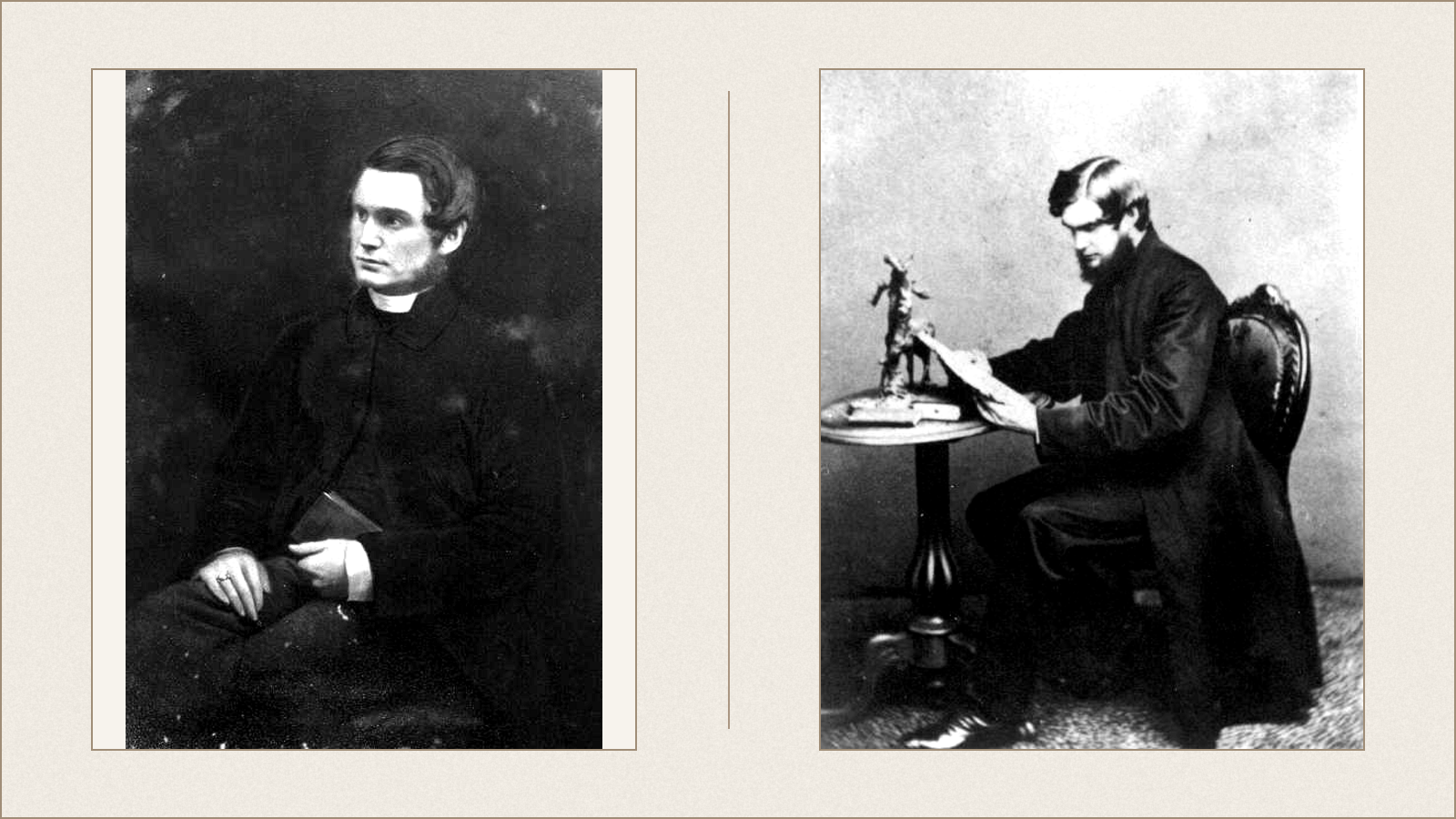
John Cartwright Jones never became a bishop, a celebrated theologian or a national figure. His clerical career was spent in three comparatively small English parishes, and his life ended before he reached his forty-fourth birthday. No substantial collection of his correspondence has yet been identified, nor did he leave behind the published scholarship that would ordinarily secure a Victorian clergyman a place in public memory. Yet obscurity is not the same thing as insignificance.
John belonged to a family moving between several worlds. His father had risen through the London legal profession before establishing Glandwr Hall near Barmouth. John received the education expected of a gentleman, attending Merchant Taylors’ School and Christ Church, Oxford, before entering the Church of England. His marriage connected the family with the professional society of Nottinghamshire, while his nine children would eventually carry the Glandwr inheritance into medicine, commerce, maritime service, the Church, professional sport and the wider British world.
New evidence also gives us a clearer view of John himself. The records of his appointment to Shelton show that his father, William Jones of Crosby Square and Glandwr, acted as patron when he was presented to the rectory in 1863. Eight years later John added his name to a national clerical remonstrance arising from the controversial Hebbert v. Purchas judgment, defending a measure of liturgical liberty within the Church of England. Neither discovery turns him into a great ecclesiastical figure, but both take us beyond the bare outline of an Oxford-educated country rector.
His importance lies partly in position. He stood between the generation that created the Glandwr estate and the generation that dispersed across Britain, Australia and the United States. His was a short life, but one situated at a revealing point in the transformation of a Victorian family.
Bishopsgate and the making of the Jones family
John Cartwright Jones was born on 21 February 1831 in Bishopsgate, at the centre of the commercial City of London. He was the second son of William Jones and Hannah Cartwright.
His father’s life represented a striking journey from Welsh origins into metropolitan professional success. William had been born in Dolgellau in 1792 and moved to London, where he established himself as a solicitor. In 1839 he entered partnership with George Blaxland, creating the legal practice of Jones and Blaxland. He later became a Commissioner for administering oaths in the Court of Chancery.
William’s marriage to Hannah Cartwright in 1821 strengthened his place within respectable London society. Hannah’s father, Thomas Cartwright, had been born in Denbighshire but settled in London during the eighteenth century. He became a successful builder and served on the City of London Common Council.
John was therefore born into a household that combined Welsh ancestry with established metropolitan connections. His father was not an aristocrat, but neither was John’s childhood one of insecurity. William’s profession, property and civic standing enabled the family to inhabit the upper reaches of the expanding nineteenth-century middle class.
In its entry for John, Joseph Foster’s Alumni Oxonienses described his father as armiger, conventionally abbreviated to arm., indicating the recognised status of a gentleman. This did not amount to a hereditary title. It did, however, reflect how far William had moved from provincial beginnings into professional and social respectability.
The creation of Glandwr
The family’s continuing Welsh identity found physical expression in Glandwr Hall.
Around 1832, William Jones began acquiring land outside Barmouth, overlooking the Mawddach estuary. Glandwr Hall, initially known as Glandwr Villa, had been completed by 1837. William gradually expanded the estate, adding farms and other properties until he became one of the larger landowners in the locality.
Glandwr was not the survival of an ancient family seat. It was a nineteenth-century creation, built from the proceeds of professional success in London. That distinction matters. For families such as the Joneses, a country house could turn financial achievement into territorial identity. Land suggested permanence. It connected a family with a locality, supplied the social standing associated with estate ownership and allowed wealth earned in the professions to assume the outward form of gentility.
John grew up within this developing family identity. His daily life belonged principally to London and later to England’s educational and clerical institutions, but Glandwr provided a Welsh centre around which the family’s memory and status could be organised.
It would be romantic to claim more than the evidence allows. We do not know how well John spoke Welsh, how frequently he visited Glandwr as a young man or precisely how he understood his national identity. What can be established is that the estate remained important to the family and that Wales ultimately became the place of his death and burial.
Merchant Taylors’ School
In 1838, when he was approximately seven years old, John entered Merchant Taylors’ School in London.
The school had been founded in the sixteenth century by the Merchant Taylors’ Company and had long educated boys from the City’s mercantile and professional families. Its classical curriculum prepared pupils for university, the learned professions and service within the Church.
John’s admission says something about both resources and intention. He was being prepared from childhood for a life founded upon education rather than trade. For a successful solicitor such as William Jones, the education of a son at Merchant Taylors’ and Oxford was also a way of ensuring that the family’s advance did not end with one generation.
Victorian social mobility rarely meant escaping hierarchy altogether. More often it meant acquiring the education, qualifications, connections and habits that allowed a family to move securely within it. John’s schooling formed part of that process.
Christ Church, Oxford
John matriculated at Christ Church, Oxford, on 31 May 1849, aged eighteen. He graduated Bachelor of Arts in 1853 and proceeded to the degree of Master of Arts in 1856. The 1851 census gives a particularly useful glimpse of him in the middle of those university years. On the night of 30 March he was resident at Christ Church itself, recorded as “John C. Jones”, aged twenty, unmarried, an undergraduate and born in London. The entry places him not simply on a university register, but within the collegiate household in which he was then living and studying.
Christ Church was among Oxford’s most prestigious foundations. It was both a college and the site of Oxford Cathedral, joining academic life to the institutional world of the Church of England. For a young man considering ordination, it offered an environment in which education, theology and clerical vocation naturally met.
John’s university years also fell within the long aftermath of the Oxford Movement. John Henry Newman had entered the Roman Catholic Church in 1845, four years before John matriculated, but the arguments associated with Newman, Edward Bouverie Pusey, John Keble and their contemporaries had by no means disappeared. Questions of liturgy, ecclesiastical authority, tradition and the Catholic inheritance of Anglicanism remained deeply contested.
For a long time it was possible to do little more than place John within that atmosphere. His Oxford education did not tell us whether he was Tractarian, evangelical, High Church or simply conventionally Anglican. A piece of evidence from 1871 now allows a little more to be said, although not enough to force him into a neat theological category.
Ordination and the beginning of ministry
John entered ordained ministry in 1854. The surviving biographical evidence indicates that he was made deacon that year while serving at Breaston in Derbyshire, and was ordained priest by the Bishop of Lichfield in 1855. He remained at Breaston until 1857.
The distinction is worth making. Anglican ordination normally proceeded in two stages, first to the diaconate and then, after a period of service, to the priesthood. John’s early career followed that conventional route.
A curacy was the practical apprenticeship of a Victorian Anglican clergyman. The curate assisted the incumbent while learning the daily realities of parish ministry. His duties could include preaching, visiting the sick, preparing candidates for Confirmation, teaching children and conducting baptisms, marriages and burials. Breaston was still predominantly rural, although the wider Midlands were already being reshaped by transport, manufacturing and urban growth.
No detailed account of John’s work there has been located. It would therefore be unsafe to invent particular reforms or pastoral achievements. His three years at Breaston nevertheless gave him the experience required to move from an assistant ministry to an incumbency of his own.
Thrumpton
In 1857 John became perpetual curate of All Saints’ Church at Thrumpton in Nottinghamshire, remaining there until 1863. The 1861 census catches him there before his marriage, recorded as “John C. Jones”, aged thirty, unmarried, born in London, Middlesex, with his occupation given plainly as “Incumbent of Thrumpton”. It is a small entry, but an important one, placing him physically within the parish he served rather than leaving the appointment as a name and date in a clerical register.
Thrumpton was a small estate village south-west of Nottingham. Its social world remained shaped by agriculture, landownership and the close relationships of a relatively contained rural community. The incumbent occupied a recognised place within that order, standing between landowners, parish officers, labouring households and the institutions of the Church.
Such ministries were built upon repetition rather than spectacle. Sunday services, baptisms, weddings, funerals and visits to the sick formed the ordinary rhythm of clerical life. The incumbent was also expected to support education, charity and respectable conduct. Much of this work left little trace unless something went wrong, which is one reason the lives of competent rural clergy can be surprisingly difficult to reconstruct.
A local tradition associates John with the establishment of Thrumpton Cricket Club. The club’s own historical account considers it strongly possible that the Reverend John Cartwright Jones was involved in its formation, but stops short of claiming documentary certainty. The possibility is attractive because cricket would later become central to the life of John’s son Arthur. It also fits a wider Victorian culture in which village cricket could be encouraged by clergy and landowners as recreation, fellowship and orderly competition. Until direct evidence appears, however, John’s role should remain a plausible tradition rather than an established fact.
Marriage to Mary White
While at Thrumpton, John married Mary White at St John’s Church, Beeston, on 23 April 1862. She was the daughter of George Mills White, a Nottinghamshire surgeon, and was around eleven years younger than her husband.
The marriage united two branches of the Victorian professional middle class. John brought the standing of an Oxford-educated clergyman, a prosperous London legal family and the growing Glandwr estate. Mary came from a medical household rooted in the Midlands. This was the social world in which clergy, doctors and solicitors increasingly overlapped, their position resting less on noble birth than on education, qualification, income, property and conduct.
Their first child, William Henry Wescomb Jones, was born in February 1863. John and Mary’s marriage would last for less than thirteen years, yet nine children were born to them between 1863 and 1874. The household that developed around them was large even by the standards of the period, and the 1871 census shows that its running depended upon three resident female servants, a nurse, a cook and a housemaid.
The road to Shelton, and the hand of his father
John’s move to Shelton in 1863 can now be described much more precisely.
The induction mandates preserved in the Archdeaconry of Nottingham record that John Cartwright Jones, M.A., was presented as Rector of Shelton following the death of the previous incumbent, John Ince Maltby. The mandate was issued on 23 October 1863. More revealing still is the name entered under patron: William Jones of Crosby Square, London and Glandwr, Merioneth, John’s father.
This is direct evidence that family influence touched John’s clerical advancement. Patronage was a normal part of the nineteenth-century Church of England. The holder of an advowson, or right of presentation, could nominate a suitably qualified clergyman to a vacant living, subject to the Church’s formal processes. We do not yet know how William Jones came to exercise the presentation at Shelton, and a gazetteer of the early 1870s names G. Maltby as patron. It would therefore be unsafe to claim that the advowson permanently belonged to the Jones family. What the 1863 mandate does establish is that, on the occasion when John obtained Shelton, his own father was the presenting patron.
That does not make John unqualified. He had an Oxford degree, nearly a decade of clerical experience and six years as an incumbent at Thrumpton. It does, however, place his career more honestly within the structures of Victorian society. Merit and connection were not opposites. A man could be capable and still benefit from family resources, property and patronage.
The family left Thrumpton towards the end of 1863. A detailed later reconstruction of Arthur Owen Jones’s family history places John’s formal licensing at Shelton early in 1864, which explains the apparent difference between sources that date his rectorship from 1863 and those that associate the family’s arrival with the opening months of the following year.
A small parish and a substantial living
Shelton was tiny. John Marius Wilson’s Imperial Gazetteer of England and Wales, published in the early 1870s, recorded a parish of 740 acres, only 127 inhabitants and 27 houses. Against that scale, the value of the rectory is striking. The living was put at £322 a year.
It was therefore a substantial clerical position in relation to the size of the community. John was not administering an urban mission or struggling through a poorly paid curacy. By his early thirties he had reached a secure rural rectory with income, residence and social standing. The 1871 census makes that world tangible. John and Mary lived at the rectory with their children and three unmarried servants, separately identified as nurse, cook and housemaid.
Domestic service should not be treated merely as a sign of comfort. With a rapidly expanding family, it was part of the machinery that made rectory life possible. The presence of a nurse also reminds us how much of the daily burden of childcare and household management fell within a female domestic world that conventional clerical biographies barely mention.
The church itself was changing during John’s incumbency. The surviving architectural history records heavy restoration, partial rebuilding and lengthening of the chancel beginning in the period 1868–78, with a north vestry added as part of the same broad campaign. The work continued beyond John’s death and there is presently no evidence that allows the scheme to be attributed personally to him. Nevertheless, the physical setting of his ministry was not static. The medieval parish church was undergoing the sort of Victorian alteration occurring across England during precisely these years.
The Purchas controversy, a glimpse of the churchman
The most revealing evidence yet found for John’s ecclesiastical outlook dates from 1871.
That year his name appeared among the clergy who signed a national remonstrance to the archbishops and bishops of the Church of England following the Judicial Committee of the Privy Council’s decision in Hebbert v. Purchas. The case formed part of the long nineteenth-century conflict over ritual, rubrics and the extent to which civil courts should determine lawful practice within the Established Church.
The particular point addressed by the remonstrance concerned the position of the minister during the Prayer of Consecration at Holy Communion. The signatories argued that the relevant rubrics had long been observed in differing ways and that the Judicial Committee had imposed an unduly restrictive interpretation upon a usage that had existed within the Church of England for generations. They appealed to the bishops to preserve the Church’s traditional breadth and what they called its “ancient liberty”. Among the names appears, without ambiguity, “Jones, John Cartwright, M.A., Rector of Shelton, Notts.”
This does not prove that John was a ritualist, an Anglo-Catholic or a committed Tractarian. The remonstrance itself attracted clergy of differing positions, and some signatories made clear that they were not personally affected by the disputed practice. Nor does it tell us how John conducted worship at Shelton. What it does prove is more modest and, for that reason, more useful. He was willing to associate his name publicly with clergy who believed that judicial intervention had narrowed legitimate Anglican practice too far.
That is the first direct evidence yet found of John taking a position in one of the major ecclesiastical disputes of his generation. It also gives greater substance to the Oxford background of his youth. We need no longer rely entirely upon the fact that he happened to be educated in an Oxford still living with the consequences of the Tractarian controversy. By 1871, as a mature rector, he had chosen to speak, however quietly, on the side of liturgical latitude and ecclesiastical comprehensiveness.
The children of Shelton Rectory, and what became of them
John and Mary’s children were born in quick succession. William Henry Wescomb arrived in February 1863, Mary Gertrude on 13 July 1864, Thomas Howel in 1865, John Llewelyn in 1866, Hugh Trevor in 1867, Christopher Lloyd in 1869, George Herbert in 1871, Arthur Owen in 1872 and Francis Horace in February 1874. The sequence is worth stating carefully, because John Llewelyn has sometimes been assigned to 1864, creating an impossible overlap with Mary Gertrude. Eight of the nine children were born during the Shelton years.
When their father died in January 1875, none of them had reached adulthood. The eldest was eleven and Francis was still an infant. Their futures therefore depended heavily upon Mary and upon the wider resources of the Jones family. The clearest evidence of that support came after the death of their grandfather William Jones in 1882. William Henry Wescomb was already a pupil at Christ’s Hospital in London, and William’s will left Mary an investment of £6,000, the annual income from which was expressly intended for the education of John Cartwright Jones’s children. She also received £100 in her own right. It is difficult to overstate the importance of that provision. The children did not simply inherit a social name. Money was deliberately set aside to give them the education required for professional careers.
William Henry Wescomb Jones, the eldest, was one of the chief mourners at his grandfather’s funeral in Llanaber in 1882. In September 1884 he left Britain for Texas, part of a broader movement that would take several of the brothers away from the Bedford household. He lived first around Marlin and later in Waco, working as a bank clerk and bookkeeper. He married twice and raised a family in Texas. His life was not publicly spectacular, but it was representative of a type of late Victorian migration in which education, literacy and commercial experience could be carried into the rapidly developing towns of the United States.
Mary Gertrude Jones, the only daughter, remained in England. On 26 April 1888 she married the Reverend Lewis Henry Pearson at St Paul’s, Bedford. Pearson combined education with the Church, teaching at Bedford Modern School before becoming headmaster of Amersham Grammar School and then Market Bosworth Grammar School, where Arthur Owen Jones was later educated. Lewis was killed in June 1926 when his motorcycle collided with a bus while he was travelling to conduct Sunday worship, and Mary was subsequently awarded £1,000 in damages. Their five children carried the family into another generation. Their son Lewis Howel Pearson became an Anglican priest and moved to South Africa in 1922, while their daughter Monica Howel Pearson received an RSPCA bronze medal in 1939 after climbing a sixty-foot tree to rescue a kitten. Through Mary, the clerical tradition of her father continued in another branch of the family.
Thomas Howel Jones also crossed the Atlantic in 1884. He settled in Texas and eventually established himself as the owner of a hardware business at Waxahachie. He married there in 1902 and had three children. Like his elder brother William, Thomas belonged to the commercial rather than professional side of the family’s dispersal. The move from a Nottinghamshire rectory to a Texas hardware business might appear a dramatic social change, yet it rested upon the same underlying inheritance of education, capital and confidence.
John Llewelyn Jones has emerged as the most interesting of the Texas brothers. A family account written by his son, J. L. Jones Jr., for a history of Coleman County in 1985 contains several errors about his English birth and parentage, and must therefore be used with care. Its account of his American years is nevertheless detailed. It records that after emigrating in 1884 he spent time in Austin, worked around the temporary Texas State Capitol, and later became a reporter and proofreader on a Dallas newspaper. He eventually chose medicine, entered the University of Virginia Medical School in the 1890s, and practised at Groesbeck and Gatesville. He served as physician to the State Reformatory for Boys and to the Cotton Belt Railroad before moving to Talpa in 1904, where he continued in practice until his death in 1940. He married Mary Irene Smith Partridge in 1898. The Coleman County account states that they had four children, two of whom died young. It also credits John with service as Texas State Librarian and State Chemist, but because those claims sit uneasily with the official chronology and the same account is demonstrably wrong about his English background, they are best left unproven.
Hugh Trevor Jones followed an entirely different route. He entered the Merchant Navy, qualifying as Second Mate in 1890, First Mate in 1892 and Master in 1895. By 1900 he was in Australia, where on 23 November he married Caroline Annie Spedding Brown, known as Daisy, at St Stephen’s Church in Sydney. The marriage notice explicitly identified him as the fourth son of the late Reverend John Cartwright Jones of Shelton and Mary Jones of Bedford. Hugh remained in Australia, where he was associated with government meteorological work and later became established in the pastoral world of New South Wales. Australian notices at the end of his life described him as a well-known pastoralist, formerly of Cooerwull, Bowenfels, where he had lived for more than thirty years. He and Daisy had four children. In his case, the son of an English rector had moved through maritime service into a distinctly Australian rural life.
Christopher Lloyd Jones chose medicine. He qualified in 1893 and built his career at Dunstable in Bedfordshire, where local records identify him as a surgeon of Lanark House. Unlike several of his brothers, he did not emigrate and appears to have spent his professional life within one community. He never married and had no children. His career was quieter than John Llewelyn’s in Texas, but it illustrates another important strand within the family, the movement into medicine and the respectable provincial professions.
George Herbert Jones initially followed Hugh to sea. He became a Second Mate in 1891, First Mate in 1893 and Master in 1894, but left the Merchant Navy in 1900 and moved into stockbroking on the London Stock Exchange. The First World War took him back to maritime service, when he commanded troop ships. After the war he became involved in the interests of former servicemen and during the 1920s served as chairman of the Redhill branch of the British Legion. He had three children. Family research has long credited George with sinking a German submarine during the war. That story is intriguing, but until an Admiralty or contemporary operational record is found it should remain a family tradition rather than an established fact.
Arthur Owen Jones, born at Shelton Rectory on 16 August 1872, became by far the best-known of the nine children. He attended Bedford Modern School and Market Bosworth Grammar School before entering Jesus College, Cambridge, and went on to represent Cambridge University, Nottinghamshire and England at cricket. He scored 22,935 first-class runs, captained Nottinghamshire from 1901, led the county to the Championship in 1907, and captained England during the 1907–08 tour of Australia. His unbeaten 296 against Gloucestershire in 1903 was then the highest score made by a Nottinghamshire batsman. Arthur’s career, his Welsh family background and the wider Jones enthusiasm for cricket are considered in full in my separate essay, Arthur Owen Jones: The Welsh Cricketer Who Captained England.
Francis Horace Jones, the youngest child, most directly continued his father’s vocation. He studied at Emmanuel College, Cambridge, from 1897 to 1900 and was sufficiently accomplished at rugby to win his university blue in 1898, 1899 and 1900, serving for a time as captain of the side. Ordained in 1900, he began as curate of Blyth in Northumberland before joining the Royal Navy as a chaplain in 1904. His naval ministry lasted for a quarter of a century. During the First World War he served aboard major warships, including Admiral Jellicoe’s flagship HMS Iron Duke, and in 1919 was appointed an Officer of the Order of the British Empire for services connected with the war. He later served at the Royal Hospital School and, from 1928 to 1931, was Vicar of St Helen’s Church, Ashby-de-la-Zouch. He married but had no children.
Taken together, the nine children show what became of the world that John and Mary had created at Shelton. Three sons made permanent lives in Texas, Hugh crossed into the Australian pastoral world, two sons became doctors, two qualified as master mariners, Francis carried the clerical tradition into the Royal Navy, Mary’s descendants continued it in South Africa, and Arthur achieved national sporting fame. Their paths were individual, but they were not disconnected. Behind them stood Mary’s long widowhood, the educational fund created by their grandfather, and a family culture that treated education and professional advancement as normal expectations. John did not live to guide them into adulthood, but the social and material structure into which they had been born continued to shape what became of them.
Death at Tynycoed
John’s health was failing while he was still a relatively young man. He died on 13 January 1875 at Tynycoed, near the Glandwr estate at Barmouth. He was forty-three years old.
The precise medical wording deserves correction. Older family summaries have described his final illness as bronchitis accompanied by kidney disease. A detailed modern biographical study of Arthur Owen Jones, reporting from John’s death certificate, instead gives chronic bronchitis together with longstanding heart disease and lung damage. Until the original certificate is independently re-examined, that more specific transcription is preferable to repeating the kidney-disease version as established fact.
The description also suggests that John’s illness was not simply a sudden final attack. If the certificate has been transcribed accurately, he had been living with serious chronic disease for some time. That adds a quieter dimension to the last years at Shelton, when he was continuing parish work while the rectory household expanded almost annually.
The probate calendar makes the financial position more precise. John’s effects were valued at under £3,000, not exactly £3,000. On 20 February 1875 administration of those effects was granted at the Principal Registry to his widow, Mary Jones of Barmouth, described in the formal wording of the record as his relict. The entry independently confirms that he had died at Barmouth on 13 January and that his last clerical residence had been Shelton. It also shows that Mary was still at Barmouth a little over a month after his death. The distinction between a will being proved and administration being granted matters, because the calendar records the latter.
The surviving records allow that transition to be followed with unusual precision. Probate papers dated 20 February 1875 place Mary in Barmouth, close to the Jones family’s Welsh base. By 3 April she was paying annual rates of eighteen shillings on 15 Alexandra Road, Bedford. In less than three months she had gone from a Nottinghamshire rectory household headed by an established clergyman to widowhood, temporary refuge in Wales and the creation of a new home in Bedford for nine children.
That sequence deserves more attention than it usually receives. Victorian clerical status could look secure, but much of it was tied to office. A rector’s widow might retain family money and social connections, yet she could lose house, local position and the structure of parish life almost at once.
John was buried in the Jones family plot at Llanaber. His burial joined him physically to the estate and to the Welsh family identity his father had constructed beside the Mawddach. It should not be treated as proof that John regarded Wales as his only true home. His life belonged to several places, Bishopsgate shaped his childhood, Oxford his education, Nottinghamshire his marriage and ministry, and Glandwr his family inheritance. His burial at Llanaber gathered those different worlds into a single memorial landscape.
A Victorian parish clergyman
The surviving evidence still does not permit a detailed reconstruction of John’s personality. We do not know whether he was warm or reserved, an impressive preacher or an ordinary one, loved by his parishioners or simply respected by them. The temptation in family biography is to fill such silences with adjectives. They are better left as silences.
What can now be said is more substantial than before. His education and appointments demonstrate professional competence. His father’s role in the Shelton presentation shows that family patronage helped to create opportunity. The scale of the living and the servants at the rectory reveal the comfortable social world in which he ministered. His signature on the 1871 remonstrance shows that he was not entirely disengaged from the larger ecclesiastical arguments of his age.
None of this requires us to turn him into a “scholar priest”, a visionary or a forgotten theological giant. Historical biography is weakened, not strengthened, when ordinary distinction is inflated into greatness.
John’s genuine significance is more recognisable. He belonged to the Victorian parish clergy, one of the most widely distributed professional bodies in nineteenth-century Britain. Clergymen served communities in which the Church remained closely involved with education, charity, social discipline and the observance of life’s principal rites. Their work was local, repetitive and often poorly recorded, but it formed part of the institutional fabric of rural society.
John’s life allows us to examine that world through the history of one family, and to see how education, patronage, property, religion and professional ambition could reinforce one another.
The limits of paternal legacy
It is tempting to look at the accomplishments of John’s children and interpret them as evidence of his successful guidance. The chronology makes that difficult.
John died in January 1875. His eldest children were only eleven, and Francis, the youngest, was still an infant. The adult characters and careers of the children were formed largely after their father’s death.
Mary survived until 1920. Her widowhood lasted forty-five years, more than three times the length of her marriage. It was she who carried the immediate responsibility for holding the family together, overseeing education and enabling the children to enter adult life. The speed with which she established the household in Bedford suggests practical determination as much as family support.
The resources of the extended Jones family also mattered. The children were not starting again without money, connections or expectations. They belonged to a family that had invested heavily in education, professional standing and property. Those advantages did not determine what each child became, but they widened the range of choices available to them.
John’s legacy should therefore be expressed with care. He did not personally direct nine distinguished careers. He helped provide the social position from which they began, and his early death left much of the work of converting that inheritance into adult opportunity to Mary.
The Glandwr inheritance
John occupies a distinctive position within the history of the Jones family.
His father, William, transformed professional success into landed identity by constructing Glandwr Hall and expanding its estate. The newly identified Shelton record shows that William’s influence could also be exercised through ecclesiastical patronage, presenting his own son to a valuable rural living in 1863. John, in turn, translated part of the family inheritance into educational and clerical standing. His children then carried the family into a more mobile world, crossing oceans and entering professions that reached far beyond London, Nottinghamshire and Merionethshire.
This was not a simple movement from Welsh roots into English success. The pattern was more fluid. William left Wales for London and then reinvested his wealth in a Welsh estate. John was born and educated in England but remained connected to Glandwr. Three of John’s sons settled in Texas, another moved to Australia, and others served institutions extending across Britain and its imperial networks.
The family belonged simultaneously to locality and movement. Glandwr supplied a centre of memory, but it did not confine those associated with it. Its descendants became doctors, merchants, mariners, clergy and sportsmen precisely because the family had acquired the resources and confidence to operate beyond the estate.
A life between generations
John Cartwright Jones was not the commanding architect of a dynasty, nor was he a forgotten theological scholar awaiting rediscovery. He was an educated Victorian clergyman born into a family of growing wealth and status, whose life connected metropolitan professional society with rural Anglican ministry and a newly established Welsh estate.
We can now see that career more clearly. His father’s patronage helped place him at Shelton. The rectory gave him a comfortable position in a parish of barely more than a hundred people. His household depended upon the labour of resident servants. His parish church was entering a period of Victorian alteration. And in 1871, amid the disputes that followed the Purchas judgment, he chose to place his name among clergy defending room for differing liturgical practice within the Church of England.
His death at forty-three interrupted a life that might still have developed in other directions. It deprived nine children of their father and left Mary with the greater part of the work of raising them. Within weeks she had begun rebuilding family life in Bedford, while the educational and social foundations created by the wider family continued to bear fruit.
John’s story is therefore one of connection rather than celebrity. Through him, the London solicitor’s household entered Oxford and the Church. Through his father’s presentation to Shelton, professional wealth touched the old machinery of ecclesiastical patronage. Through his marriage, the family joined the professional society of Nottinghamshire. Through his burial, it returned to the landscape of Glandwr. Through his children, it travelled onwards to Texas, Australia, the Royal Navy, medicine, commerce and the playing fields of international cricket.
He lived for only forty-three years, but his life stood at the meeting point of several generations. That is his place within the Glandwr inheritance, not its greatest public figure, but one of the bridges by which the family passed from Victorian ambition into a wider world.
Related Books
William Jones of Glandwr Hall: Law, Authority, and the Making of a Victorian Life
For the life of John’s father and the creation of the Glandwr family’s legal, civic and landed position.
Kindle · Paperback
Old Llyfnant Valley Farming Families
This wider family history places John Cartwright Jones within the broader Jones of Glandwr story and its Merionethshire setting.
Kindle · Paperback
Arthur Owen Jones (1872–1914): England Captain, Gentleman Amateur, and the Fragility of Edwardian Greatness
For the full story of John’s son Arthur, whose sporting career carried the family into national prominence.
Kindle · Paperback
Related Essays
- The Women of Glandwr: Kinship, Household and Inheritance in a Victorian Welsh Family
- Athelstan Jasper Blaxland (1880–1963): A Glandwr Descendant and a Surgeon Through Two World Wars
- John Howel (c.1765–1835): The Woollen Manufacturer Behind the Jones Family of Glandwr
- Gatty Wynne Jones (1859–1913): From Melbourne and Glandwr to the American Banjo
Explore more family and Glandwr history
Continue with the Jones Family of Glandwr Hall, or browse Family History & Genealogy.
Receive new historical essays by email
For new essays on Welsh history, biography, genealogy and rural community life, subscribe on the homepage.
Sources and Further Reading
- Joseph Foster, Alumni Oxonienses: The Members of the University of Oxford, 1715–1886, entry for John Cartwright Jones, recording matriculation at Christ Church on 31 May 1849, B.A. 1853, M.A. 1856, and his clerical appointments. Digitised entry.
- 1851 Census of England, Christ Church College, Oxford, John C. Jones, aged 20, unmarried undergraduate, born London, HO 107/1728.
- Merchant Taylors’ School Register, entry for John Cartwright Jones.
- 1861 Census of England, Thrumpton, Nottinghamshire, John C. Jones, aged 30, unmarried, “Incumbent of Thrumpton”, born London, Middlesex, RG 9/2444.
- University of Nottingham, Manuscripts and Special Collections, Archdeaconry of Nottingham, Abstracts of names of clergymen, taken from Induction Mandates, especially AN/IM 213/190, 23 October 1863, recording John Cartwright Jones as Rector of Shelton, the death of John Ince Maltby, and William Jones of Crosby Square and Glandwr as patron; and AN/IM 214/1/90, 17 April 1875, recording the appointment of John Forbes St Maur Russell following Jones’s death. University of Nottingham appendix.
- An Alphabetical List of the Signatures to a Remonstrance Addressed to the Archbishops and Bishops of the Church of England on Occasion of the Report of the Judicial Committee of the Privy Council in Re Hebbert v. Purchas (London, 1871), including “Jones, John Cartwright, M.A., Rector of Shelton, Notts.” Project Canterbury transcription.
- John Marius Wilson, Imperial Gazetteer of England and Wales, entry for Shelton, Nottinghamshire, recording 740 acres, population 127, 27 houses and a rectory valued at £322. A Vision of Britain through Time.
- 1871 Census of England and Wales, Shelton Rectory, Nottinghamshire, for the Jones household and resident nurse, cook and housemaid.
- Southwell & Nottingham Church History Project, St Mary and All Saints, Shelton, for the architectural history of the church and the chancel restoration and rebuilding of 1868–78. Church history.
- Association of Cricket Statisticians and Historians, Famous Cricketers, No. 63: A. O. Jones, especially the family history material concerning John Cartwright Jones, the corrected chronology of the children, the 1871 rectory household, William Jones’s £6,000 educational provision for his grandchildren, Mary Jones’s move to Bedford and the later movements of the four eldest sons. Family background and later family history.
- Principal Probate Registry, National Probate Calendar, 1875, entry for the Reverend John Cartwright Jones: administration granted 20 February 1875 to Mary Jones of Barmouth, widow, following his death at Barmouth on 13 January 1875; effects under £3,000.
- J. L. Jones Jr., “John L. and Mary Irene Jones Family”, in A History of Coleman County and Its People (1985), for the Texas career of John Llewelyn Jones. The account is especially valuable because it was written by his son, although its statements about John’s English birth and parentage contain errors and have therefore been treated cautiously. Coleman County family history.
- Australian newspaper records available through Trove, including the marriage notice for Hugh Trevor Jones and Caroline Annie Spedding Brown in Sydney in 1900 and later notices describing his life in New South Wales. Marriage notice.
- Association of Dunstable Charities, historical material identifying Christopher Lloyd Jones as a surgeon of Lanark House, Dunstable. Charity history.
- Supplement to the London Gazette, 3 June 1919, recording the appointment of the Reverend Francis Horace Jones, M.A., R.N., as an Officer of the Military Division of the Order of the British Empire for services connected with the First World War. London Gazette.
- St Helen’s Church, Ashby-de-la-Zouch, historical list of clergy, recording Francis Horace Jones as Vicar from 1928 to 1931. St Helen’s clergy.
- Bedford parish marriage records, including the marriage of Mary Gertrude Jones and Lewis Henry Pearson at St Paul’s, Bedford, on 26 April 1888. Marriage index.
- All Saints’ Church, Thrumpton, historical succession of incumbents, confirming John Cartwright Jones’s service from 1857 to 1863.
- Thrumpton Cricket Club, “From the Archives, Wisden Cricketer of the Year, Arthur Owen Jones”, for the local tradition associating John with the origins of the club. Club history.
- Parish register for St John’s, Beeston, Nottinghamshire, marriage of John Cartwright Jones and Mary White, 23 April 1862.
- Civil registration and death-certificate material relating to John Cartwright Jones, including his death on 13 January 1875.
- Cricket reference works and career records for Arthur Owen Jones, including Wisden and ESPNcricinfo.
- Antony David Davies, Old Llyfnant Valley Farming Families: Including the Jones Glandwr and Davies Caeadda Families (2015), especially the Jones family and Arthur Owen Jones sections.
- Antony David Davies, William Jones of Glandwr Hall: Law, Authority, and the Making of a Victorian Life, for the wider legal, civic and landed history of the family.
- Antony David Davies, “Arthur Owen Jones: The Welsh Cricketer Who Captained England”, for a fuller account of John and Mary’s seventh son and the family’s cricketing tradition. Read the essay.