
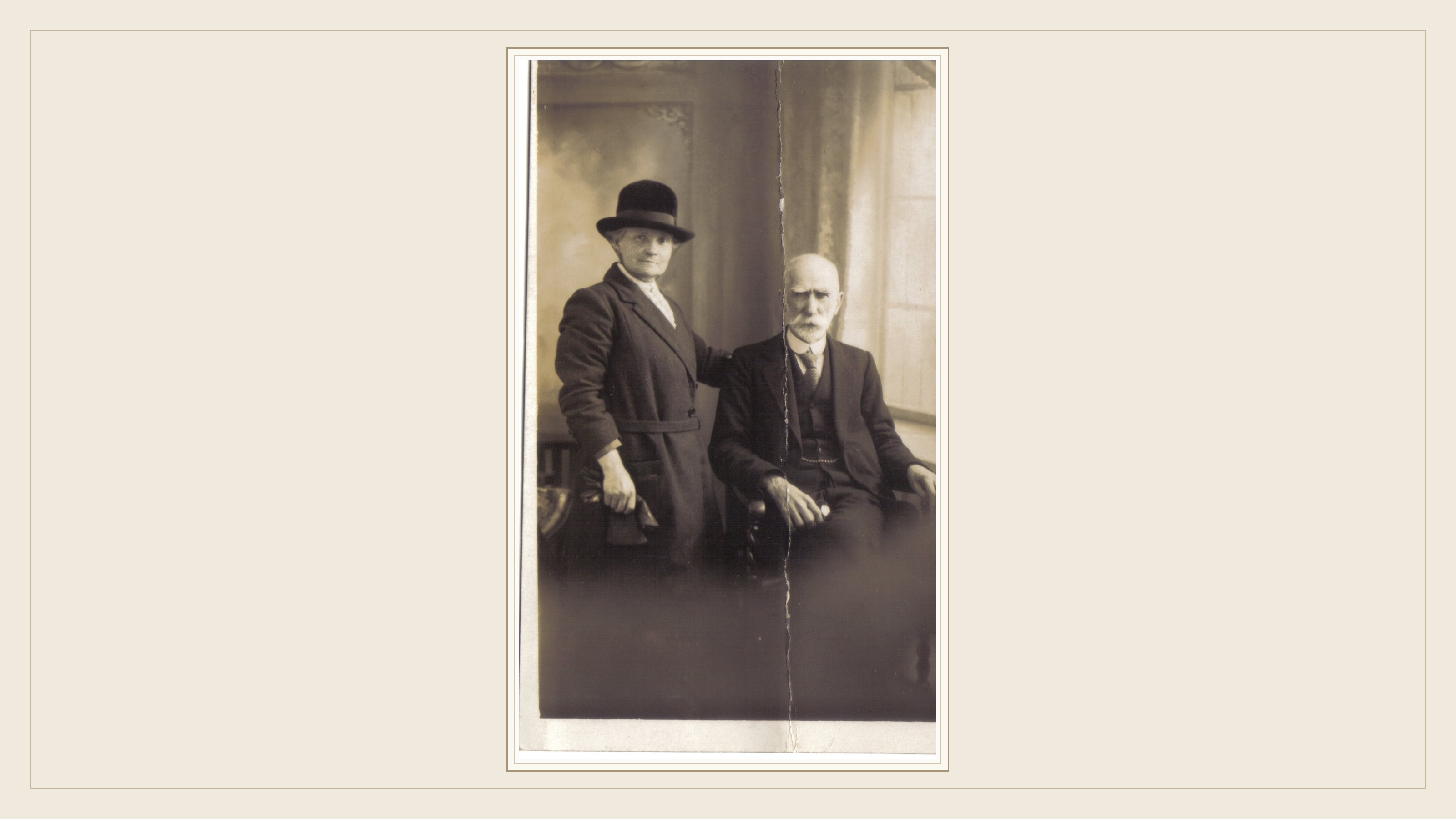
In September 1909, Penlan, a substantial sheep farm in the hills above Ceinws, was offered for sale. Its 866 acres included mountain grazing, arable land and woodland, together with the farmhouse and agricultural buildings. The annual rent was £100, a considerable sum for a farm in western Montgomeryshire during a period when agriculture had been under pressure for several decades.
The farmer was Thomas Davies, who had moved to Penlan from Caeadda, Llanwrin, some twelve years earlier. He had taken over the holding as an unmarried man in his early thirties and established himself as a successful sheep farmer. By the Edwardian period he was also known through his work on Llanwrin Parish Council, the local school, agricultural shows and the administration of poor relief.
His life was closely connected with the changing circumstances of farming in Victorian and Edwardian Wales. He belonged to a generation which had inherited the knowledge and traditions of the older upland agricultural economy, but which also experienced the sale of landed estates, changes in local government, the difficulties of agricultural depression and the demands of the First World War.
Thomas was my great-uncle, an elder brother of my grandfather Griffith Llewellyn Davies. I first investigated his life while reconstructing the history of the Davies family of Caeadda, and subsequently included his story in my studies of the older farming families of the Llyfnant Valley.
The surviving evidence allows considerably more to be recovered than the outline of a farmer who occupied two properties. It reveals a man whose farming career, public responsibilities and family circumstances provide a useful insight into the life of rural Montgomeryshire during a period of considerable change.
The Davies Family of Caeadda
Thomas Davies was born at Caeadda on 13 February 1864, the son of Thomas Davies (1827–1891) and Gwen Jones (1841–1926).
The family had been associated with Caeadda since the eighteenth century. Successive generations had occupied the farm, first as tenants and eventually as owners, developing close connections with other agricultural households in Llanwrin and the surrounding district.
Thomas’s mother, Gwen Jones, had been born in Liverpool in January 1841, although her family connections lay firmly in Montgomeryshire. She was a granddaughter of John and Gwen Jones of Esgair Llewelyn, an old farmhouse whose history extended back several centuries. Her marriage to Thomas Davies at Llanwrin parish church on 22 June 1859 brought together two established farming families.
Caeadda was a substantial holding. Its economy depended upon sheep, cattle, agricultural labour, woodland and the careful management of land in a district where weather and terrain frequently determined the success of the agricultural year.
Thomas grew up as one of twelve children. The size of the household meant that family labour was particularly important, while the older children were expected to acquire the practical knowledge which would allow them to earn their living in agriculture or elsewhere.
His early life belonged to a period when formal education was becoming increasingly accessible in rural Wales. Llanwrin’s National School opened in 1876, when Thomas was twelve. The school provided local children with opportunities which earlier generations had not always enjoyed, although the demands of farming continued to influence the working lives of young people.
The surviving records do not establish precisely how Thomas was educated. What is clear is that he remained closely associated with Caeadda during his youth and entered the family occupation.
His father and grandfather were both experienced farmers, and Thomas would have grown up in an environment where agricultural knowledge was passed from one generation to another through daily work. Sheep husbandry, grazing, harvesting and the maintenance of buildings and boundaries were practical skills which could not be learned simply from books.
By the time Thomas reached adulthood, he was part of an extensive family whose members would pursue occupations in farming, business and professional life. Several eventually established themselves on separate farms, while others sought opportunities away from Montgomeryshire.
The Death of His Father and Changes at Caeadda
Thomas’s father died at Caeadda in March 1891.
The death brought a change in the management of the holding. His eldest brother, John Davies, succeeded their father as the principal farmer, working alongside their mother Gwen.
John became well known for his ability with sheep and sheepdogs, winning prizes at local agricultural shows. He was also involved in the musical life of Llanwrin, conducting the local glee club and taking part in community gatherings.
Thomas remained at Caeadda during these years, working with his brother and contributing to the agricultural business.
The arrangement could not continue indefinitely. With several sons in the family, there was a limit to the number who could establish independent livelihoods upon a single holding. The younger men needed opportunities elsewhere, whether through employment, marriage or the acquisition of farms of their own.
By the middle of the 1890s Thomas was approaching his early thirties. He had considerable practical experience, but he remained a member of his brother’s farming household.
The opportunity to take over Penlan appears to have arisen during 1897.
This was an important turning point. Thomas was not merely moving to another farm as an agricultural labourer. He was assuming responsibility for a large upland holding and the financial obligations which accompanied it.
Penlan: A Farm Above Ceinws
Penlan stands high above Ceinws, near Esgairgeiliog, in the hills of western Montgomeryshire.
The farmhouse occupies an exposed position towards the head of Cwm Glesrych. Its walls were constructed largely from pale quartz stone, giving the building a distinctive appearance against the surrounding landscape. The holding extended into steep upland country where sheep grazing was an essential part of the agricultural economy.
A nineteenth-century farmer at Penlan would have been responsible for land extending far beyond the immediate farmhouse. The work involved managing grazing over considerable distances, maintaining fences and boundaries, watching livestock in difficult weather and moving animals between the mountain and lower ground according to the season.
The farm was already established before Thomas arrived.
The 1895 edition of Slater’s Directory of North and Mid Wales identifies John Tudor as the farmer at Penlan. The same directory names other Llanwrin farmers, including members of the Davies family at Caeadda and the occupants of Gwernstablau.
The Tudor family’s subsequent financial difficulties appear to have contributed to Penlan becoming available. My earlier family research records their bankruptcy in 1897, following a difficult period for the farming business.
The precise date on which Thomas took possession has not yet been established from a tenancy agreement, but the available evidence points towards the early months of 1897.
He was then thirty-three years old and unmarried.
This was a considerable undertaking. The occupation of such a large farm involved obligations for rent, rates, livestock, servants, repairs and agricultural equipment. Success depended not only upon practical knowledge but also upon sound financial management.
The Penlan holding was described in the 1909 sale particulars as extending to 866 acres. Much of this was suitable for sheep grazing, although the property also included arable land and woodland.
The buildings comprised the farmhouse, stables, cow houses, a wain house and a shed. These structures were essential to the operation of a mixed upland farm, providing accommodation for livestock, implements and the storage of agricultural produce.
Thomas’s annual rent was £100.
The amount gives some indication of the scale of his responsibility. A farmer occupying Penlan had to generate sufficient income to maintain the household, meet the rent and other charges, employ assistance where necessary and replace livestock lost through age, disease or adverse weather.
There was little room for prolonged failure.
An Unmarried Farmer and His Household
One of the interesting features of Thomas’s early occupation of Penlan is that he took over the farm before marrying.
For many farming families, marriage marked the establishment of an independent household. A farmer’s wife generally assumed substantial domestic and agricultural responsibilities, while children and other relatives eventually contributed to the working life of the holding.
Thomas’s circumstances were different.
He appears to have relied partly upon members of his own family to help maintain the household and undertake agricultural work.
His younger brother Owen Jones Davies was employed at Penlan from about 1897 until approximately 1902. Owen had previously spent time in London, where he was apprenticed in the drapery trade, but returned to Montgomeryshire and worked for Thomas before eventually emigrating to North America.
Owen was also a talented singer. Newspaper references from the early months of 1898 record his success in tenor competitions at concerts held in Ceinws. These gatherings formed part of the Welsh-language musical culture which remained important in the communities around Corris and Machynlleth.
The presence of Owen at Penlan is a reminder that the farm was not an isolated business operated by a single individual. It was connected with the movement of brothers, sisters and other relatives between households, occupations and districts.
Thomas’s younger sister Ellen Louisa Davies was also associated with Penlan. The 1901 census records her living there alongside Thomas and Owen. She may have been assisting with the domestic management of the household before her marriage to Robert Hughes of Tyddyndu later that year.
A further example appears in the 1911 census.
By then Thomas’s sister Jane, who had married William Nutting, was living at Penlan with her young daughter Gwen Jones Nutting. Jane was described as a dairymaid, while her husband was working on his grandfather’s farm at Dolwen.
These details reveal something of the practical arrangements through which extended farming families supported one another. The household at Penlan could accommodate relatives whose circumstances were changing, while those relatives provided labour and assistance within the agricultural business.
The distinction between family life and employment was often less clear than it became in later generations.
Sheep Farming and Agricultural Success
Penlan was principally a sheep farm, and Thomas’s success depended upon his ability to manage livestock in challenging upland conditions.
The sheep farmer’s year was governed by a succession of demanding tasks. Lambing required constant attention during the spring, while grazing, gathering, shearing, marking and preparing animals for market occupied much of the remainder of the year.
On a holding of Penlan’s size these activities could not be undertaken without considerable experience and, at certain times, assistance from neighbouring farmers.
Agricultural shows provided opportunities for farmers to compare their stock and demonstrate the quality of their breeding.
Thomas entered animals at local shows, although the surviving references suggest that he competed less frequently than his younger brother David of Caeadda.
At the Machynlleth Agricultural Show in August 1901 he won first prize for a Welsh yearling ram which had been grazed on the mountain between May and August.
The following August, at the Corris Show, he achieved first and second prizes with Welsh Mountain wethers.
These were meaningful successes. The animals were being judged by people familiar with the demands of local hill farming, and prizes offered recognition of a farmer’s husbandry and the quality of his livestock.
A surviving photograph of a shearing day at Penlan, probably taken between about 1905 and 1915, provides another valuable record of agricultural life at the farm.
The photograph shows a gathering of men connected with neighbouring farming families. Among those identified are William Davies of Esgair Llewelyn, David Davies of Caeadda and my grandfather Griffith Llewellyn Davies.
Such photographs are especially useful because they demonstrate the cooperative nature of the work. Farmers and experienced shearers frequently assisted one another during the shearing season, moving between holdings as the work required.
Penlan was therefore part of a larger agricultural community. Its sheep, fields and buildings belonged to one holding, but the labour upon which it depended connected it with farms throughout the surrounding district.
The relationship with the wider market economy was equally important. Sheep and cattle were sold through the fairs and markets of Machynlleth, where farmers met buyers, obtained supplies and conducted the business upon which their livelihoods depended.
The Sale of Penlan in 1909
The sale of Penlan in September 1909 took place during a period of substantial change in the ownership of agricultural land.
From the later nineteenth century onwards, the agricultural depression had placed pressure upon both tenant farmers and the owners of large estates. Falling agricultural returns reduced the rental income of landowners, while taxation, estate expenditure and changing financial circumstances encouraged many families to sell property which had remained in their possession for generations.
Across Montgomeryshire, farms which had traditionally formed parts of landed estates were increasingly offered for sale.
The occupation of these holdings did not necessarily change when they were sold. In some cases the existing tenant purchased the property, while elsewhere a new owner acquired the farm as an investment and retained the established occupier.
The Penlan sale particulars provide a particularly useful account of the holding at the height of Thomas’s agricultural career.
At 866 acres, Penlan was much larger than many of the family farms in the district. Its mixture of mountain grazing, cultivable ground and woodland reflected the nature of upland agriculture, in which apparently extensive acreage did not always translate into high financial returns.
The property was reportedly sold for £1,890.
It is possible that Thomas purchased it, although this has not been established from the conveyance or sale records. What is clear is that he continued to occupy Penlan after the transaction.
This distinction matters. It would be misleading to describe Thomas as the owner of Penlan without identifying the purchaser. The occupation of a substantial farm is well supported, but the question of ownership remains open.
The sale nevertheless places Thomas within a wider transformation in Welsh agriculture. The older relationship between great estates and their tenants was changing, and many farming families found themselves facing opportunities and obligations which earlier generations had not encountered.
Llanwrin Parish Council and Local Government
Thomas’s activities extended beyond the management of Penlan.
In April 1896 he was elected to Llanwrin Parish Council, and he was re-elected in April 1898.
Parish councils had been established under the Local Government Act of 1894 as part of wider reforms intended to provide rural communities with elected local institutions.
Their responsibilities varied, but they dealt with matters affecting everyday parish life, including local facilities, rights of way and aspects of community administration.
The elections brought farmers, tradesmen and other established local residents into formal positions of responsibility.
Thomas’s involvement is particularly interesting because it began shortly before he left Caeadda for Penlan. He had therefore already acquired sufficient standing within the locality to become involved in parish affairs while still associated with the family farm.
His election suggests that he was regarded as a suitable person to take part in local administration, although the surviving references do not establish his political opinions or the full extent of his activities on the council.
He was also involved in education.
Between approximately 1902 and 1907 Thomas served as one of the managers of Llanwrin National School, having been appointed through the parish council.
The position placed him within the local administration of an institution which had become increasingly important to farming families. Education was no longer solely a matter for churches and chapels. It was becoming part of a more extensive public system, with attendance, finance and the responsibilities of local authorities subject to greater regulation.
Thomas belonged to a generation which had grown up before these arrangements became firmly established, yet he was participating in their administration during the Edwardian period.
Poor Relief and Community Responsibility
Thomas was also appointed an Overseer of the Poor for Llanwrin.
The Machynlleth Board of Guardians appointed him in May 1905, and he received a further appointment in April 1916.
This was not simply an honorary office.
The old poor-law system depended upon a network of parish officials, guardians and other local administrators. Overseers were concerned particularly with the financial and administrative arrangements through which the parish contributed to poor relief.
The work could involve rates, records, payments and the wider administration of responsibilities which affected households in difficult circumstances.
In an agricultural district, the need for assistance could arise from illness, unemployment, old age, the death of a principal wage-earner or the loss of an ability to work.
The administration of relief consequently brought local officials into contact with some of the most difficult circumstances experienced by their neighbours.
Thomas’s appointment indicates the confidence placed in him by the authorities. He was a substantial farmer, accustomed to managing accounts and responsibilities, and had already served in other positions within the parish.
It also gives his biography a dimension beyond the boundaries of Penlan. He was participating in the institutions which helped determine how the community responded to poverty and hardship.
Chapel Life, Agricultural Shows and Public Meetings
Religion and public gatherings formed another part of Thomas’s life.
In December 1902 he was among the organisers of a concert held for the benefit of Sion Methodist Chapel in Llanwrin.
The chapel had longstanding associations with the Davies family of Caeadda. Such events were an important part of rural Welsh community life, combining fundraising with music, recitation and opportunities for local people to meet.
Thomas’s brother Owen had already appeared in musical competitions around Ceinws, while other members of the family were associated with choir singing and local eisteddfodau.
Thomas also served on the organising committee of the Corris Agricultural Show in August 1902 and again in August 1903.
This involvement was separate from his success as an exhibitor. Agricultural shows required local organisation, subscriptions, stewards, judges, prizes and arrangements for exhibitors and visitors.
Their committees were drawn from farmers and other residents prepared to undertake the necessary work.
During the First World War Thomas again appeared in connection with a public gathering.
On 1 December 1914 he was among those who organised a meeting at Pantperthog to allow a recruiting officer from Machynlleth to address young men of the district.
The meeting took place only a few months after Britain entered the war, when recruitment depended heavily upon public appeals and local organisation.
The surviving account establishes Thomas’s involvement in arranging the meeting, but it does not tell us what he said or reveal his wider opinions about the conflict.
Taken together, these activities place him among the farmers who helped sustain the public institutions and communal activities of western Montgomeryshire.
Marriage to Mary Davies
Thomas remained unmarried until comparatively late in life.
On 7 February 1911, shortly before his forty-seventh birthday, he married Mary Davies at the Congregational Chapel in Baker Street, Aberystwyth.
The witnesses were his younger brother David Davies and Hannah Breese.
Mary had been born in 1871 and belonged to another established Montgomeryshire farming family. Her parents were Edward Davies (1833–1904) and Ann Jarman (1838–1907).
Edward was originally from Llanfihangel-y-Creuddyn in Cardiganshire. Following his marriage he settled in the Llanwrin district and farmed Poisnant near Cemmaes.
Ann Jarman came from a prosperous farming family associated with Darowen.
Mary’s brothers also followed agricultural careers. John Davies farmed at Cwmllywi Isaf, David Jarman Davies succeeded their father at Poisnant, and Richard Davies farmed at Croft.
The marriage therefore brought together two farming families with substantial interests in the same part of Montgomeryshire.
By this time Thomas had occupied Penlan for approximately fourteen years. His marriage did not mark the beginning of his independent agricultural career, as was often the case for younger farmers. Rather, Mary joined a household and business which were already well established.
Her arrival would have altered the domestic organisation of Penlan, although the census evidence shows that other relatives continued to be associated with the household during this period.
The marriage also strengthened Thomas’s connections with the Davies family of Poisnant, which would become important in the administration of his estate.
The Loss of Their First Child
Thomas and Mary had two children.
Their first child, a daughter named Mary Davies, was born at Penlan on 10 April 1913.
She survived for only eleven days, dying on 21 April. Her death was attributed in the family research to spina bifida and epilepsy.
The loss was a severe beginning to the couple’s family life.
Thomas and Mary had married only two years earlier, and their daughter was born when Thomas was forty-nine. The death of an infant in such circumstances must have been difficult for the household, although no personal account of their bereavement has survived.
Infant mortality remained a familiar reality in early twentieth-century Britain, particularly where serious congenital conditions could not be treated effectively.
The experience belonged to a wider pattern of loss within the Davies family, but it should not be reduced to a general statistic. Mary had a name, a date of birth and a brief life which the surviving family records allow us to remember.
Three years later, on 30 March 1916, Thomas and Mary welcomed a son, Thomas Edward Davies.
He was also born at Penlan and would eventually become the next generation of the family’s farming history.
The Move to Gwernstablau
At some point between 1918 and 1924 Thomas left Penlan and moved to Gwernstablau, a smaller farm in Llanwrin parish.
The history of Gwernstablau had already been connected with his family long before he became its occupier.
His paternal grandmother, Anne Davies of Caeadda, had been a daughter of John and Mary Davies of Esgair Hir. Her brother David Davies (1771–1843) had farmed Gwernstablau during the earlier nineteenth century.
Thomas was therefore returning to a holding associated with an older branch of his own family.
The property had also been part of the estate of Sir Watkin Williams-Wynn.
In June 1917 Gwernstablau was included among the farms offered for sale as the estate’s holdings were dispersed. The farm, extending to approximately 89 acres, was purchased by John Reynolds of Carno for £1,650.
In April 1918 the existing tenant, Mrs Margaret Jones, held a sale of her livestock and farming implements.
This provides a possible indication of when the tenancy became available, although it does not prove the date upon which Thomas arrived.
There was a considerable difference between the two properties.
Penlan extended to 866 acres, much of it upland grazing. Gwernstablau was a substantially smaller holding.
It is reasonable to suggest that the move represented a reduction in the scale of Thomas’s agricultural responsibilities, although his precise reasons remain uncertain.
He was approaching his sixties, had a young family and had already spent many years managing the demands of a large mountain farm.
The change may have provided an opportunity to continue farming on a more manageable scale. It should not, however, be attributed directly to illness without further evidence.
What can be established is that Thomas and Mary settled at Gwernstablau, where the next generation of the family would remain for many years.
Illness and the Final Years
Thomas’s later years were affected by increasingly serious illness.
His death certificate records that he underwent a prostatectomy in 1924, apparently for enlargement of the prostate.
Such an operation was a substantial medical procedure during the early twentieth century. Recovery and subsequent health could vary considerably, and the surviving information does not establish how far the operation affected Thomas’s ability to continue managing the farm.
He made his will on 24 May 1924.
The proximity of the will to the period of his medical treatment is interesting, although there is insufficient evidence to establish that the operation directly prompted the document.
The following years appear to have been difficult.
Thomas eventually developed bladder cancer, and his final illness brought him to the Londonderry Cottage Hospital in Machynlleth.
He died there on 22 March 1930, aged sixty-six. His death certificate recorded bladder cancer and liver failure.
His death came at the end of a period in which the treatment of cancer remained extremely limited by modern standards. Although surgery and other interventions were available, advanced disease was frequently beyond the effective reach of contemporary medicine.
Thomas had spent more than thirty years farming independently, first at Penlan and subsequently at Gwernstablau.
The records of his final illness stand in marked contrast to those of his earlier years, when he had been managing a large upland property, competing successfully at agricultural shows and undertaking public responsibilities across the district.
His Will and the Family Estate
Probate was granted on 7 May 1930 to three executors.
They were Thomas’s brother David Davies of Caeadda, his nephew Trevor Owen Davies and his brother-in-law David Jarman Davies of Poisnant.
The selection is revealing. The administration of the estate was entrusted to men drawn from both sides of the family, including relatives with considerable agricultural experience.
Thomas’s estate was valued at £4,325 1s 7d.
The earlier family research records a lower net value of approximately £1,937 after deductions for debts, duties and other liabilities.
The difference should be kept in mind when considering the family’s financial position. A probate valuation does not necessarily represent money which could immediately be divided between the beneficiaries. Farming businesses involved livestock, equipment, property interests and financial obligations.
In his will Thomas directed that his estate should be divided equally between his wife Mary and their son Thomas Edward.
He described Mary as his “devoted wife.”
It is a brief expression, but an unusually personal one within the formal language of a legal document.
Mary survived her husband by a little more than seven years. She died on 13 June 1937.
She did not leave a will. Her personal estate was valued at £4,390 5s 1d, and administration was granted to her son Thomas Edward Davies on 1 October 1937.
Thomas and Mary were buried in the Nonconformist cemetery at Machynlleth.
Their graves were situated near members of Mary’s Davies family rather than among Thomas’s own relatives from Caeadda.
The arrangement reflects the family connections formed through their marriage, although the precise reasons for the choice of burial place are not recorded.
Thomas Edward Davies and the Continuation of Gwernstablau
The death of Mary in 1937 brought the family estate more fully into the hands of Thomas Edward Davies.
He was only twenty-one, but had grown up within the agricultural household at Gwernstablau and continued the farming occupation established by his father.
On 23 February 1939 he married Beryl Jones Davies, a farmer’s daughter, at Newtown.
The couple had one son.
Thomas Edward remained associated with Gwernstablau for the remainder of his life, continuing to farm there until his death in 1978.
His long occupation gives the property an important place in the history of the Davies family. What had begun as a move from a much larger holding during his father’s later years became the centre of the next generation’s working life.
The continuity also illustrates how family circumstances could alter the fortunes of a farm.
Penlan had been the scene of Thomas’s early independence and his greatest agricultural responsibilities. Gwernstablau, although smaller, became the property through which his family maintained its agricultural identity well into the twentieth century.
The Later History of Penlan
The subsequent history of Penlan adds another dimension to the story.
A local history compiled around Ceinws and Esgairgeiliog records that the farm continued to be occupied after Thomas’s departure.
Following the Second World War, Idwal Evans farmed at Penlan before moving to Esgairlwyd and later Brynmair. Photographs preserved within the local collection show Penlan during the 1940s and 1950s.
The land around the farm underwent considerable change.
Much of the former agricultural holding was sold to the Forestry Commission after the war, and extensive forestry planting gradually altered the appearance of the surrounding hills.
The farmhouse survived, with a smaller area of land retained around it.
This later development helps place Thomas’s occupation in perspective. The 866-acre sheep farm which he managed around the turn of the twentieth century belonged to a landscape whose economic use subsequently changed.
Land once devoted to the grazing of livestock became part of the forestry economy, while the old farmhouse remained as evidence of the agricultural community which had preceded it.
Penlan is therefore more than the former home of one farmer. Its history reflects the changing use of land in western Montgomeryshire, from the large upland sheep holdings of the Victorian period to the forestry landscapes of the twentieth century.
A Farmer Who Served His Community
Thomas Davies was not a nationally prominent figure. His importance lay in the agricultural and community life of the district in which he was born.
He grew up at Caeadda within a large farming family, acquired the practical skills necessary to manage a substantial holding and established himself at Penlan while still unmarried.
He became a successful exhibitor of Welsh Mountain sheep and undertook responsibilities extending beyond his own farm.
His service on Llanwrin Parish Council, his involvement with the local school, his appointments as Overseer of the Poor and his work for agricultural shows and chapel events place him among the men who helped administer and sustain rural society.
His career also illustrates the financial and social changes occurring in Welsh agriculture during the late Victorian and Edwardian periods.
The sale of Penlan in 1909 belonged to a broader transformation in the relationship between landowners and tenants. His later move to Gwernstablau reflected a different stage in his life, when the management of a smaller holding replaced the demands of an extensive mountain farm.
Marriage and fatherhood came comparatively late. He and Mary experienced the loss of their infant daughter, but their son continued the family’s farming interests long after both parents had died.
In researching Thomas, I have been particularly interested in the ways in which his life connects the history of several farms.
Caeadda was where he was born and learned agriculture. Penlan was where he established his independence and became a figure of some standing in the district. Gwernstablau was the farm of his later years and the home in which his son continued the family occupation.
These connections are also personal.
Thomas was my great-uncle, and his life forms part of the wider history of my own Davies family. The surviving documents, photographs and newspaper references provide a means of recovering something of the man behind the name, rather than simply recording his place within a family tree.
His story deserves to be remembered because it represents a world which has largely disappeared: a society of substantial upland sheep farms, closely connected agricultural families, chapel gatherings, parish administration and neighbouring cooperation.
It was through the working lives of men and women such as Thomas and Mary Davies that the communities of western Montgomeryshire maintained their continuity during a period of considerable economic and social change.
- Caeadda, Llanwrin: Three Centuries of Farming in the Montgomeryshire Uplands, the family farm where Thomas was born and learned agriculture.
- Gwen Jones of Caeadda, 1841–1926: A Welsh Farming Matriarch, the life of Thomas’s mother and the wider Davies family.
- Esgair Llewelyn: A Medieval Welsh Farmhouse and the Social History of a Llanwrin Family, another important family holding and the surviving Penlan shearing photograph.
- Machynlleth Fairs and Markets: Trade, Farming and Rural Life in Victorian and Edwardian Montgomeryshire, the market economy in which Thomas conducted his business.
- The Tragedy of Maescelyn: The Jenkins Family and the Loss of an Upland Farming Home, 1906–1913, farming and family continuity in the district.
- John Pugh of Glyncaerig (1834–1912): From Farm Labourer’s Son to Montgomeryshire Landowner, another substantial farmer of the same generation.
- Owen Jones Davies (1875–1958): From Caeadda to the Welsh Settlement of Wood River, Thomas’s brother Owen, who worked at Penlan before emigrating and establishing a farm in Alberta.
Continue with the Montgomeryshire History, Welsh Rural History, Family History & Genealogy and Victorian & Edwardian Wales guides, or browse the related essays above.
For new essays on Welsh history, biography, genealogy and rural community life, subscribe on the homepage.
Sources and Further Reading
The principal sources for this biography are my own family-history studies, The Davies Caeadda Family: A Welsh Farming Dynasty, 1700–1966, particularly the chapter on Thomas Davies, and Old Llyfnant Valley Farming Families, especially pp. 181–186. These works draw upon census returns, marriage and death certificates, probate records, family photographs, contemporary newspapers and local agricultural records.
The 1895 edition of Slater’s Directory of North and Mid Wales provides independent evidence of the earlier occupiers of Penlan and Gwernstablau. The Llanwrin farmers’ directory lists John Tudor at Penlan and Henry Thomas at Gwernstablau.
The 1909 sale particulars for Penlan, as reproduced in my family research, provide the acreage, description of the holding, agricultural buildings and annual rent. The identity of the purchaser remains to be established from the original sale or conveyance records.
Contemporary newspaper reports used in the earlier research include the Llanwrin Parish Council elections of April 1896 and April 1898; the Machynlleth Agricultural Show of August 1901; the Corris Show of August 1902; appointments associated with the local school and poor-law administration; and the Pantperthog recruiting meeting of 1 December 1914. The original reports and their precise page references should be checked again before final publication.
The marriage certificate of Thomas Davies and Mary Davies, dated 7 February 1911, identifies their marriage at the Congregational Chapel in Baker Street, Aberystwyth, with David Davies and Hannah Breese as witnesses.
The sale of Gwernstablau in June 1917 and the April 1918 dispersal of livestock and agricultural implements are recorded in the earlier family research. Although Thomas subsequently occupied the farm, the precise commencement of his tenancy remains uncertain.
The death certificate of Thomas Davies records his death at the Londonderry Cottage Hospital, Machynlleth, on 22 March 1930, together with the medical circumstances of his final illness. His will, dated 24 May 1924, and the probate grant of 7 May 1930 provide evidence of his estate and beneficiaries.
The later history of Penlan is documented by Ceinws Archive in Penlan Farm, Dyfi Forest, near Ceinws/Esgairgeiliog, with photographs by Ray Gunn, and in the local history of Esgairgeiliog and Ceinws, which includes material on Penlan after the Second World War.
Family photographs reproduced in Old Llyfnant Valley Farming Families include a portrait of Thomas Davies around 1910 and a photograph of Thomas and Mary taken during the late 1920s, both credited to Dafydd Pughe. The early twentieth-century shearing photograph at Penlan provides further evidence of the family and agricultural networks associated with the farm.
The family-history evidence establishes Thomas’s occupation of Penlan and Gwernstablau, but the purchase of Penlan in 1909, the precise date of his move to Gwernstablau and some details of his final farming arrangements remain open to further investigation.