
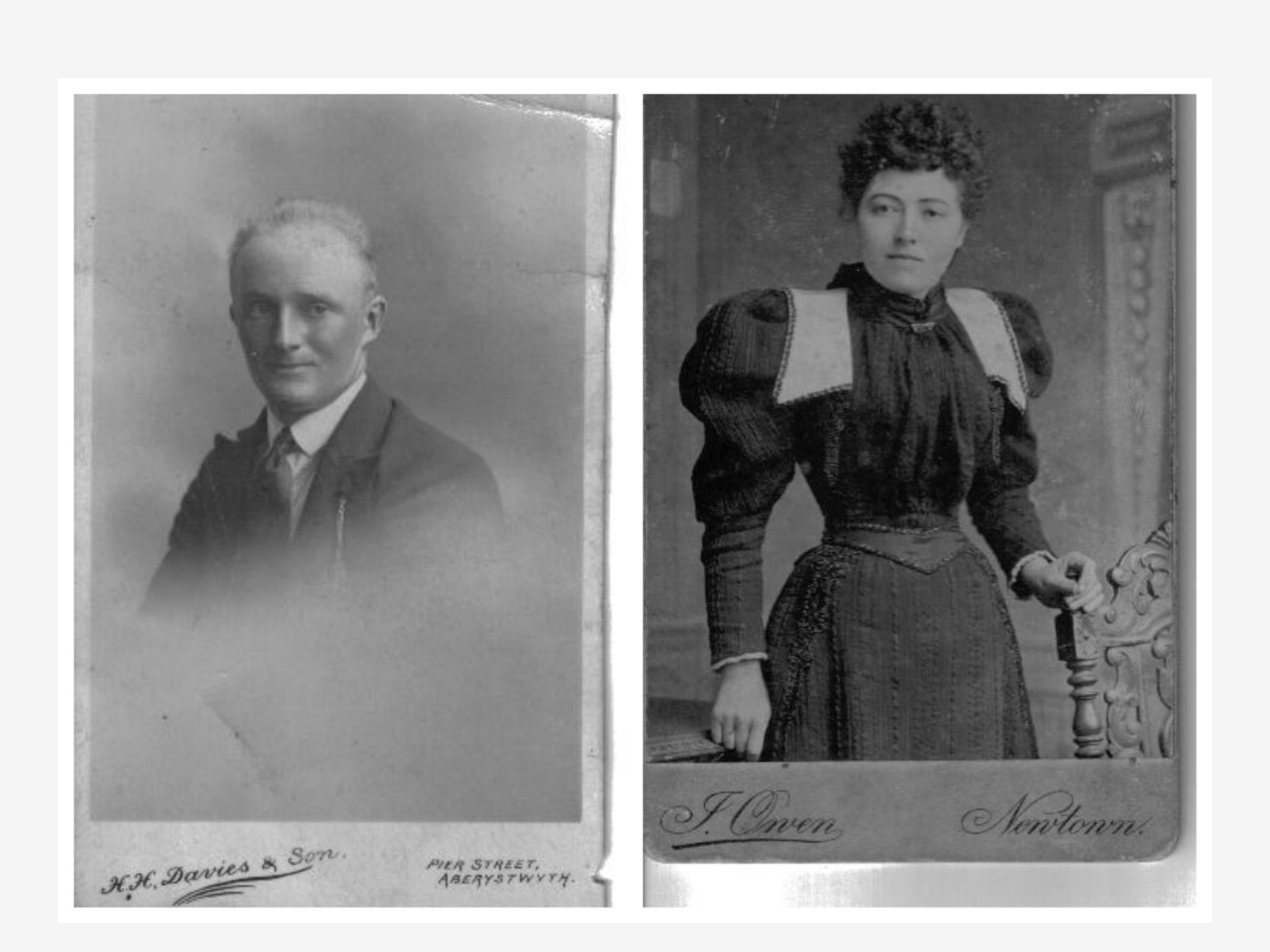
In April 1906, a farming family at Maescelyn, in the Llyfnant Valley near Machynlleth, suffered two deaths within three weeks. Harriet Mary Jenkins, born on 6 April, lived for only two days. Her mother, Elizabeth Ann Catherine Jenkins, died on 27 April following complications after childbirth. Four young children were left without their mother, the eldest not yet five years old.
Their father, Thomas Jenkins, had grown up at Maescelyn and spent almost all his life working the land. He belonged to a family which had farmed there since the 1860s and was known locally through chapel life, music and the eisteddfod. Yet within a few years he had left Maescelyn and become an agricultural labourer at Forge. By 1913 he too was dead, and the children were growing up in different households.
Thomas and Elizabeth were my great-grandparents. Their daughter Sarah Gwendolen Jane Jenkins, always known in the family as Sally, was my grandmother. I began investigating their lives while reconstructing the old farming families of the Llyfnant Valley, research which I subsequently published in Old Llyfnant Valley Farming Families. The story which emerged from census returns, family records, certificates and newspaper references was more complicated than the account of bereavement with which I had started.
The Jenkins Family at Maescelyn
Thomas was born at Cwmrhaiadr on 15 January 1859, a son of David Jenkins and Jane Owen. David had married Jane at Machynlleth in July 1848 and was then farming Cwmrhaiadr, an upland sheep farm later described as containing approximately 260 acres. Their children were born into a countryside in which the working year was governed by livestock, the weather, the markets and the demands of hill farming.
Between 1862 and 1866 the family moved to Maescelyn, a holding of approximately 300 acres near Glasbwll. Its name appears in the records under several spellings, including Maescilin, Maesycilyn and Maes Y Celin. The variety has occasionally made the property difficult to trace, although the farm itself remained an established feature of the valley.
The place had a history before the Jenkins family arrived. The nineteenth-century Hanes Eglwysi Annibynol Cymru, in its account of Glasbwll, identifies Maesycilin as one of the houses at which Independents held occasional religious meetings in the early nineteenth century. It records that John Davies came to live at Maesycilin around the time such meetings became more regular, about 1806. This is evidence of the farm’s earlier place within the religious life of the district, not evidence that the later Jenkins household belonged to the same congregation.
Thomas learned farming under his father and alongside his brothers. He also developed interests beyond the farm. Newspaper references record him as a member of the Derwenlas choir in the 1880s, singing at the Glasbwll Eisteddfod in 1886, and exhibiting paintings at local eisteddfodau during the 1890s. By 1891 he was described as a deacon at Glasbwll. His Methodist associations belong to the chapel life of his own generation, distinct from the earlier Independent meetings recorded at Maescelyn.
Such interests were important in rural Welsh society. The chapel and eisteddfod brought together people whose daily occupations might otherwise leave little time for public activity. They offered opportunities for education, music, religious service and local recognition. Thomas appears in surviving newspaper reports because of these activities, rather than because of any prominence as a landowner.
David Jenkins died at Maescelyn of bronchitis on 24 September 1901, aged seventy-six. He had occupied the farm for roughly thirty-five years. Thomas appears to have succeeded him in its management, continuing a family occupation which had lasted through much of the Victorian period.
Marriage and a Young Family
On 12 December 1900 Thomas married Elizabeth Ann Catherine Pugh at the Graig Welsh Calvinistic Methodist Chapel in Eglwys Fach. Elizabeth, known as Lissi Ann, had been born at Tymawr, Aberangell, on 2 November 1871. Her parents, John Pugh and Ann Elizabeth Jones, were associated with several farms in the district, including Glyncaerig near Cemmaes and Alltddu, which adjoined Maescelyn.
The marriage brought together two families already familiar with the demands of farming the Montgomeryshire and Cardiganshire border country. Their wedding reception was held at the Blue Bell Inn in Machynlleth. Afterwards they travelled by train to London for their honeymoon, a small but telling example of how the railway had widened the horizons of families living in apparently remote valleys.
Their first child, Ann Evlin Rees Jenkins, was born in August 1901. John David Owen Jenkins followed in October 1902, Sarah Gwendolen Jane Jenkins in September 1903, and Griffith Wilding Thomas Jenkins in May 1905. The household was still growing, and Thomas was managing a sizeable farm while taking part in the affairs of the district.
In early April 1906 he attended a meeting of local farmers at the Vane Hall in Machynlleth concerning compulsory sheep dipping. The meeting is a useful documentary glimpse of him at work in the local agricultural community, just days before events at Maescelyn changed the family’s circumstances.
Three Weeks in April 1906
Elizabeth gave birth to the couple’s fifth child, Harriet Mary, at Maescelyn on 6 April 1906. The baby died on 8 April. Elizabeth subsequently developed complications following the birth and died at the farm on 27 April, aged thirty-four.
The existing family research establishes that her death followed childbirth, but it does not identify the precise medical complication. Without checking the original death certificate, it would be wrong to assign a particular cause such as puerperal fever or haemorrhage. The dates alone convey the severity of the family’s loss.
Elizabeth’s obituary remembered her as being “of an amiable and quiet disposition and highly respected”. A contemporary account of the funeral described the attendance as among the largest seen in the Machynlleth district. Newspaper language of this kind was sometimes conventional, but the report nevertheless shows that her death was noticed well beyond the household.
Thomas was forty-seven years old, with four surviving children aged between eleven months and four years. Their mother’s death also removed a central figure in the organisation of the farmhouse. On upland farms the work of a farmer’s wife often included the care of children, management of food and household supplies, dairying, poultry and the feeding of servants. These responsibilities were part of the working economy of a farm, not merely its domestic background.
We do not know exactly how Thomas arranged life at Maescelyn in the first months after Elizabeth died. The surviving records are sufficient to establish what followed, but not every decision made while the family was in mourning.
The Loss of the Farm
Sometime between April 1906 and 1910 Thomas left Maescelyn. By 1910 he was living at Tycroes, Forge, near Machynlleth, and working as an agricultural labourer. The change was considerable. He had spent his working life on a farm of approximately 300 acres, first with his father and then apparently as its principal farmer. At Forge he earned his livelihood by working for others.
The reason for his departure remains unknown. It would be easy to suggest that Thomas could not manage the farm after his wife’s death, or that he encountered financial difficulties, but no surviving evidence establishes either explanation. A change in tenancy, ill health or a combination of circumstances cannot be ruled out. Until estate or tenancy records come to light, his departure must remain an unresolved part of the story.
There is one modest glimpse of his continuing practical ability. At the Machynlleth Agricultural Show in August 1910 Thomas won first prize in a gate-making competition with a six-rail larch gate. The former farmer was still an accomplished country craftsman, whatever the change in his position.
The 1911 census shows Thomas at Forge with his two eldest children, Evlin and John David Owen, known as Jack. Sally and Griffith Wilding were living with their maternal grandparents, John and Ann Elizabeth Pugh, at Glyncaerig near Cemmaes. The census tells us where the children were living on that particular night. It does not explain how the arrangements were agreed or whether they had originally been intended to last.
What it does show is the importance of relations beyond the immediate household. For farming families, grandparents, aunts and uncles could provide accommodation, care and an opportunity to begin again after a death or financial setback. The separation of the four children would affect the shape of their later lives, but they were not without family support.
Thomas Jenkins’s Final Years
Thomas survived Elizabeth by nearly seven years. On 13 March 1913 he died from tuberculosis at the Memorial Hospital in Newtown, aged fifty-four. His death certificate still described him as an agricultural labourer of Forge.
Tuberculosis was a serious and frequently fatal disease in the years before effective antibiotic treatment. The records so far available do not establish when Thomas became ill, and there is no basis for claiming that the disease caused his loss of Maescelyn.
For a long time his death eluded my research. I had initially believed that he might have died close to the time of Elizabeth’s death. When the 1911 census showed him still living, I searched death registrations around Machynlleth and subsequently investigated possible entries in London and Aberystwyth. None proved satisfactory.
I eventually returned to the Montgomeryshire records and obtained the certificate for a Thomas Jenkins who had died in Newtown in 1913. It was the right man. The certificate established not only where and when he died, but also the illness from which he had suffered and his circumstances at the end of his life. It resolved a family question which had remained unanswered for many years.
The Children After Maescelyn
The four surviving children grew up with different branches of the family. Evlin and Jack became closely associated with their paternal aunt Catherine Jenkins and her husband David Jones, who had established themselves in the drapery trade at Llangefni on Anglesey. The couple had no children of their own, and later provisions in their wills reflected their continuing concern for their niece and nephew.
Evlin spent time in London and married John Davies at a Welsh Calvinistic Methodist chapel in Willesden in May 1924. They settled at Blaenau Ffestiniog, where John worked as a quarryman. Evlin died in 1993, aged ninety-one.
Jack trained as a chemist in London. His first businesses in the Lewisham area encountered financial difficulty and closed in 1931, but he subsequently established a pharmacy at Bexleyheath. He remained in business until retirement in 1967 and died in 1987.
The younger children remained more closely connected with their mother’s family. Griffith Wilding was brought up at Glyncaerig. His aunt Sarah Jones Pugh took a particular interest in him and, following her marriage to Humphrey Howells in 1913, he went with her to Brongamlan near Aberangell. He later farmed there, before leaving agriculture for forestry work. He died in 1999, aged ninety-four.
My grandmother Sally also grew up at Glyncaerig, where her uncle William Griffith Pugh and aunt Catherine Harriet Pugh appear to have taken much of the responsibility for her upbringing. On 21 May 1929 she married Griffith Llewelyn Davies at Maengwyn Street Chapel in Machynlleth. Griffith came from the Davies family of Caeadda, and the couple went to farm at Tymawr in Ceinws.
Sally had six children, but hardship returned to the family when Griffith died in January 1943. His estate was left insolvent after debts and death duties, and Sally moved with her children to Corris. In July 1951 she lost her eldest son, David William Davies, who died of meningitis at Caeadda, aged twenty. Sally nevertheless raised her family and was remembered with affection and respect by those who knew her. She died in December 1992, aged eighty-nine.
The four children had been born at the same farm, within a period of less than four years. After 1906 their lives took them to Anglesey, London, Blaenau Ffestiniog, Kent, Aberangell and Corris. The range of their later experiences shows how widely one rural family could be dispersed within a single generation.
A Family and a Vanished Household
The history of Maescelyn is not simply a record of deaths. It shows how vulnerable even a reasonably established farming household could be when illness and bereavement interrupted its working life. Thomas had inherited years of practical experience and the standing of a family which had occupied the same farm since the 1860s. Neither prevented a marked change in his circumstances.
It also shows the strength of the family connections which linked neighbouring farms. The Pughs of Glyncaerig and the Jenkins relatives at Llangefni provided homes and support for children who could no longer grow up together at Maescelyn. Their intervention helped determine the opportunities available to the next generation.
There are limits to what the records can tell us. We cannot know how Thomas regarded his departure from the farm, what he said to his children about their mother, or whether the arrangements made for them were thought to be temporary. The gaps ought to remain gaps rather than be filled with explanations which merely sound plausible.
When I began studying my grandmother’s family, Maescelyn was a name attached to an earlier generation. Research into the lives of Thomas and Elizabeth explained why Sally was raised at Glyncaerig, and how the later history of my own family became connected with Caeadda and the neighbouring farms.
Maescelyn continued as a working place in the Llyfnant landscape, but the particular Jenkins household established there by David and Jane in the nineteenth century had come to an end. The tragedy of 1906 and the years that followed deserve to be remembered as part of the history of the farming families whose labour, relationships and losses shaped this part of rural Wales.
Related Essays
- Caeadda, Llanwrin: Three Centuries of Farming in the Montgomeryshire Uplands, the farm associated with the Davies family into which Sally Jenkins married.
- The Llyfnant Valley: Farming, Waterfalls, Tourism and the Waters Family, the landscape and farming community around Maescelyn.
- The Women of Glandwr: Kinship, Household and Inheritance in a Victorian Welsh Family, another account of family networks and the lives of women in nineteenth-century Mid Wales.
- Gwen Jones of Caeadda, 1841–1926: A Welsh Farming Matriarch, exploring rural work, widowhood and family continuity.
- Machynlleth Fairs and Markets: Trade, Farming and Rural Life in Victorian and Edwardian Montgomeryshire, the wider trade and agricultural society surrounding the Jenkins family’s upland farming life near Machynlleth.
- John Pugh of Glyncaerig (1834–1912): From Farm Labourer’s Son to Montgomeryshire Landowner, the grandfather whose Glyncaerig household helped care for the surviving Jenkins children after the Maescelyn tragedy.
- Thomas Davies of Penlan and Gwernstablau (1864–1930): Farming, Family and Public Life in Montgomeryshire, the extended Davies farming family of the same locality, whose kinship networks connected the farms of western Montgomeryshire.
Explore more Montgomeryshire and rural history
Continue with the Montgomeryshire History, Welsh Rural History, Family History & Genealogy and Victorian & Edwardian Wales guides, or browse the related essays above.
Receive new historical essays by email
For new essays on Welsh history, biography, genealogy and rural community life, subscribe on the homepage.
Sources and Further Reading
The principal source is my own family research, Old Llyfnant Valley Farming Families: Including the Jones Glandwr and Davies Caeadda Families (copyright 2014), particularly pp. 45–48, 58–60 and 145–150. That study draws upon census records, marriage and death certificates, family recollections and photographs, wills and contemporary local newspaper reports. The original book reproduces portraits of Thomas and Elizabeth Jenkins credited to Glyn Davies.
For the earlier religious history of Maescelyn, see Thomas Rees and John Thomas, Hanes Eglwysi Annibynol Cymru, volume I, Glasbwll. The passage identifies Maesycilin among the houses associated with early Independent preaching and describes the arrival of John Davies at the farm around 1806.
The newspaper evidence cited in the family study includes references to the Derwenlas choir and local eisteddfodau, the farmers’ meeting at the Vane Hall in April 1906, the death and funeral of Elizabeth Jenkins, and Thomas Jenkins’s gate-making prize at the Machynlleth Agricultural Show in August 1910. The precise newspaper titles, dates and page references for these particular reports should be added when the original cuttings have been rechecked.
The circumstances of Elizabeth’s final illness, and the reason Thomas left Maescelyn between 1906 and 1910, remain matters for further investigation. No specific medical complication or explanation for the loss of the farm is asserted without supporting evidence.