
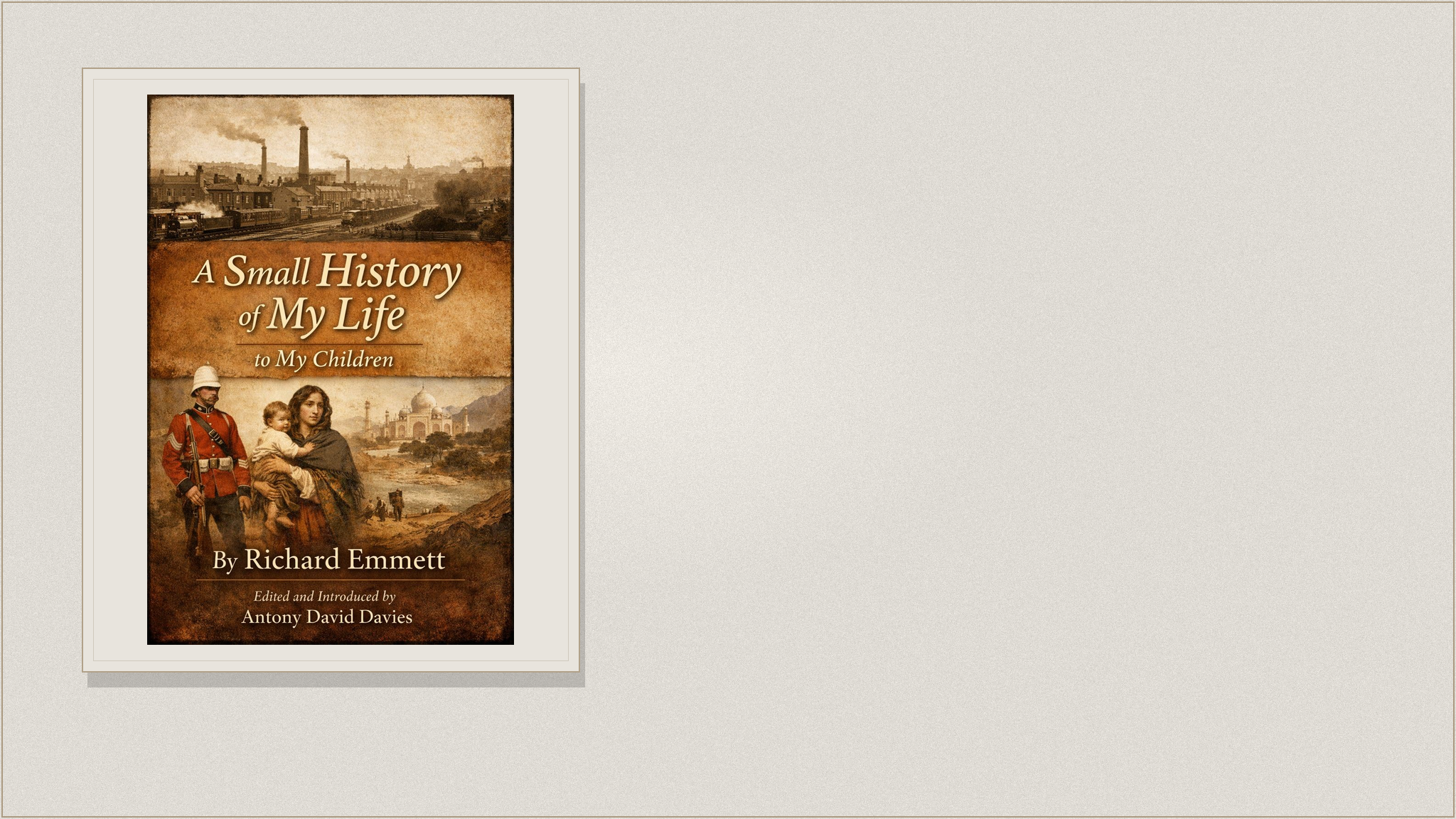
When Richard Emmett died in Crewe in 1906, there was little in the circumstances of his death to suggest the geographical breadth of the life he had lived.
He had been born into poverty in Salford, entered industrial employment as a boy and spent more than twenty years in the British Army. His service had carried him through barracks and garrison towns in Britain and across the imperial world, including Malta, Mauritius and India. He had experienced illness, bereavement, prolonged separation and the strain of raising a family within the uncertain structures of military life.
Yet he ended his days modestly, supported by the pension his service had secured. Following an inquest, he was buried in an unmarked grave. There was no public monument and no lasting place for him within conventional military history.
Richard might have disappeared almost completely from the record. What prevented that disappearance was a manuscript written for his children and entitled A Small History of My Life to My Children.
Richard Emmett was my three-times great-grandfather. His memoir is now available in a substantially revised second edition, prepared not simply as a family publication but as an edited historical source.
A Childhood in Industrial Salford
Richard was born during the early 1840s into a large working-class family in Salford, at the centre of one of Victorian Britain’s most rapidly expanding industrial districts.
Salford and neighbouring Manchester had become synonymous with the economic power and social disruption of industrialisation. Mills, engineering works, warehouses and crowded working-class districts expanded together. Employment could begin early, education was limited and household security depended upon the continuing ability of family members to earn.
Richard entered factory work while still young. In his memoir, he recalled his dissatisfaction at not being given an apprenticeship. This was not a minor grievance. A recognised trade could provide skill, identity and a degree of bargaining power. Factory labour without training offered fewer routes towards independence.
His disappointment reveals a young man already conscious of the limits being imposed upon him. He understood that work alone did not guarantee advancement. The nature of the work, and whether it led towards a recognised occupation, mattered profoundly.
Employment dominates many nineteenth-century working-class autobiographies. As historian Emma Griffin has observed, men frequently arranged the stories of their lives around work because labour was central to income, independence and masculine identity. Richard’s memoir belongs within this tradition, but his response to industrial labour was departure.
He initially considered going to sea. Instead, he entered military life, first through the militia and then through enlistment in the Regular Army.
The Army as an Alternative
For working-class men with limited prospects, enlistment offered both opportunity and danger. The army supplied clothing, food, accommodation and regular pay, although all were subject to military regulations and deductions. It provided movement beyond the districts into which many recruits had been born. Long service might eventually lead to a pension, one of the few forms of dependable support available to an ageing working man before the development of modern state welfare.
In return, the soldier surrendered much of his freedom. His place of residence, daily routine, clothing, movements and conduct were regulated. Discipline could be severe. Overseas service exposed him to unfamiliar climates and diseases, while long voyages separated soldiers from the communities in which they had grown up.
The army was neither simply an escape from poverty nor an uncomplicated instrument of advancement. It was another form of labour, governed by contract, discipline and institutional power.
Richard understood that bargain. His memoir repeatedly returns to the practical foundations of military existence, pay, food, accommodation, health and the accumulation of service towards a pension. He did not describe enlistment as the beginning of a heroic destiny. It was a decision made within the narrow range of choices available to a young working-class man.
More Than Twenty Years in Uniform
Richard served as a private soldier for more than twenty years, principally with the 22nd Regiment of Foot, later associated with the Cheshire Regiment.
His service took him across Britain and into a network of imperial garrisons. He spent extended periods in Malta, Mauritius and India, places that occupied strategic positions within the British military system.
Most soldiers did not spend their careers moving from one celebrated battle to another. Much of imperial military life consisted of garrison duty, drill, guard duty, inspections, marches, maintenance and long periods of waiting. Climate and illness could be more immediate dangers than enemy action. That ordinary machinery of military power is central to Richard’s testimony.
He recorded the routines through which the empire was maintained by common soldiers. His world was not the world of senior commanders, government policy or triumphal campaign histories. It was a world of barrack rooms, rations, ships, changing stations and the effort required to remain healthy and solvent. His military career was shaped by endurance rather than glory.
This does not make it historically insignificant. It makes it representative of how the British Army actually functioned across much of the nineteenth century. Imperial power depended not only upon dramatic conquest, but upon thousands of men performing repetitive duties in distant garrisons, often without distinction or public recognition.
The Soldier as Worker
Modern military history has increasingly examined the rank-and-file soldier as a worker.
Historian Nick Mansfield has argued that class and labour are essential to understanding the nineteenth-century British Army. Soldiers entered a contractual institution in which their labour was purchased, organised and disciplined. They brought attitudes formed in civilian employment into the barracks and sought whatever limited opportunities the army allowed them.
Richard’s memoir supports this interpretation. He was acutely aware of material conditions. He noticed differences in food, prices, accommodation and treatment. He calculated the consequences of decisions and understood the value of continuous service. His concern with reaching a pensionable position reflects the outlook of a man who had known insecurity from childhood.
The military pension eventually gave him a modest protection unavailable to many civilian labourers of his generation. It was not wealth, nor compensation for every hardship endured. It was a limited form of stability purchased through decades of service.
The surviving pension and discharge records of Victorian soldiers are important partly for this reason. The National Archives holds extensive material within the Royal Hospital Chelsea series, including service documents created or retained because a man became eligible for a pension. Such papers commonly record enlistment, regiment, physical description, service and discharge.
Official records can reconstruct the administrative outline of a career. Richard’s memoir supplies the life within it.
A Family Within the Regiment
The manuscript also reminds us that military service was rarely sustained by the soldier alone.
Soldiers’ wives occupied an uncertain place within the Victorian military system. Only a restricted number were officially recognised as accompanying the regiment. Women and children could experience crowded accommodation, repeated movement and the danger of being stranded by illness, bereavement or administrative decisions.
Their labour was indispensable even when it went unrecorded. Military wives maintained households under conditions they did not control. They cared for children during voyages and overseas postings, found ways to supplement limited incomes and responded to the repeated disruption of relocation. Some undertook laundry, sewing, nursing or other paid work associated with the regiment.
Richard’s narrative necessarily centres upon his own experience, but family responsibility runs through it. Marriage and fatherhood changed the practical meaning of service. Decisions about money, movement and eventual retirement were no longer his alone.
The death of a child forms part of this history. In an age of high infant and childhood mortality, military families serving overseas faced the additional dangers of climate, disease, difficult travel and restricted medical provision. Such losses might appear in official registers, but rarely with any indication of their emotional consequences.
Richard’s plain treatment of bereavement should not be mistaken for indifference. Victorian working-class writing often approached suffering without extensive emotional declaration. Grief appears through its place in the narrative and through the fact that the event remained important enough to record years later.
The Power of Plain Writing
The most compelling quality of A Small History of My Life to My Children is its restraint.
Richard did not write like an officer producing a campaign narrative for publication. He did not attempt to present himself as a hero, philosopher or imperial adventurer. Nor did he turn his life into a continuous lesson in moral improvement.
He wrote in direct, practical prose. Events follow one another steadily. Work, food, pay, illness, travel and family occupy the space that grander memoirs reserve for strategy and public affairs. This lack of ornament gives the manuscript its authority.
The reader encounters a man explaining his life in the terms through which he understood it. Richard did not know that historians might one day examine his words as evidence of class, military labour or empire. His intended audience was his children.
The title itself defines the purpose. This was a small history, written within a family and for a family. It explained where their father had come from, what he had endured and how the household they knew had been formed. Its original privacy is one of its greatest historical strengths.
How Unusual Is the Memoir?
Working-class autobiographical writing from the nineteenth century was not vanishingly rare. Scholars such as John Burnett, Jonathan Rose, Emma Griffin and Carolyn Steedman have demonstrated that labourers, artisans, domestic servants, soldiers and other working people recorded their experiences in greater numbers than older histories once assumed. Survival was nevertheless uneven.
Many manuscripts remained within families and were eventually lost. Others survived only in extracts or through heavily edited publications. Literacy, leisure and access to paper shaped who could write at length. Publication favoured lives that could be made to fit established religious, political or moral narratives.
A sustained memoir by a rank-and-file Victorian soldier, written for his children rather than a commercial readership, remains an important survival. It offers a view of military life distinct from the familiar accounts of officers and celebrated campaigners.
There are parallels. The memoir of John Pearman, a Victorian soldier later studied by Carolyn Steedman, similarly demonstrates what an ordinary serviceman’s narrative can reveal about labour, class and political thought. Richard’s account belongs within this wider tradition of writing from below.
Its importance lies not in claiming that no comparable text exists, but in the particular combination of evidence it provides. It joins industrial Salford, militia service, the Regular Army, overseas garrisons, military family life and retirement in Crewe within a single first-person narrative.
Return to Civilian Life
Leaving the army did not erase the habits or consequences of military service.
After returning to England and completing his career, Richard had to construct a civilian life from the resources available to him. His pension offered a measure of security, but retirement from the ranks did not transform him into a prosperous man.
He lived modestly in Crewe, a town shaped by railway labour and working-class migration. It was an appropriate final setting for a man whose life had been defined by movement, discipline and institutional employment.
Richard died in 1906. The circumstances of his death were examined at a local inquest and reported in the press. These records provide a documented conclusion to a memoir that otherwise draws quietly towards its end.
He was buried in an unmarked grave. There is no need to turn that absence into sentimental tragedy. Countless working people were buried without permanent memorials. The unmarked grave was not an exceptional injustice imposed upon Richard. It was part of the ordinary economy of death among families whose resources were limited.
But the disappearance of the marker makes the survival of his words more important. The manuscript became his monument.
Preparing the Second Edition
The second edition of A Small History of My Life to My Children is not simply a reprint of the earlier publication.
The purpose has been to create a more complete and historically defensible edition while preserving the character of Richard’s original testimony. His voice remains central. Editorial material has been added to explain the world through which he moved, not to replace his interpretation with mine.
The new edition includes an expanded introduction setting the memoir within the social history of industrial Salford and the Victorian Army. A detailed chronology reconstructs the sequence of Richard’s life and service. A glossary explains military and historical terms that may be unfamiliar to modern readers.
The edition also contains a summary of the surviving army records, allowing the memoir to be read beside the official evidence generated by the institutions through which Richard passed. An appendix reproduces contemporary newspaper reporting of the inquest into his death.
Together, these additions help the reader distinguish between Richard’s recollection, the documentary record and the broader historical context.
Editorial intervention presents a particular responsibility when dealing with working-class testimony. Irregular spelling, grammar or chronology should not become excuses to silence the author beneath correction. Nor should an editor make the prose appear more polished than the writer intended.
The aim has therefore been to clarify where necessary while retaining the plainness that gives the memoir its character.
Why Publish an Ordinary Life?
Richard did not write for posterity in the grand sense. He addressed his children.
Publishing the memoir beyond the family inevitably changes its audience, but it need not betray its original purpose. The edition allows Richard’s descendants to understand him more fully while making his testimony available to local historians, military researchers and students of Victorian society.
His account matters precisely because he was not famous. Victorian Britain and its empire were sustained by people whose names seldom entered the histories written about them. Factories depended upon child and adult labour. Regiments depended upon private soldiers. Military households depended upon women whose work was rarely acknowledged. Industrial towns depended upon families continually adjusting to insecurity.
Richard’s life brings these structures together. He did not rise dramatically through the ranks, acquire wealth or return home as a celebrated hero. His achievement was quieter. He escaped one constricted form of labour, endured another, supported a family and survived long enough to secure a pension.
There was compromise in that life, as there is in most lives. There was also determination.
History does not consist only of people who altered the course of nations. It also concerns those who moved within the conditions nations created, trying to make lives from the choices available to them.
Richard Emmett left no public monument. He left something more revealing, an account of how it felt to live as an ordinary soldier in Victorian Britain and across its empire. The second edition ensures that his voice remains audible.
Availability
A Small History of My Life to My Children: The Memoir of Richard Emmett, a Victorian Soldier, edited by Antony David Davies, is available in Kindle and paperback formats. About the book · Kindle · Paperback
Related Essays
- From Spa Town to Administrative Capital: Civic Government and the Making of Llandrindod Wells
- Llandrindod Wells Hospital: From Cottage Hospital to County War Memorial
- Board and Lodging: The Boarding Houses of Llandrindod Wells
- Bowling in Llandrindod Wells: From the Spa Greens to Rock Park and the Indoor Game
Explore more Welsh history
Browse more research in Essays and Notable People of Mid Wales.
Receive new historical essays by email
For new essays on Welsh history, biography, genealogy and rural community life, subscribe on the homepage.
Sources and Further Reading
- Richard Emmett, A Small History of My Life to My Children: The Memoir of Richard Emmett, a Victorian Soldier, edited by Antony David Davies, second edition.
- The National Archives, British Army and Militia Records, 1760–1915
- The National Archives, British Army Soldiers up to 1913
- John Burnett, Useful Toil: Autobiographies of Working People from the 1820s to the 1920s, Routledge, 1994.
- Jonathan Rose, The Intellectual Life of the British Working Classes, Yale University Press, 2001.
- Emma Griffin, Bread Winner: An Intimate History of the Victorian Economy, Yale University Press, 2020.
- Nick Mansfield, Soldiers as Workers: Class, Employment, Conflict and the Nineteenth-Century Military, Liverpool University Press, 2016.
- Carolyn Steedman, The Radical Soldier’s Tale: John Pearman, 1819–1908, Routledge, 1988.
- Cheshire Military Museum, which holds the archive of the Cheshire Regiment.