
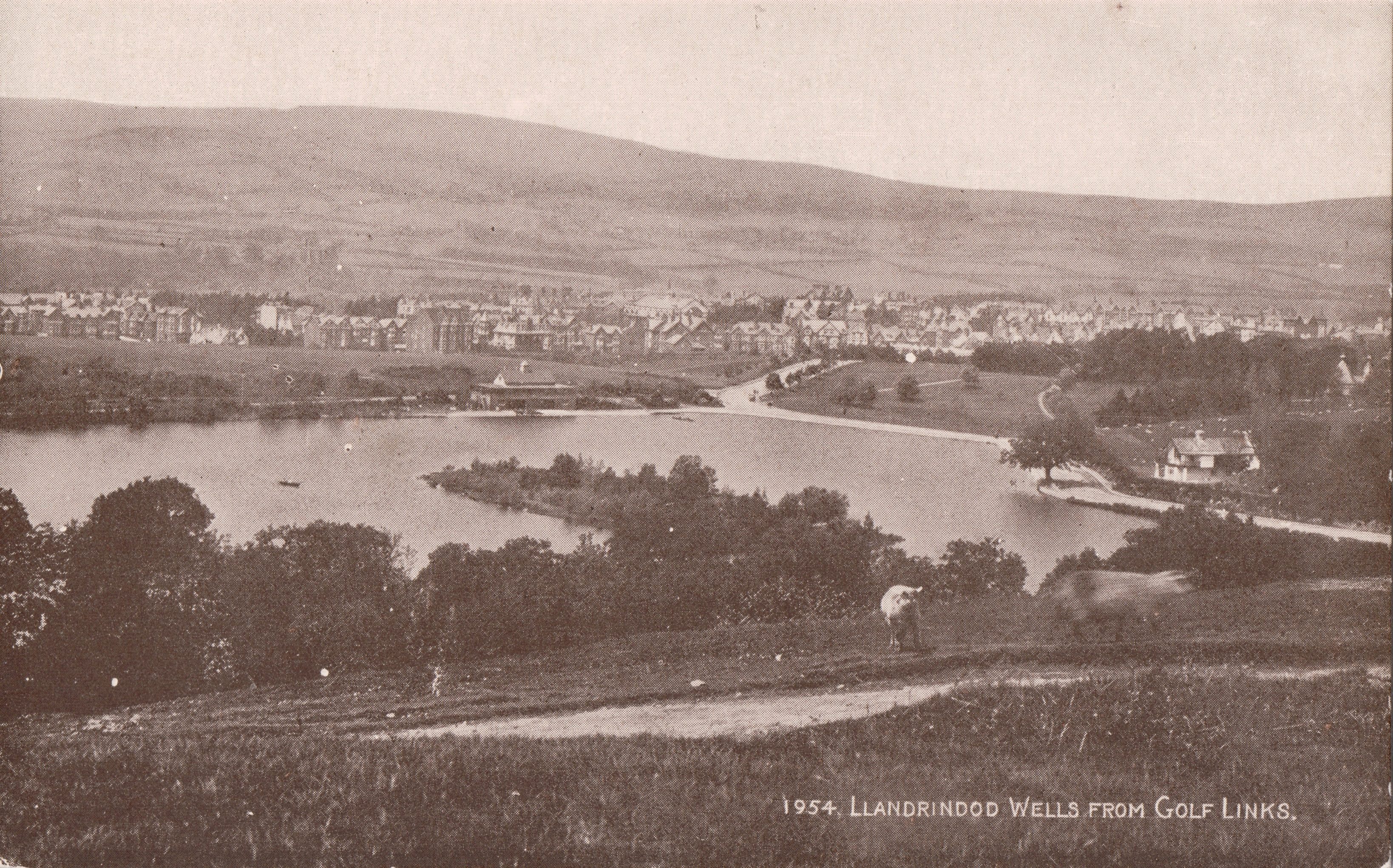
Of all the surviving features of Victorian Llandrindod Wells, the lake is among the easiest to take for granted. It sits so naturally within the landscape, framed by wooded slopes, roads and walks, that it is tempting to assume that the town simply grew around an existing stretch of water. In reality, the lake is as much a product of Victorian Llandrindod as the Pump House Hotel, the great boarding houses and the railway which brought thousands of visitors into the town each season. It was created deliberately as part of the transformation of a rural common into a fashionable inland resort.
The history of the lake is therefore about much more than boating. It is a story of land improvement, hotel enterprise, municipal ambition, sport, tourism and social life. It includes Victorian regattas, brass bands, women competing in canoe races, hotel servants enjoying a few hours of freedom after work, arguments over public expenditure and mineral springs, and the gradual replacement of private spa provision by civic recreation. Even the familiar boathouse has a more complicated history than has generally been recognised.
Most significantly, contemporary evidence now allows the chronology of the second boathouse to be corrected. It was not first built around 1920, as has sometimes been stated. The building was planned, debated and constructed in 1908, was photographed as the “New Boat House” that year, and had a café operating above it by the summer of 1909. The works undertaken in 1920 were alterations to a building already more than a decade old.
A Lake Made, Not Found

The creation of the lake belonged to the extraordinary expansion of Llandrindod Wells during the second half of the nineteenth century. The railway arrived in 1865, transforming access to what had previously been an awkwardly situated spa settlement. The enclosure and division of the common created opportunities for systematic development, and by 1868 Edward Middleton Evans was having parts of his Llandrindod property laid out for building. A surviving coloured plan prepared by the Hereford architect Thomas Nicholson in that year demonstrates how deliberately the Pump House side of the emerging town was being planned. It does not, by itself, prove that Nicholson designed the lake, but it places its creation firmly within a wider programme of estate development.
Before that transformation, the site was very different. At the Local Government Board inquiry of 1908, T. Evans, who said that he had known the place for around fifty years, remembered the future lake as a turbary, ground from which local people cut turf. This was not an ornamental landscape waiting to be discovered. It was working common land, wet and useful in a very different way from the recreational space which followed.
Cadw dates the construction of the lake to 1872 and 1873 and attributes its creation to the Pump House Hotel. It was deliberately made shallow for boating, and the surviving historic landscape is now recognised as part of the Grade II* registered Llandrindod Wells Public Parks.
A much more personal account of its creation emerged more than thirty years later. During the debate over a new boathouse in 1908, the civil engineer William Norman Swettenham stated that he had known Llandrindod for thirty-nine years and had directed the laying out of the lake and the erection of the original boathouse. His evidence deserves considerable weight. He was speaking publicly, before a Local Government Board inspector, during a dispute in which his knowledge of the site was central to his case.
Swettenham also supplied a useful figure. The original boathouse, including a refreshment room, had cost £223. That detail is important because it shows that the combination of boating and refreshments, later so closely associated with the Lakeside Boathouse, belonged to the lake from its Victorian beginnings. Visitors were not merely expected to hire a boat, row around for half an hour and leave. The lake was designed as somewhere to linger.
Cadw identifies Lake Cottage, on the higher ground overlooking the north-western side of the water, as this original boathouse. The ground once descended directly from the building to the lake, before the later road was cut into the slope below it. The building consequently appears rather detached from the water today, but its original position made much more sense before the later road system altered the landscape.
The Lake Becomes a Victorian Playground

Within less than twenty years of its creation, the lake had become an established venue for organised public entertainment. The earliest regatta I have so far found was held on Saturday, 16 August 1890. The South Wales Daily News reported that fine weather attracted a large number of visitors and that the sport was greatly enjoyed. After expenses had been paid, thirty shillings was handed to the secretary of the convalescent home.
That small financial detail says quite a lot about the social life of Victorian Llandrindod. Leisure, civic life and charity overlapped. A sporting afternoon beside the lake could entertain visitors while raising money for an institution concerned with health and recovery, entirely appropriate in a town whose prosperity depended so heavily upon its reputation as a place of cure and convalescence.
By 1896 the programme had become much more elaborate. The Brecon County Times described a successful regatta that August, with numerous entries and a large crowd gathered around the banks. A stiff breeze made the rowing difficult, and showers inconvenienced spectators towards the end, but the range of events gives a vivid impression of what an afternoon at the lake could involve.
There were ladies’ and gentlemen’s outrigger races, pair-oared rowing, canoe races and swimming. Miss Ward won the ladies’ outrigger event, while Miss Ida Davies came second and also won the ladies’ canoe competition. The presence of women competing on the water is worth emphasising. The lake was not simply a place where female visitors sat decorously on the bank while men took part in sport. Women were active participants in the competitive recreational life of the resort.
Some events were intended as much for amusement as serious competition. There was a greasy pole suspended above the water, a duck hunt and a canoe event in which competitors had to fall out twice during the course. The newspaper noted the entertainment caused by unsuccessful attempts to negotiate the greasy pole. It is a useful corrective to the rather stiff impression sometimes created by surviving Victorian photographs. Llandrindod’s visitors could enjoy deliberately ridiculous entertainment as readily as formal concerts and promenades.
By 1898 the event was being advertised explicitly as the “Annual Regatta and Aquatic Sports”. Llandrindod Town Brass Band was to attend, Peter Lloyd Williams was named as starter, and admission to any part of the lake cost threepence. That admission charge demonstrates the organised character of the occasion. Regatta day temporarily turned the whole lakeside into a managed entertainment ground, with sport, music and spectators forming part of one event.
The regattas help explain why the lake acquired such importance so quickly. It was not simply an attractive sheet of water beside the Pump House. It had become one of the stages upon which the resort performed itself. Visitors came to Llandrindod to drink the waters, but they also expected amusement, sociability and somewhere to be seen. The lake provided all three.
Walking, Looking and Showing Off the Lake

The grand events are well documented because newspapers reported them, but quieter evidence can sometimes tell us more about how a place fitted into everyday life. A surviving diary of a four-week visit to Llandrindod in May 1900 repeatedly mentions the lake in an entirely casual way. On 3 May the writer walked along it before continuing towards the old church. When another visitor arrived the next day, one of the first things they did was take her to see the lake. Another walk passed through woodland with views of the water, and towards the end of the stay there was another circuit of the lake while a band played in the Pump Gardens.
Nothing exceptional happened on any of these occasions, and that is precisely why the diary is valuable. By 1900 the lake had become part of the ordinary rhythm of a stay in Llandrindod. It was somewhere to walk after tea, somewhere to show a newly arrived friend and somewhere around which visitors could fill an hour between other activities. The success of the lake did not depend solely upon regattas or boating receipts. Its landscape had become one of the attractions of the town in its own right.
The lake was also closely tied to the Pump House Hotel, physically and socially. The hotel stood immediately to the north and the two formed part of the same resort landscape. Visitors moved between hotel, pump room, common, woodland and water with little sense that these were separate attractions. The lake was effectively an outdoor room within the larger spa.
The Drowning of George Neupert
One of the most detailed glimpses of the working life surrounding the lake comes from tragedy. On the night of 4 July 1906 George Neupert, a young employee of the Pump House Hotel, drowned after taking a canoe onto the water.
Early reports rendered his surname incorrectly, but the subsequent inquest identified him clearly as George Neupert, about twenty-five years old and believed to be Bavarian. He worked as a carver at the Pump House Hotel and lived there. His colleagues included Emil Burkhardt, Heinrich Ostermann and Alex Burri, the last of whom was Swiss. The inquest itself required interpreters because several of Neupert’s friends and fellow workers were foreign nationals.
The evidence is a reminder of how cosmopolitan the great hotels could be. Llandrindod was geographically remote, but its resort economy brought together visitors and workers from much further afield. A large hotel required not simply cleaners and waiters but cooks, carvers, porters, boots and other specialised staff. Neupert was one of those workers whose labour supported the world experienced by the paying visitor.
The men finished work at about ten o’clock that evening and went out together. They visited the Llanerch Hotel before walking across the Common towards the lake, arriving at about twenty past eleven. After standing near the boathouse talking and smoking, Neupert proposed taking a canoe onto the water. His companions tried to dissuade him. It was dark, boating had finished for the day and they considered it dangerous.
Horace Griffiths, the lake boatman, later explained the normal closing arrangements. The boathouse had been locked at about 8.45 p.m., the boats had been taken to the island and moored there, the small canoes had been turned upside down on the landing stage, and all the paddles were locked inside the boathouse. Neupert nevertheless launched one of the canoes and used a loose board in place of a paddle.
He disappeared from sight towards the island. Several minutes later his companions heard cries and splashing. Burkhardt ran around the lake, entered the water and attempted to reach him, swimming almost as far as the island before returning exhausted. He went into the water again from the landing stage, but by then Neupert had fallen silent. His body was subsequently recovered, and Dr A. Miller Kerr found clear evidence of drowning and no signs of violence.
The accident reveals another side of the lake. We tend to see Edwardian Llandrindod through postcards of sunny afternoons and well-dressed visitors, but the same landscape existed after the hotels had finished serving dinner and their employees finally had a few hours of their own. Neupert’s death belongs in the history of the lake because it restores one of those workers to the story.
It also gives us useful evidence about the boating business before municipal ownership. Griffiths said that he had worked for John Bound for seven years, taking their association back to about 1899. Bound therefore appears to have been operating a substantial boating concern by the turn of the century, with a dedicated boatman, controlled storage and established closing procedures.
From Private Amenity to Municipal Asset

By the first years of the twentieth century Llandrindod was changing. The town created by private landowners, hotel proprietors and speculative development increasingly required public authorities to take responsibility for its parks, roads and recreational spaces.
Municipal interest in the lake can be traced before the final purchase. An agreement of 10 August 1905 provided that, if the council’s Parliamentary Bill was successful, Llandrindod Wells Urban District Council would acquire the unsold parts of the Common and Lake together with land around the water for the provision of a road. The proposed consideration at that stage was £15,865 15s.
The final transaction took place on 3 December 1907. The Urban District Council acquired the Common and Lake for £21,420. It was a substantial civic investment and marked a decisive shift in the history of the landscape. What had begun as an amenity created within the orbit of the Pump House estate was now becoming public property.
The council was not buying an undeveloped lake. It had inherited a well-established attraction, complete with boating, regattas, crowds and an existing commercial operation. Municipal ownership therefore immediately raised practical questions about how the place should be run, what facilities it required and who should pay for them.
The old boathouse was one of the first complications.
The Battle Over the New Boathouse

The clearest account of the dispute comes from the Local Government Board inquiry held at the Victoria Hall on 22 April 1908. Llandrindod Wells Urban District Council sought approval to borrow £800 for a new boathouse, landing stage and refreshment room beside the lake on Pump House Common.
The council’s supporters made a straightforward case. Jeffrey Jones, a long-serving councillor and managing director of the Brynawel Hotel, said that the purchase of the Common had already proved successful. The recent Easter season had demonstrated the importance of the council controlling the lake, and he believed it would become an even greater attraction under the new arrangements. Shelter was needed, as was somewhere for visitors to obtain light refreshments.
C. S. Davies, chairman of the Pleasure Grounds Committee, explained that the new lessee had already brought an excellent class of boat to the lake and had more boats which he wished to introduce. Evan Bufton added a crucial commercial detail. The lake had been let for £150 a year on the condition that a boathouse and refreshment room were provided.
The new building was therefore not simply an act of civic beautification. It formed part of the economic arrangement under which the lake was to operate. The council expected rental income and a better attraction, while the lessee expected facilities capable of supporting a larger boating business.
Swettenham opposed the proposal. His argument is especially interesting because he could compare the new scheme with a lake he claimed to have laid out himself. He reminded the inquiry that he had directed the creation of the lake and erection of the existing boathouse, which he said had cost £223 including its refreshment room.
Part of the problem was ownership. The old boathouse had not passed straightforwardly to the council with the Lake and Common. There had been discussion about renting it, and figures of £20, £10 and £12 a year appeared during negotiations involving the estate and John Bound. Swettenham considered renting or purchasing the existing premises far more sensible than building another facility elsewhere.
He also objected to the new location. The proposed boathouse and landing stage were to be placed on the opposite side of the lake, apparently following the wishes of the new lessee from Cardiff. Swettenham believed the old site had clearer water, while the new position was muddy and geologically unsuitable.
His most serious objection concerned the mineral springs. Swettenham feared that driving piles for the new works could penetrate the clay beneath the lake and interfere with the saline water associated with the Pump House. For an ordinary town this might have been a technical argument. For Llandrindod it touched the foundation of the local economy.
Swettenham recalled that part of the lake bed had consisted of soft yellow clay which was practically watertight. He argued that the geological strata near the proposed site might be connected with the route of the saline spring. He even told the inquiry that the late Middleton Evans had privately passed on what he knew about the springs because he feared the knowledge might die with him.
Others strongly disagreed. James Edwards said that he had spent ten years in charge of the Pump House mineral waters and had seen the springs opened. He did not believe that the saline water approached from the direction suggested by Swettenham. C. S. Davies dismissed the objections as speculative, and the Local Government Board inspector noted that the estate itself had not appeared to express concern.
The disagreement is fascinating because it captures Llandrindod at a point of transition. The town was trying to develop a modern public leisure facility while still depending economically upon poorly understood underground waters which had first brought visitors there. The lake and the spa were not separate stories. They occupied the same ground, quite literally.
The 1908 Boathouse

The council proceeded remarkably quickly. On 8 July 1908 the Daily Telegraph & Courier reported that the new boathouse and refreshment room at the lake were nearing completion. The same report noted that entertainments held on the banks were very well attended, while fishing and boating remained popular. Elsewhere in the town, tennis, croquet, bowls and golf were also attracting visitors.
Photographic evidence independently confirms the date. The James Valentine collection at the University of St Andrews contains a photograph entitled “New Boat House, Llandrindod Wells”, registered in 1908.
The building was fully established by the following summer. On 10 July 1909 the Radnorshire Standard advertised “Boating and Refreshments” at Llandrindod Lake and announced that a “NEW CAFE” was now open above the “New Boat-house”. Teas and refreshments were available at reasonable prices, parties could be catered for, and boating was offered on the lake. The advertisement appeared under the name H. U. Thomas and gave the telephone number as Llandrindod 48.
That advertisement tells us something important about the building itself. The new boathouse was never intended simply as storage for rowing boats. It was a combined leisure facility. Visitors could hire a boat, sit above the water for tea, arrange a party or simply watch others on the lake. Its architecture embodied the social character of the resort.
It also settles a longstanding chronological problem. Cadw’s otherwise invaluable register states that a second boathouse was built on the site of the present building around 1920. Contemporary evidence shows that this date cannot represent its original construction. The new boathouse was being publicly debated in April 1908, was nearing completion by July, was photographed as new that year and was operating beneath a café by July 1909.
The explanation lies in the surviving council building records. On 13 February 1920 plans were submitted for “alterations and additions to the Old Boat House, Princes Ave”, including three plans and a specification. By then the building was already being described as old. The 1920 date therefore belongs to a substantial remodelling or enlargement of the 1908 structure, not its original construction.
This is a small correction in terms of years, but an important one historically. The boathouse belongs to the first phase of civic improvement immediately following municipal acquisition of the lake, rather than to a post-First World War rebuilding programme.
Princes Avenue and the Edwardian Promenade

The new boathouse was only one part of the council’s transformation of the lake. The 1905 acquisition agreement had already contemplated land around the water for a road, showing that improved access formed part of the municipal vision before the purchase was completed.
That ambition culminated in the opening of Princes Avenue in September 1910. The Daily Telegraph & Courier reported on 14 September that a large and representative gathering had attended when Mrs Kennedy Jones formally opened the avenue on the previous Saturday. The newspaper described it as a new promenade around the extensive lake and remarked that it greatly increased the attractiveness of the place.
The word “promenade” matters. This was more than a road designed to move traffic around the water; it was part of the experience of visiting the lake. Edwardian resorts depended heavily upon walking, seeing and being seen. A promenade gave visitors a formal route around the attraction, allowing them to stop, talk, watch boating and take in views across the water.
The newspaper’s wider description of the town reinforces this interpretation. Golf, boating and bowling were among the popular pastimes and there were large numbers of visitors in Llandrindod. The lake had become one element within a remarkably developed leisure economy. The mineral waters may have provided the reason for the town’s original rise, but by 1910 Llandrindod was offering far more than treatment.
The surviving postcards capture this particularly well. Deckchairs were placed beside the water, visitors walked the promenade and the boathouse stood conspicuously across the lake. The scene was carefully arranged for leisure. A person could spend an afternoon at the lake without ever entering a boat.
What Happened to the Original Boathouse?

The construction of the new establishment did not mean that the original Victorian boathouse disappeared. Cadw identifies it with Lake Cottage, which survives above the north-western shore. Its later conversion into a private residence, combined with alterations to the surrounding roads and ground levels, disguised its original purpose.
The 1908 inquiry helps explain why it survived. The council had bought the lake but had not obtained straightforward control of the old boathouse. Rather than continue renting a building tied to the Pump House estate, it constructed a new municipal facility elsewhere.
Later evidence supports that separation. When the Pump House Hotel estate was offered for sale on 24 September 1929, the particulars included the Pump House Hotel, Southfield and Lake Cottage. More than twenty years after the lake itself had passed to the council, the former boathouse still remained within the Pump House property portfolio.
The result is an unusually interesting survival. Llandrindod still possesses the building identified as its first Victorian boathouse, albeit converted to another use, while the site of the 1908 boathouse continues to perform its old recreational function.
The Lake Between the Wars
The First World War damaged the old world of the spa, but it did not end Llandrindod’s life as a holiday resort. The social character of tourism was changing. Visitors increasingly included families whose holidays depended not upon wealth and long seasons away from home, but upon savings, factory closures and, eventually, paid leave.
A particularly evocative account survives in the May Hewlett Collection. Anthony Hewlett, who worked at the Baglan Bay Tin Plate Works, was photographed canoeing on Llandrindod Lake during the 1930s. His daughter later remembered how industrial families saved throughout the year for their summer holiday. Her own family repeatedly came to Mid Wales. In Llandrindod they rose early to gather mushrooms, drank sulphur or chalybeate water at the pump room, went boating on the lake, played bowls and took long walks, before returning in the evening for games or singing around the piano.
It is difficult to find a better illustration of how the resort had changed. The facilities created for Victorian spa visitors had found a new clientele. The lake remained useful because it did not depend upon one particular social class. A wealthy Edwardian visitor could row upon it, but so could a tinplate worker enjoying the one week of holiday his family had saved for all year.
The buildings continued to evolve as well. The 1920 alterations had already changed the boathouse, and council records later show further work to the Lake Chalet, including a kitchen extension in 1939. The waterside business was clearly still expected to provide food and refreshment as well as access to the lake.
From Resort Attraction to Community Landscape

The later history of the lake is less about a spa season and increasingly about the everyday community. That does not represent decline so much as adaptation. Many Victorian resort structures struggled when their original clientele disappeared, but an open landscape could be used in new ways.
The lake remained a place for boating, angling and public events. In October 1981 it even hosted a 440-yard model boat records day. Model Boats magazine described calm, warm conditions, competitors testing their craft and families and friends gathering on the banks. The boats had changed considerably since the rowing regattas of the 1890s, but the basic pattern had not. People were still coming to Llandrindod Lake to compete on the water and watch from the shore.
This continuity helps explain why the lake survived more successfully than some of the enormous buildings once associated with the resort. It was never dependent upon a single function. The Pump House Hotel eventually disappeared, but the water beside it could be used for rowing, fishing, walking, birdwatching, model boating or simply sitting.
An Artificial Lake Becomes an Ecological One
There is a further irony in the history of the lake. A body of water created artificially for Victorian amusement eventually became important enough as a habitat to attract serious scientific study.
Research published in the British Journal of Herpetology in 1981 examined toad migration around Llandrindod. The lake supported an estimated breeding population of around 8,000 common toads, enormously greater than the smaller populations studied at nearby Pentrosfa Pond and Llanfawr Quarry.
The lake’s ecology has not always been straightforward. A major scientific study by Brian Moss, Laurence Carvalho and Joanne Plewes, published in 2002, described the competing pressures created by recreation, angling and conservation. After the 1950s the once clearer water became increasingly dominated by phytoplankton. The researchers considered the introduction of common carp for angling a likely major factor, because disturbance of the sediments released nutrients into the water. At times concern about cyanobacterial blooms became serious enough for water-contact activity to be restricted.
Attempts to improve the lake brought their own complications. Fish management and other restoration measures succeeded in restoring clearer water and aquatic plants, but dense plant growth then became another difficulty. It is a useful reminder that the lake has always required management. The Victorians made it, the Edwardians developed it, and later generations have had to balance wildlife, fishing, boating and public use.
There is something rather pleasing in the fact that ground once remembered as a turbary became first a pleasure lake and then an ecosystem important enough to be studied scientifically. Its natural history is itself largely the consequence of human history.
The Modern Lakeside Boathouse

The 1908 boathouse did not survive intact into the present day. Cadw records that it was replaced in the early 1990s by a new building in a similar style. The present Lakeside Boathouse therefore occupies the historic site and continues the traditional relationship between refreshment, recreation and the water, but it should not be mistaken for the original Edwardian structure.
That distinction does not lessen its significance. Buildings beside the lake have always changed. The first Victorian boathouse became Lake Cottage. The second, constructed in 1908 and altered in 1920, evolved through the twentieth century before being replaced. What has survived most strongly is the function.
Today the boathouse continues to offer access to the water through pedal boats, canoes, kayaks, rafts and paddleboards, alongside refreshments and other recreational activities. It is a strikingly modern version of the same idea being promoted in the Radnorshire Standard in 1909, when visitors were invited to come for boating, tea and refreshments beside the lake.
The equipment has changed. The social world surrounding it has changed almost beyond recognition. The principle has not.
A Victorian Idea That Survived

Llandrindod Lake is now more than 150 years old. That longevity can make it appear inevitable, as though the lake had always occupied this hollow below the hills. Its history shows the opposite.
It began with the deliberate remaking of common land during one of the most remarkable periods of urban growth in Mid Wales. A turbary became a boating lake. A private hotel amenity developed an annual regatta, a boathouse and refreshment room. Crowds paid to watch canoe races, swimming and greasy-pole contests. Women competed on the water. Brass bands played. Hotel servants walked there when their shifts ended.
Municipal ownership brought another transformation. The council bought the Lake and Common in 1907, fought over the location and cost of a new boathouse, completed it in 1908, and gradually formalised the landscape around the water. The opening of Princes Avenue in 1910 completed the transition from a hotel-side attraction into a civic promenade.
The interwar period brought working families whose holidays looked very different from those of wealthy Victorian spa visitors, but boating remained part of the experience. Later generations brought fishing, model boats, wildlife conservation and new forms of watersport. The Victorian boathouse became a house, the Edwardian one disappeared after decades of alteration, and a modern building took its place.
What endured was the landscape itself. That, perhaps, is why the lake matters so much to the history of Llandrindod Wells. Many parts of the spa were specialised creations. Once the world which supported them disappeared, their usefulness became difficult to sustain. The lake was different. It had been created for pleasure, and pleasure could be continually redefined.
A visitor in 1896 might have watched a woman race a canoe across the water. Another in 1910 might have walked along the newly opened promenade before taking tea above the boathouse. A tinplate worker in the 1930s could spend part of his annual holiday paddling on the same lake. Later generations brought fishing rods, model boats and cameras. Today they bring paddleboards and kayaks. The lake survives not because it remained unchanged, but because it never needed to.
The Victorians made the water. Llandrindod made it part of the town. For the wider context of the town’s development, hotels, mineral waters, transport and public life, see the Llandrindod Wells History guide.
Related Essays
Explore more Llandrindod Wells history
Continue with the Llandrindod Wells History guide, or follow the related essays above to explore the people, buildings and institutions that shaped the town.
Sources and Further Reading
The principal contemporary newspaper sources used are the South Wales Daily News, 20 August 1890; Brecon County Times, 21 August 1896; Radnorshire Standard, 10 August 1898, 29 April 1908 and 10 July 1909; Cambria Daily Leader, 6 July 1906; Brecon and Radnor Express and Carmarthen Gazette, 12 July 1906 and 30 April 1908; Daily Telegraph & Courier, 8 July 1908 and 14 September 1910. These accounts provide the evidence for the Victorian regattas, George Neupert’s drowning and inquest, the 1908 Local Government Board inquiry, construction of the new boathouse, opening of the café and the opening of Princes Avenue.
Powys Archives, Llandrindod Wells Urban District Council records, R/UD/LW, contain the surviving legal and administrative records concerning the Lake and Common, including the 1905 agreement for acquisition of land around the lake, the 1907 conveyance, the 1908 boathouse construction records and the 1920 plans for alterations and additions.
Cadw, Llandrindod Wells Public Parks, PGW(Po)20(POW), provides the principal published account of the historic park landscape, including the construction of the lake in 1872–73, the identification of Lake Cottage as the original boathouse and the later replacement of the lakeside building. The contemporary evidence assembled above suggests that its circa-1920 date for the second boathouse should be revised to 1908.
The James Valentine Photographic Collection at the University of St Andrews contains the photograph “New Boat House, Llandrindod Wells”, registered in 1908, providing independent visual confirmation of the corrected chronology.
The Royal Commission on the Ancient and Historical Monuments of Wales, through Coflein, preserves material relating to Lake Cottage and the Pump House estate, including the 1929 sale particulars in which Lake Cottage was still included among the estate properties.
The May Hewlett Collection at People’s Collection Wales provides valuable first-hand social history of holidays in Llandrindod during the 1930s and includes the photograph of Anthony Hewlett canoeing on the lake.
For the modern ecological history see Brian Moss, Laurence Carvalho and Joanne Plewes, “The lake at Llandrindod Wells, a restoration comedy?”, Aquatic Conservation: Marine and Freshwater Ecosystems, volume 12, 2002, pages 229–245, together with P. J. Wisniewski, L. M. Paull and F. M. Slater’s work on common toad populations around Llandrindod Lake.