
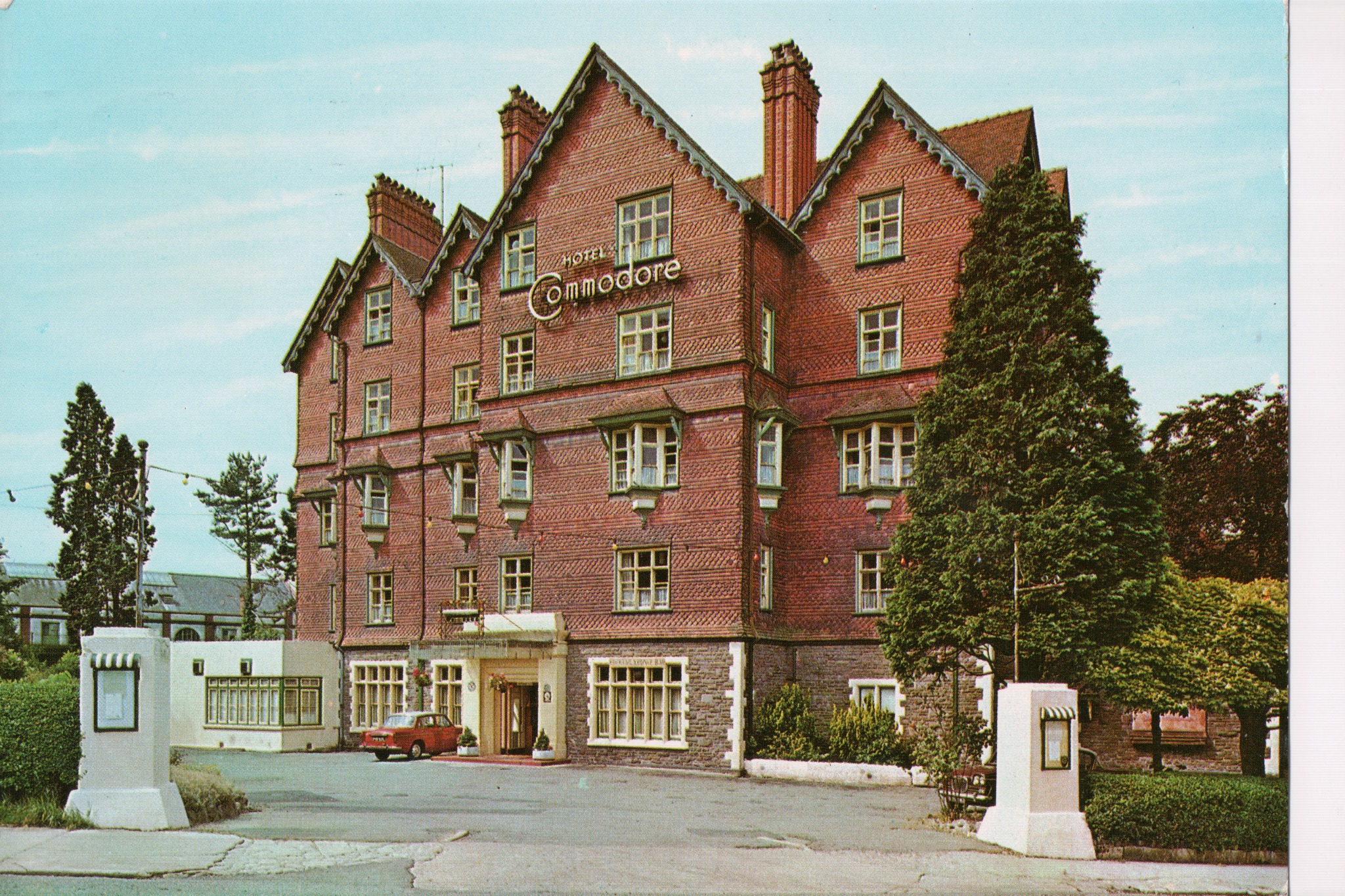
Few buildings in Llandrindod Wells tell the story of the town as completely as the Hotel Commodore. Long before it acquired that name, the building had been a substantial Victorian rectory, then Plas Winton, one of the resort’s best-known private hotels. Its history stretches from the confident expansion of the spa in the 1880s, through the great age of boarding houses and mineral-water tourism, the growth of the Recreation Ground and Pavilion, two world wars, post-war modernisation and the changing holiday trade of the later twentieth century. At the centre of much of that story was one remarkable woman, Jane Sheen, whose connection with Plas Winton lasted for around forty years.
The Rectory and Henry de Winton
The origins of the building lie not in the hotel trade but in the Church. In August 1881 the Ven. Henry de Winton, already Archdeacon of Brecon and Rector of Boughrood, was appointed Rector of Cefnllys with Llandrindod. De Winton was a senior and well-connected churchman. Born in 1823, he had studied at Trinity College, Cambridge, was ordained in the late 1840s and had served for many years at Boughrood before coming to Llandrindod.
A substantial new rectory was erected for him in Spa Road during the early 1880s. Designed by Stephen W. Williams, one of the architects most closely associated with the development of Victorian Llandrindod, it was an imposing building appropriate both to de Winton’s ecclesiastical position and to the rapidly growing importance of the town. Surviving plans and elevations dating from 1883 and 1884 preserve the original design, while later witnesses remembered building materials being carried to the site during the construction of the house. The architectural character which still distinguishes the Commodore owes much to these Victorian origins. Stepped gables, elaborate chimney stacks, decorative tile hanging and terracotta detail gave the building a picturesque quality quite unlike the plainer domestic architecture found elsewhere in the town. Parts of the original ecclesiastical complex also survived later conversion, including the former parish room or Sunday-school section.

The decision to build such a substantial rectory was closely connected with the changing geography of the parish. Cefnllys and Llandrindod had been united as a benefice in 1876, while Holy Trinity in the rapidly expanding spa town was becoming the natural centre of Anglican life. Following his appointment in 1881, de Winton established himself beside the new church in a purpose-built rectory which also provided accommodation for parish activity. Its position reflected the growing importance of modern Llandrindod over the older and more scattered church centres at Cefnllys and Old Llandrindod, and formed part of the wider movement of institutions into the developing town.
Henry de Winton remained Rector of Cefnllys with Llandrindod until his death in April 1895. He died at Tenby, where he had gone following a period of ill health. Contemporary reports referred both to a serious attack of influenza and to heart disease. His funeral became a notable local occasion. The body was brought to Llandrindod Wells and a memorial service held at Holy Trinity Church before clergy, choir, members of the Urban District Council, relatives and townspeople accompanied the coffin in procession to the railway station. From there it was taken to Boughrood, where de Winton was buried. His death ended the first chapter in the building’s history.
His widow remained at the Rectory for a time after his death, but by May 1896 she was preparing to leave Llandrindod. An advertisement in the South Wales Daily News announced a three-day auction at the Rectory on 18, 19 and 20 May, held on the instructions of Mrs de Winton, “who is leaving the neighbourhood”. The scale of the dispersal gives an unusually detailed glimpse of the house before its conversion to hotel use. The sale included the contents of the lamp room, boot room, scullery, pantry, china pantry, kitchen, housekeeper’s room, housemaid’s closet, servants’ bedrooms, study, cellar, vestibule, entrance hall, dining room and drawing room, together with a coachman’s room, bathroom, dressing room and bedrooms identified by colour as brown, green, blue, yellow, red and pink. The inclusion of a parish room is particularly significant, independently confirming that the Rectory served a parochial as well as a domestic function.
The auction also makes clear the scale of de Winton’s household. This was not a modest clerical residence but a substantial Victorian establishment with servants, a housekeeper, a coachman and extensive service accommodation. That helps explain why the building could be adapted so readily for hospitality. Much of the domestic organisation needed by a large private hotel was already present before Greenway began altering the property.
From Rectory to Private Hotel
Mrs de Winton’s departure provides the clearest surviving explanation for the end of the house’s life as a rectory. Later in 1896 Dr Alfred Greenway acquired the house and land which had belonged to Archdeacon de Winton, a transaction Greenway himself described in court in 1904 when the deed was produced as evidence. The precise legal route by which the property passed to Greenway has not yet been established from the conveyance itself, so it would be unsafe to say more than the evidence allows. What is clear is that the contents of the Rectory were dispersed as Mrs de Winton left the district, and within the same year Greenway had acquired the property. He was closely connected with the development of Llandrindod as a health resort and with the town’s mineral-water culture, making his acquisition of such a prominent house particularly appropriate. In a town whose visitor economy was expanding rapidly, the large building and its grounds also had obvious commercial potential.
The former rectory was enlarged and adapted for commercial accommodation, and by August 1898 it was being advertised as Plas Winton Private Hotel. An advertisement of that year described it as pleasantly situated in two acres of its own grounds, close to the church, wells and baths. Guests were offered electric light, hot and cold baths, dinner at seven o’clock, lawn tennis, a coach house and stabling. The reference to electric lighting is particularly revealing, for it was still sufficiently novel to be advertised as a selling point. Plas Winton was offering the comforts of a modern hotel while retaining the spaciousness and domestic atmosphere associated with the better class of private hotel and boarding-house trade.

The transformation continued after the first conversion. In January 1901 builders and contractors were invited to tender for further alterations and additions to Plas Winton Hotel. The architect was R. Wellings Thomas, another important figure in the architectural development of Llandrindod. Building records from later that year refer specifically to a new dining room for Dr Greenway, with plans and specifications surviving. By 1904 the scale of the hotel had increased markedly. It was then advertising upwards of sixty rooms, a large dining hall, separate tables, certified sanitation, electric lighting throughout, a coach house and stabling, garage and cycle house, as well as golf, tennis and fifteen miles of fishing. In a single advertisement one can see the transition from the horse-drawn world to the motor age, for horses, bicycles and cars were all being accommodated at the same establishment.
Jane Sheen and the Making of Plas Winton
The person who did more than anyone to establish the reputation of Plas Winton as a hotel was Jane Sheen. She was already advertising herself as proprietress by 1898, but her connection with the town’s accommodation trade went deeper. Census evidence places Jane within a family already involved in boarding-house keeping. In 1901 she was recorded with her sisters at The Lindens, where Mary Sheen was a boarding-house keeper and Jane herself was similarly occupied.
The legal relationship at Plas Winton is particularly well documented. During a major right-of-way case in 1904, Dr Alfred Greenway was explicitly described as the owner of Plas Winton and Jane Sheen as his tenant. She nevertheless advertised herself as proprietress, a perfectly normal distinction in the hotel trade. Greenway owned and developed the property, while Sheen operated the business. By 1911 Jane was recorded as head of the household at Plas Winton, unmarried, a private hotel keeper and an employer. Ten years later she remained there, employing cooks, waitresses, kitchen maids and housemaids. The census returns give a rare glimpse behind the public face of the hotel and show a substantial workforce supporting the business.
Among her staff was Aaron Stephens, a gardener from Berriew who later appeared in wartime records as Miss Sheen’s porter and gardener when he sought exemption from military service. There was continuity among the staff as well. Mary Sealbridge, recorded as cook in 1911, appears still to have been in the same position a decade later. These details give Plas Winton a human dimension which hotel advertisements alone cannot provide.
Jane Sheen’s tenure was remarkable for its length. She remained associated with Plas Winton into the 1930s and was still advertising herself as proprietress in 1933. Her death in 1938 brought to an end approximately four decades in which she had been the defining public figure of the hotel.
The Recreation Ground, War and the Interwar Years
Plas Winton’s location was one of its greatest advantages. It stood close to Holy Trinity, the mineral wells and baths, but also immediately beside the Recreation Ground. That placed it at the meeting point of three different aspects of Llandrindod life, the ecclesiastical town around Holy Trinity, the medicinal spa centred upon the waters, and the developing leisure resort represented by the Recreation Ground, bowling greens and later the Grand Pavilion.
That relationship occasionally produced friction. In 1904 Greenway and Sheen brought proceedings against Llandrindod Wells Urban District Council over a road adjoining Plas Winton and the Recreation Ground. The dispute concerned entrances and the council’s desire to provide public access to the recreation land. Evidence stretched back to the Victorian development of the area, with witnesses recalling the building of de Winton’s house and the movement of materials along the adjoining roads. The case is important because it captures Llandrindod in the process of becoming an organised resort town, with private property, public recreation and access to the mineral-water district increasingly being forced to coexist.
Within a few years the Recreation Ground had become still more important. A bowling green opened there in 1907, having been converted from a tennis court, and the Grand Pavilion followed in 1911. Plas Winton therefore stood beside one of the busiest areas of Edwardian resort life. Sport had already become part of the hotel’s appeal, with golf, tennis and fishing all being promoted to visitors before the First World War.
The war transformed Llandrindod. Thousands of Royal Army Medical Corps personnel passed through or were stationed in the town, and hotels and other buildings became part of the military accommodation system. Plas Winton was among them. Surviving photographs show RAMC personnel outside the hotel, while contemporary evidence confirms that members of the corps were billeted there. The wider wartime use of the town’s large buildings can also be seen in the histories of Llandrindod Wells Hospital and the Radnorshire County Club. Later accounts have sometimes described Plas Winton as a military hospital, but the stronger surviving evidence supports the more cautious conclusion that it formed part of the wider military occupation of the town.
The war also intruded into the everyday running of the hotel. In 1916 Jane Sheen was prosecuted after an electric light was allowed to show from one of the windows contrary to wartime blackout regulations. Aaron Stephens, her porter and gardener, appeared before a military tribunal the same year seeking exemption from service. Plas Winton nevertheless survived the war with its old name intact. This is important because later accounts have sometimes claimed that it was renamed the Commodore immediately after the First World War. Contemporary evidence proves otherwise.
It remained Hotel Plas Winton through the interwar years. In 1933 the contents of the hotel were advertised for auction, including furnishings from the entrance hall, dining and drawing rooms, lounge, smoke room, twenty bedrooms and the usual offices. The sale might suggest a closure, but later advertisements show that Plas Winton continued to trade. Indeed, by August of the same year Jane Sheen was again advertising the hotel as proprietress. In 1936 and 1937 the hotel promoted its elevated position, extensive views, lift to all floors, private garage and convenient access to the spa and Recreation Ground. The Victorian private hotel had become a modern interwar establishment serving motorists as well as more traditional spa visitors.
From Plas Winton to the Commodore
The death of Jane Sheen in 1938 marked the end of an era. The 1939 Register shows that the property was still called Hotel Plas Winton, but a new management regime was in place. Joseph Frank Ritchie was recorded as hotel organiser and manager, while his wife Helena was involved in hotel management or housekeeping. Their daughter Pauline lived with them at the hotel.
That record is particularly important because Joseph Ritchie would remain at the centre of the business after Plas Winton became the Commodore. The precise date at which the name changed has not yet been established. The evidence is clear at either end, in 1939 it was still Hotel Plas Winton, while by July 1947 it was unquestionably the Hotel Commodore. The transformation therefore occurred during the Second World War or the immediate post-war period. Later accounts associate Plas Winton with wartime requisition and officer training, followed by refurbishment, and this chronology is much more compatible with the surviving evidence than the older claim of a post-1918 renaming.
What is certain is that Ritchie provided continuity across the change. He managed Plas Winton in 1939 and was later resident managing director of the Commodore. The change of name appears to have coincided with something much larger, a deliberate attempt to reinvent the hotel for a post-war generation.
By 1947 the Commodore was already hosting important regional gatherings. In July that year the first meeting of the executive council of the newly formed Industrial Association of Wales and Monmouthshire took place there. The following year the hotel was advertising Saturday dinner dances and themed evenings such as “A Night at Maxim’s”. Then, in 1949, a national magazine offered an unusually detailed description of the new Commodore. Visitors encountered a brightly decorated entrance hall, a ladies’ cocktail lounge and a silent lift to the fifth floor. Bedrooms contained spring divan beds, individual reading lamps, telephones, built-in wardrobes, luggage cupboards, electric fires, fitted carpets and carefully designed lighting, while many had private bathrooms.
The dining room was designed so that its character could be altered between lunch and evening, when it became a setting for dining and dancing. The hotel’s cooking, presentation and service received particularly warm praise. Later that year the Commodore advertised itself nationally as “Britain’s Most Modern Hotel”. It also called itself a “dream hotel”, promoted tariffs from twenty-five shillings a day and advertised fishing, bowling, golf and tennis. The claims were promotional, but they tell us something important. The Commodore was deliberately distancing itself from the image of an ageing Victorian spa hotel. It was presenting itself as modern, sophisticated and forward-looking.
The Post-war Hotel
Joseph Frank Ritchie remained closely associated with the hotel for many years. In 1953 he was still directly involved in its licensed operation, appearing before Llandrindod magistrates in connection with the serving of alcohol outside permitted hours. The incident is minor in itself, but it confirms that Ritchie remained involved in the everyday management of the business.
By 1955 the Commodore was receiving distinguished guests. In March that year King Hussein of Jordan stayed at the hotel during a visit to the district. In 1956 the Commodore advertised that it was always open to non-residents for meals and was available for wedding dances, dinner parties and conventions. The hotel had therefore become as much a social and function venue for the district as a place of accommodation. By 1958 it was being promoted as an AA four-star establishment offering “superb comfort, perfect cuisine” and “outstanding service”, still under Ritchie’s personal supervision.
His association with the building can therefore be traced from Plas Winton in 1939 through the creation and consolidation of the Commodore in the post-war period. Under his management the hotel moved far beyond its original role as a private spa establishment and became one of the best-known hospitality venues in central Wales.
Later Years and Survival
As the traditional spa economy declined, the Commodore adapted again. By the 1970s advertisements described it as a privately owned family hotel in the heart of Wales and an ideal touring centre. Residents were offered free use of an eighteen-hole golf course and shooting arrangements, while the hotel remained open throughout the year. Winter weekend packages and after-dinner entertainment continued the social traditions established in the post-war years.
The shift in emphasis was striking. In the 1890s Plas Winton had sold itself through proximity to the mineral wells and baths. By the 1970s the Commodore was selling central Wales itself, scenery, touring, golf, shooting and recreation. Yet there was considerable continuity. Golf had been advertised at Plas Winton as early as 1904, while fishing, tennis and bowls remained part of the Commodore’s appeal decades later.
A 1984 advertisement gives another clear glimpse of the hotel’s later management. The Commodore was then described as family owned and under the personal supervision of resident directors Philip Edwards and Mrs Mary Edwards. Visitors were offered fishing, golf, sailing, tennis, pony trekking, rambling and bird-watching, while the hotel was presented as a base for exploring the countryside of Mid Wales. The advertisement called the Commodore an Edwardian building, although its origins were in fact Victorian. The description nevertheless illustrates how thoroughly the earlier rectory and Plas Winton identities had by then been absorbed into the Commodore story.
By 1995 ownership had passed to the Baird-Murray family, who also owned the Metropole Hotel in Temple Street. That year the Commodore was placed on the open market through Christie & Co. The property then contained fifty-six bedrooms and was described as the largest Mid Wales hotel to have come onto the market for more than twenty-five years. The Baird-Murrays intended to concentrate their efforts on the Metropole. The following year the importance of the building’s historic fabric was reflected in the award of a £2,000 historic building grant towards urgent repairs.
The history of Plas Winton and the Commodore is therefore much more than the story of a single hotel. The building began as the home of a Victorian archdeacon when Llandrindod was still taking shape around its churches, mineral springs and new streets. Under Dr Alfred Greenway it became part of the commercial spa economy. Under Jane Sheen it developed into a successful private hotel serving generations of visitors. Its position beside the Recreation Ground placed it at the heart of the town’s expanding leisure culture, while wartime use and changing patterns of tourism repeatedly forced it to adapt.
After the death of Jane Sheen, Joseph Frank Ritchie carried the business into another age. The old Plas Winton name disappeared, the Commodore emerged, and a Victorian hotel was deliberately remade for the world of cocktail lounges, dinner dances, modern bedrooms, touring holidays and four-star hospitality.
Few surviving buildings in Llandrindod contain so many layers of the town’s history. The church, the spa, the boarding-house economy, the Recreation Ground, bowling, wartime Llandrindod, post-war tourism and the later struggle to maintain a large historic hotel all meet in one place. The Commodore stands today not simply as an old hotel, but as one of the clearest surviving witnesses to the changing fortunes of Llandrindod Wells itself.
Related Essays
- Board and Lodging: The Boarding Houses of Llandrindod Wells
- The Hotel Metropole, Llandrindod Wells
- The Montpellier Hotel, Llandrindod Wells
- The Grand Pavilion, Llandrindod Wells
- Bowling in Llandrindod Wells
- The Waters That Built a Town
- A Town Marked Out on the Common: The Making of Llandrindod Wells
Explore more Llandrindod Wells and Radnorshire history
Continue with the Llandrindod Wells History, Radnorshire History and Victorian & Edwardian Wales guides, or browse the related essays above.
Sources and Further Reading
The principal contemporary newspaper sources used for this history include the Sheffield Daily Telegraph, 25 August 1881, for Henry de Winton’s appointment to Cefnllys with Llandrindod; the Brecon County Times, 12 April 1895, the Morning Post, 11 April 1895, and the Cardiff Times, 20 April 1895, for de Winton’s death and funeral; the South Wales Daily News, 15 May 1896, for Mrs de Winton’s departure and the three-day sale of the Rectory’s household contents; the Radnorshire Standard, 17 August 1898, 2 January 1901, 30 March 1904 and 22 August 1933, for Plas Winton’s operation, enlargement and facilities; the Brecon and Radnor Express and Carmarthen Gazette, 14 July 1904, and the Radnor Express, 23 June 1904, for the Greenway and Sheen right-of-way case; the Western Mail, 25 February and 22 August 1933, 15 July 1947, 5 March 1948, 4 November 1953, 16 October 1956 and 25 February 1958; the Wellington Journal, 19 September 1936 and 21 August 1937; the Illustrated Sporting and Dramatic News, 4 May 1949; the Birmingham Daily Gazette, 25 October 1949; the Wolverhampton Express and Star, 23 February 1976; the Shropshire Star, 27 January 1976, 21 February 1984 and 5 July 1996; and the South Shropshire Journal, 19 May 1995.
Census and register evidence includes the 1901, 1911 and 1921 censuses and the 1939 Register. Architectural evidence includes the surviving 1883–84 plans of the rectory by Stephen W. Williams, Llandrindod Wells Urban District Council building records, the 1901 alterations under R. Wellings Thomas, and the statutory listing of the building. Further contextual material comes from Powys Archives, Cadw, Church in Wales heritage records and surviving records relating to the united benefice of Cefnllys with Llandrindod, the Recreation Ground, Grand Pavilion, Llandrindod’s mineral springs and the Royal Army Medical Corps presence during the First World War.
The feature image is a historic view of the Hotel Commodore, formerly Plas Winton.